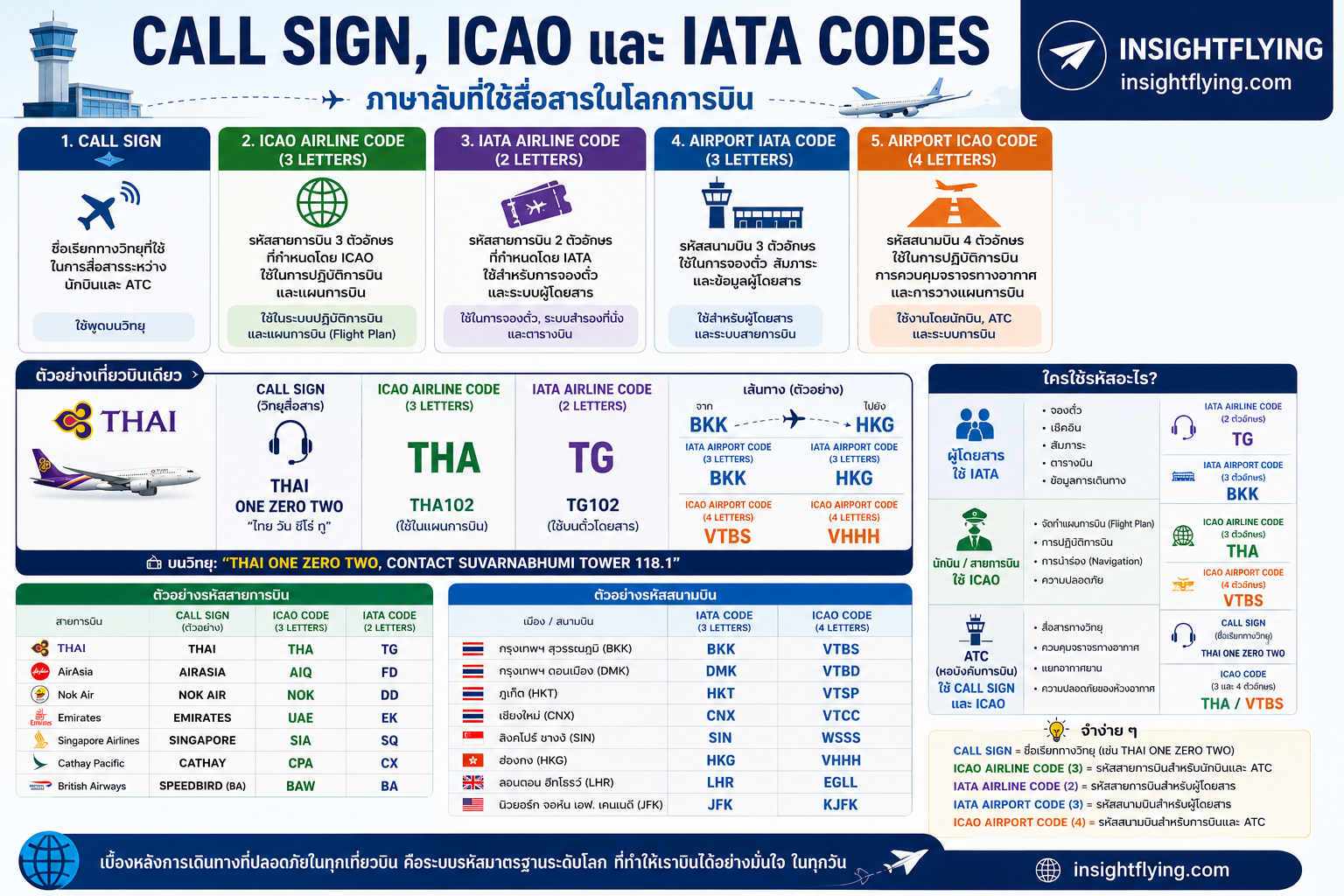
เมื่อเราเดินทางด้วยเครื่องบิน เรามักเห็นรหัสต่าง ๆ ปรากฏอยู่บนตั๋วโดยสาร หน้าจอแสดงเที่ยวบิน หรือแม้แต่ได้ยินจากการสื่อสารระหว่างนักบินกับหอบังคับการบิน เช่น TG102, BKK, VTBS หรือ THA
หลายคนอาจสงสัยว่ารหัสเหล่านี้คืออะไร และแตกต่างกันอย่างไร
ในความเป็นจริง อุตสาหกรรมการบินทั่วโลกมีระบบรหัสมาตรฐานหลายประเภท เพื่อให้สามารถสื่อสารและปฏิบัติการได้อย่างถูกต้อง ปลอดภัย และมีประสิทธิภาพ
1. Call Sign คืออะไร
Call Sign คือชื่อเรียกทางวิทยุที่ใช้ในการติดต่อสื่อสารระหว่างนักบินและเจ้าหน้าที่ควบคุมจราจรทางอากาศ (ATC)
ตัวอย่างเช่น
เที่ยวบิน TG102 ของการบินไทย
บนวิทยุจะใช้ Call Sign ว่า
“THAI One Zero Two”
หรือ
เที่ยวบิน FD3021 ของ AirAsia
จะใช้ Call Sign ว่า
“AIRASIA Three Zero Two One”
Call Sign มีความสำคัญอย่างมาก เพราะเป็นตัวระบุอากาศยานแต่ละลำในระหว่างการปฏิบัติการบิน
ตัวอย่าง Call Sign ของสายการบิน
- THAI = การบินไทย
- AIRASIA = AirAsia
- NOK AIR = Nok Air
- EMIRATES = Emirates
- SINGAPORE = Singapore Airlines
- SPEEDBIRD = British Airways
- CATHAY = Cathay Pacific
บางครั้ง Call Sign อาจไม่เหมือนชื่อสายการบินที่ผู้โดยสารคุ้นเคย
ตัวอย่างเช่น
British Airways ใช้ Call Sign ว่า
“SPEEDBIRD”
ซึ่งเป็นชื่อที่สืบทอดมาตั้งแต่ยุคของ BOAC (British Overseas Airways Corporation)
2. ICAO Airline Code คืออะไร
ICAO Airline Code เป็นรหัสสายการบินแบบ 3 ตัวอักษร ที่กำหนดโดยองค์การการบินพลเรือนระหว่างประเทศ หรือ ICAO
ตัวอย่าง
- THA = Thai Airways
- AIQ = Thai AirAsia
- NOK = Nok Air
- UAE = Emirates
- SIA = Singapore Airlines
- CPA = Cathay Pacific
รหัส ICAO ถูกใช้ในระบบควบคุมจราจรทางอากาศ แผนการบิน และระบบปฏิบัติการบินทั่วโลก
ตัวอย่าง Flight Plan
THA102
หมายถึงเที่ยวบิน 102 ของการบินไทย
AIQ321
หมายถึงเที่ยวบิน 321 ของ Thai AirAsia
3. IATA Airline Code คืออะไร
IATA Airline Code เป็นรหัสสายการบินแบบ 2 ตัวอักษร หรือ 2 ตัวอักษรผสมตัวเลข ซึ่งกำหนดโดยสมาคมขนส่งทางอากาศระหว่างประเทศ (IATA)
ผู้โดยสารจะพบรหัสนี้บ่อยที่สุด เพราะใช้ในการจำหน่ายบัตรโดยสาร ระบบสำรองที่นั่ง และตารางบิน
ตัวอย่าง
- TG = Thai Airways
- FD = Thai AirAsia
- DD = Nok Air
- EK = Emirates
- SQ = Singapore Airlines
- CX = Cathay Pacific
ดังนั้น
เที่ยวบิน TG102
ประกอบด้วย
- TG = IATA Code
- 102 = Flight Number
4. Airport IATA Code (3 ตัวอักษร)
รหัสสนามบินแบบ 3 ตัวอักษร เป็นรหัสที่ผู้โดยสารพบเห็นบ่อยที่สุด
ตัวอย่าง
- BKK = Bangkok Suvarnabhumi
- DMK = Don Mueang
- HKT = Phuket
- CNX = Chiang Mai
- SIN = Singapore Changi
- HKG = Hong Kong
- LHR = London Heathrow
- JFK = New York John F. Kennedy
เมื่อเห็นบนตั๋วโดยสาร
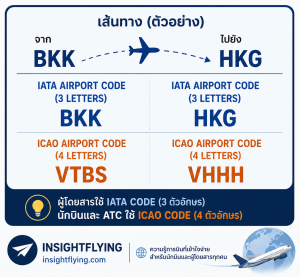
BKK-HKG
หมายถึง
เดินทางจากกรุงเทพฯ ไปฮ่องกง
รหัส 3 ตัวอักษรนี้ถูกใช้ในระบบจองตั๋ว สัมภาระ และข้อมูลผู้โดยสาร
5. Airport ICAO Code (4 ตัวอักษร)
ICAO Airport Code เป็นรหัสสนามบินแบบ 4 ตัวอักษร ที่ใช้ในการปฏิบัติการบิน การควบคุมจราจรทางอากาศ และการวางแผนการบิน
ตัวอย่าง
- VTBS = Suvarnabhumi Airport
- VTBD = Don Mueang Airport
- VTSP = Phuket Airport
- VTCC = Chiang Mai Airport
- WSSS = Singapore Changi Airport
- VHHH = Hong Kong International Airport
- EGLL = London Heathrow Airport
- KJFK = John F. Kennedy Airport
นักบินและพนักงานอำนวยการบินจะใช้รหัสเหล่านี้เป็นหลักในการจัดทำ Flight Plan
ตัวอย่าง
Route:
VTBS → VHHH
แทนที่จะใช้
BKK → HKG
ทำไมต้องมีทั้ง IATA และ ICAO
เหตุผลหลักคือผู้ใช้งานแตกต่างกัน
IATA
เน้นผู้โดยสารและธุรกิจสายการบิน
ใช้สำหรับ
- การจองตั๋ว
- สัมภาระ
- ตารางบิน
- ข้อมูลการเดินทาง
ICAO
เน้นการปฏิบัติการบิน
ใช้สำหรับ
- Flight Planning
- Air Traffic Control
- Navigation
- Safety Management
สรุป
รหัสต่าง ๆ ที่เราเห็นในโลกการบินมีหน้าที่แตกต่างกันอย่างชัดเจน
- Call Sign คือชื่อเรียกทางวิทยุ
- ICAO Airline Code คือรหัสสายการบิน 3 ตัวอักษรสำหรับการปฏิบัติการบิน
- IATA Airline Code คือรหัสสายการบิน 2 ตัวอักษรสำหรับผู้โดยสาร
- IATA Airport Code คือรหัสสนามบิน 3 ตัวอักษร
- ICAO Airport Code คือรหัสสนามบิน 4 ตัวอักษรสำหรับการบินและการควบคุมจราจรทางอากาศ
แม้ผู้โดยสารอาจเห็นเพียง TG102 หรือ BKK แต่เบื้องหลังการเดินทางหนึ่งเที่ยวบินนั้น มีระบบรหัสมาตรฐานระดับโลกที่ช่วยให้นักบิน เจ้าหน้าที่ควบคุมจราจรทางอากาศ และสายการบินทั่วโลกสามารถสื่อสารกันได้อย่างถูกต้องและปลอดภัยทุกวัน

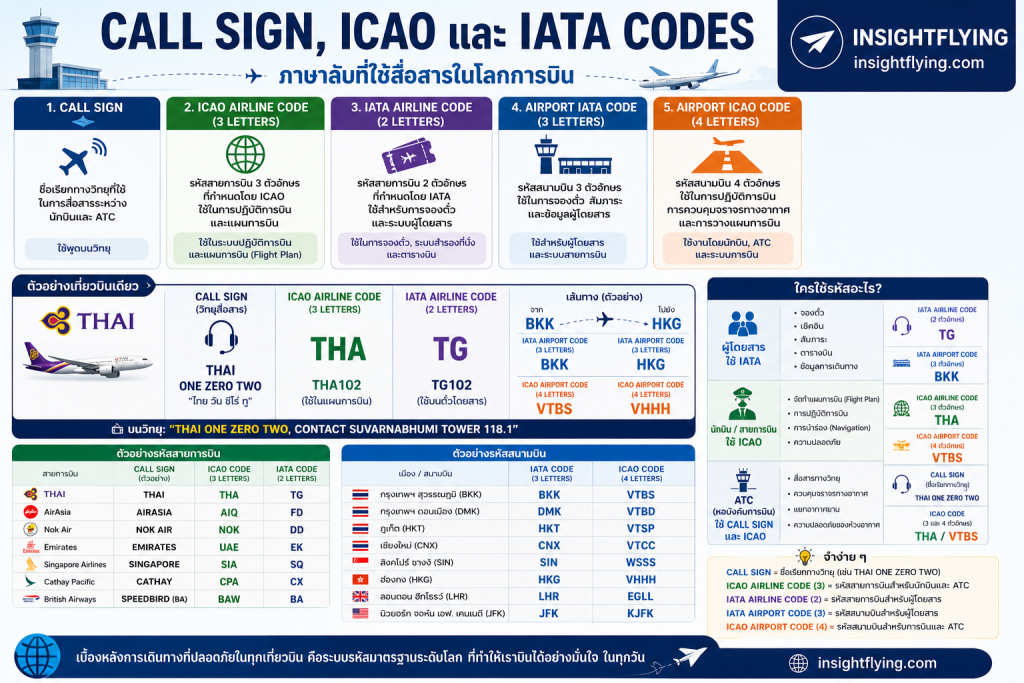
Call Signs, ICAO Codes, and IATA Codes: The Language of Aviation
When traveling by air, you may notice various codes appearing on your boarding pass, flight information screens, airport signs, or even hear them in aviation communications. Codes such as TG102, BKK, VTBS, or call signs like “THAI One Zero Two” are used every day in the aviation industry.
But what do these codes mean, and why are there so many different systems?
In reality, aviation relies on several internationally standardized coding systems to ensure safe, efficient, and accurate communication among airlines, pilots, air traffic controllers, airports, and passengers worldwide.
What Is a Call Sign?
A Call Sign is the name used by pilots and Air Traffic Control (ATC) during radio communications.
For example:
Flight TG102 operated by Thai Airways will use the radio call sign:
“THAI One Zero Two”
Similarly, AirAsia flight FD3021 will use:
“AIRASIA Three Zero Two One”
The call sign identifies a specific flight while it is operating and helps avoid confusion in radio communications.
Examples of airline call signs include:
- THAI – Thai Airways
- AIRASIA – AirAsia
- NOK AIR – Nok Air
- EMIRATES – Emirates
- SINGAPORE – Singapore Airlines
- SPEEDBIRD – British Airways
- CATHAY – Cathay Pacific
Interestingly, some call signs differ from the airline’s commercial name.
For example, British Airways uses the famous call sign “SPEEDBIRD,” inherited from its predecessor, BOAC (British Overseas Airways Corporation).
What Is an ICAO Airline Code?
An ICAO Airline Code is a three-letter airline designator assigned by the International Civil Aviation Organization (ICAO).
Examples:
- THA = Thai Airways
- AIQ = Thai AirAsia
- NOK = Nok Air
- UAE = Emirates
- SIA = Singapore Airlines
- CPA = Cathay Pacific
ICAO airline codes are primarily used for:
- Flight planning
- Air Traffic Control
- Airline operations
- Safety systems
For example:
THA102
indicates Flight 102 operated by Thai Airways.
AIQ321
indicates Flight 321 operated by Thai AirAsia.
What Is an IATA Airline Code?
An IATA Airline Code is a two-character airline identifier assigned by the International Air Transport Association (IATA).
Passengers encounter these codes most frequently because they are used in:
- Ticketing
- Reservations
- Flight schedules
- Baggage handling
Examples:
- TG = Thai Airways
- FD = Thai AirAsia
- DD = Nok Air
- EK = Emirates
- SQ = Singapore Airlines
- CX = Cathay Pacific
Therefore:
TG102
consists of:
- TG = IATA Airline Code
- 102 = Flight Number
Airport IATA Codes (3 Letters)
Airport IATA Codes are three-letter identifiers commonly seen by passengers.
Examples:
- BKK = Bangkok Suvarnabhumi Airport
- DMK = Don Mueang Airport
- HKT = Phuket Airport
- CNX = Chiang Mai Airport
- SIN = Singapore Changi Airport
- HKG = Hong Kong International Airport
- LHR = London Heathrow Airport
- JFK = John F. Kennedy International Airport
When you see:
BKK – HKG
it simply means a flight from Bangkok to Hong Kong.
These codes are widely used in:
- Ticketing systems
- Boarding passes
- Baggage tags
- Flight information displays
Airport ICAO Codes (4 Letters)
ICAO Airport Codes are four-letter identifiers used primarily for aviation operations.
Examples:
- VTBS = Bangkok Suvarnabhumi Airport
- VTBD = Don Mueang Airport
- VTSP = Phuket Airport
- VTCC = Chiang Mai Airport
- WSSS = Singapore Changi Airport
- VHHH = Hong Kong International Airport
- EGLL = London Heathrow Airport
- KJFK = John F. Kennedy International Airport
Pilots, dispatchers, and air traffic controllers use these codes extensively in flight planning and operational documentation.
For example:
VTBS → VHHH
rather than
BKK → HKG
Why Do We Need Both IATA and ICAO Codes?
The answer lies in the different users of the aviation system.
IATA Codes
Designed primarily for:
- Passengers
- Travel agencies
- Reservation systems
- Airline commercial operations
Examples:
- TG
- BKK
- HKG
ICAO Codes
Designed primarily for:
- Pilots
- Dispatchers
- Air Traffic Controllers
- Flight Operations Personnel
Examples:
- THA
- VTBS
- VHHH
Quick Comparison
| Type | Example | Used By |
|---|---|---|
| Call Sign | THAI One Zero Two | Pilots & ATC |
| ICAO Airline Code | THA | Flight Operations |
| IATA Airline Code | TG | Passengers & Reservations |
| IATA Airport Code | BKK | Tickets & Baggage |
| ICAO Airport Code | VTBS | Flight Planning & ATC |
Conclusion
Behind every flight is a global language of aviation codes that keeps the system running safely and efficiently.
While passengers may only see codes such as TG102, BKK, or HKG, aviation professionals rely on a more comprehensive set of identifiers, including THA, VTBS, VHHH, and radio call signs such as “THAI One Zero Two.”
These internationally standardized codes ensure that airlines, pilots, dispatchers, airports, and air traffic controllers around the world can communicate clearly and operate safely every day.
Understanding these codes offers a fascinating glimpse into the highly coordinated world of aviation that works behind every successful flight.