
สองคำที่คล้ายกัน แต่มี “ขอบเขต” และ “ผู้รับผิดชอบ” ต่างกันอย่างชัดเจน
ในวงการการบิน เรามักได้ยินคำว่า
- Continuing Airworthiness
- Continued Airworthiness
หลายครั้งสองคำนี้ถูกใช้ปะปนกัน
แม้แต่คนในอุตสาหกรรมเองก็ยังสับสนอยู่บ่อยครั้ง
เพราะทั้งสองคำเกี่ยวข้องกับ “Airworthiness” หรือ “ความสมควรเดินอากาศ” เหมือนกัน
แต่ในความเป็นจริง
ทั้งสองคำสะท้อน “มุมมอง” และ “หน้าที่รับผิดชอบ” ที่แตกต่างกันในระบบความปลอดภัยการบิน
และความเข้าใจเรื่องนี้สำคัญมากสำหรับผู้ที่ทำงานด้าน
- Flight Operations
- CAMO
- Maintenance
- Engineering
- Aircraft Design
- Safety Management
- Regulatory Oversight
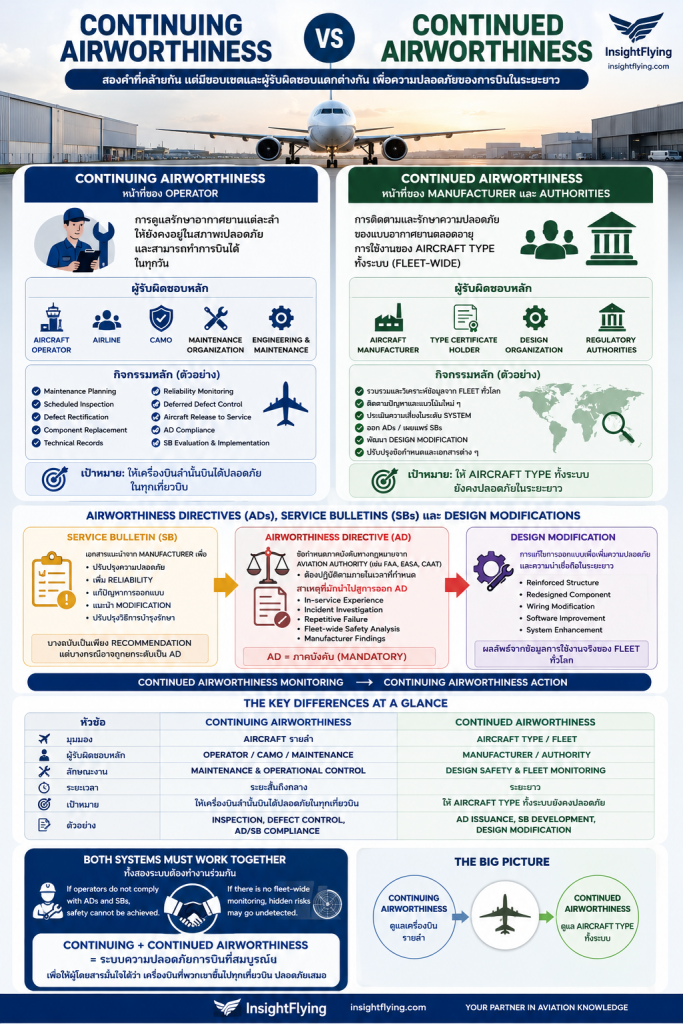
Airworthiness ไม่ได้จบลงหลังวันรับมอบเครื่องบิน
เครื่องบินไม่ได้ปลอดภัยตลอดไป
เพียงเพราะผ่านการรับรอง Type Certificate หรือ Certificate of Airworthiness ในวันแรก
เมื่อเวลาผ่านไป เครื่องบินต้องเผชิญกับปัจจัยต่าง ๆ เช่น
- Structural Fatigue
- Corrosion
- Component Wear
- Software Issues
- Operational Trends
- Human Factors
- Aging Aircraft Problems
- Defects ที่ไม่เคยพบมาก่อน
ดังนั้น “ความสมควรเดินอากาศ” จึงต้องถูกดูแลตลอดอายุการใช้งานของอากาศยาน
คำถามสำคัญคือ
ใครรับผิดชอบอะไร?
และนี่คือจุดที่ Continuing Airworthiness และ Continued Airworthiness เริ่มแตกต่างกันอย่างชัดเจน
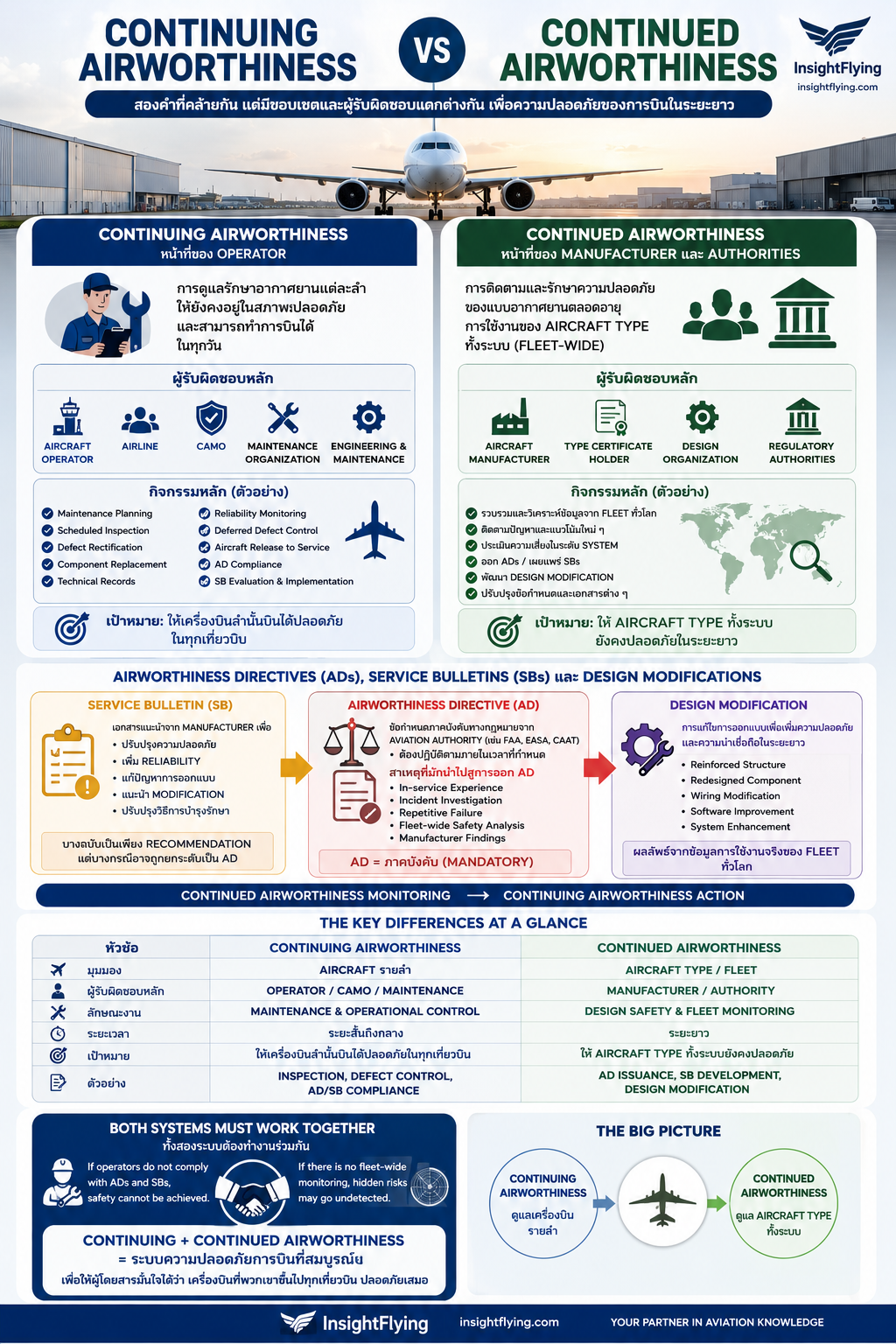
Continuing Airworthiness
หน้าที่ของ Operator และระบบซ่อมบำรุง
Continuing Airworthiness หมายถึง
การดูแลรักษาอากาศยานแต่ละลำให้ยังคงอยู่ในสภาพปลอดภัยและสามารถทำการบินได้
นี่คือหน้าที่หลักของ
- Aircraft Operator
- Airline
- CAMO
- Maintenance Organization
- Engineering & Maintenance Department
โดยเน้นไปที่การดูแล “เครื่องบินรายลำ” ในการปฏิบัติการประจำวัน
กิจกรรมสำคัญ เช่น
- Maintenance Planning
- Scheduled Inspection
- Defect Rectification
- Component Replacement
- Technical Record Keeping
- Reliability Monitoring
- Deferred Defect Control
- Aircraft Release to Service
- Airworthiness Directive (AD) Compliance
- Service Bulletin (SB) Evaluation & Implementation
Operator มีหน้าที่ตรวจสอบว่า AD ที่มีผลบังคับถูกปฏิบัติครบถ้วนภายในเวลาที่กำหนด
รวมถึงประเมินและดำเนินการตาม SB ที่เกี่ยวข้องกับความปลอดภัย ความน่าเชื่อถือ หรือประสิทธิภาพของอากาศยาน
พูดง่าย ๆ คือ
Continuing Airworthiness คือ
“การบริหารดูแลเครื่องบินแต่ละลำ”
เพื่อให้เครื่องบินลำนั้นยังคง Airworthy ทุกวันที่ขึ้นบิน
จึงเป็นเหตุผลที่เราเห็นคำว่า
- Continuing Airworthiness Management Organization (CAMO)
- Continuing Airworthiness Records
- Continuing Airworthiness System
เพราะคำนี้เน้น “ระบบการดูแลต่อเนื่อง”
Continued Airworthiness
หน้าที่ของ Manufacturer และ Regulatory Authority
ส่วน Continued Airworthiness มีมุมมองที่กว้างกว่า
ไม่ได้มองแค่เครื่องบินลำใดลำหนึ่ง
แต่กำลังมอง “Aircraft Type” ทั้ง fleet ทั่วโลก เช่น
- Airbus A320 Family
- Boeing 737 Series
- ATR72
- Embraer E-Jets
Continued Airworthiness หมายถึง
การติดตามและรักษาความปลอดภัยของแบบอากาศยานตลอดอายุการใช้งาน
นี่คือหน้าที่ของ
- Aircraft Manufacturer
- Type Certificate Holder
- Design Organization
- Regulatory Authorities
เพราะเมื่อมี aircraft หลายพันลำบินอยู่ทั่วโลก
ผู้ผลิตและหน่วยงานกำกับดูแลต้องติดตามข้อมูลจาก fleet ทั้งระบบ เพื่อค้นหาความเสี่ยงหรือแนวโน้มใหม่ ๆ เช่น
- Structural Crack
- Corrosion Pattern
- Recurring Failure
- Software-related Issues
- Aging Aircraft Concerns
- Design Vulnerability
- Human-Machine Interaction Problems
เมื่อพบปัญหาที่อาจกระทบต่อความปลอดภัยในระดับ fleet
ผู้ผลิตหรือหน่วยงานกำกับดูแลอาจดำเนินการ เช่น
- ออก Airworthiness Directives (ADs)
- เผยแพร่ Service Bulletins (SBs)
- ปรับปรุง Inspection Program
- แก้ไข Maintenance Limitation
- พัฒนา Software Update
- ออกแบบ Design Modification ใหม่
- เพิ่ม Structural Reinforcement Program
นี่คือหัวใจของ Continued Airworthiness
เพราะไม่ได้มองแค่ “เครื่องบินลำเดียว”
แต่มองถึง “ความปลอดภัยระยะยาวของ aircraft type ทั้งระบบ”
Airworthiness Directives (ADs), Service Bulletins (SBs) และ Design Modifications
หนึ่งในตัวอย่างที่ชัดที่สุดของ Continued Airworthiness คือการจัดการผ่าน
- Airworthiness Directives (ADs)
- Service Bulletins (SBs)
- Design Modifications
Service Bulletin (SB)
SB คือเอกสารที่ออกโดย Manufacturer เพื่อ
- ปรับปรุงความปลอดภัย
- เพิ่ม Reliability
- แก้ปัญหาการออกแบบ
- แนะนำ Modification
- ปรับปรุงวิธีการบำรุงรักษา
SB บางฉบับเป็นเพียง recommendation
แต่บางกรณี หากหน่วยงานกำกับดูแลพบว่ามีผลต่อความปลอดภัย
SB นั้นอาจถูกยกระดับกลายเป็น AD ได้
Airworthiness Directive (AD)
AD คือข้อกำหนดภาคบังคับทางกฎหมาย
ที่ออกโดย Aviation Authority เช่น
- FAA
- EASA
- CAAT
Operator ต้องปฏิบัติตามภายในเวลาที่กำหนด
AD หลายฉบับเกิดจาก
- In-service Experience
- Incident Investigation
- Repetitive Failure
- Fleet-wide Safety Analysis
- Manufacturer Findings
ซึ่งสะท้อนให้เห็นว่า
Continued Airworthiness Monitoring
สามารถนำไปสู่
Continuing Airworthiness Action ในระดับ operator ได้โดยตรง
Design Modification
ในหลายกรณี การแก้ปัญหาไม่ได้จบเพียง inspection หรือ replacement
แต่จำเป็นต้องแก้ไข “การออกแบบ”
เช่น
- Reinforced Structure
- Redesigned Component
- Wiring Modification
- Software Logic Improvement
- Fuel System Improvement
Design Modification เหล่านี้คือผลลัพธ์ของ Continued Airworthiness Process
ที่อาศัยข้อมูลจาก fleet ทั่วโลก
เพื่อปรับปรุง aircraft type ให้ปลอดภัยมากยิ่งขึ้นในระยะยาว
Instructions for Continued Airworthiness (ICA)
อีกคำที่พบเสมอคือ
Instructions for Continued Airworthiness (ICA)
คือเอกสารจาก Manufacturer หรือ Design Approval Holder
ที่กำหนดว่า หลังมีการ modification หรือ installation ใหม่
จะต้องตรวจสอบ ดูแล หรือบำรุงรักษาอย่างไร
เพื่อให้ aircraft type ยังคงปลอดภัยต่อไปในอนาคต
ความแตกต่างที่สำคัญที่สุด
| หัวข้อ | Continuing Airworthiness | Continued Airworthiness |
|---|---|---|
| มุมมอง | Aircraft รายลำ | Aircraft Type / Fleet |
| ผู้รับผิดชอบหลัก | Operator / CAMO / Maintenance | Manufacturer / Authority |
| ลักษณะงาน | Maintenance & Operational Control | Design Safety & Fleet Monitoring |
| เป้าหมาย | ให้เครื่องบินลำนั้นบินได้ปลอดภัย | ให้ aircraft type ทั้งระบบยังปลอดภัย |
| ระยะเวลา | ระยะสั้นถึงกลาง | ระยะยาว |
| ตัวอย่าง | Inspection, Defect Control, AD/SB Compliance | AD Issuance, SB Development, Design Modification |
ทั้งสองระบบต้องทำงานร่วมกัน
ต่อให้ Manufacturer ออก AD ที่ดีที่สุดในโลก
แต่ถ้า Operator ไม่ปฏิบัติตาม
ความปลอดภัยก็ไม่เกิดขึ้น
ในทางกลับกัน
ต่อให้ Operator ดูแลเครื่องบินดีเพียงใด
แต่ไม่มีระบบติดตามปัญหาระดับ fleet-wide
อันตรายบางอย่างก็อาจไม่ถูกค้นพบ
ดังนั้น
Continuing Airworthiness
และ Continued Airworthiness
จึงเป็นเหมือน “สองด้านของระบบเดียวกัน”
ด้านหนึ่งดูแล aircraft รายลำ
อีกด้านดูแลความปลอดภัยของ aircraft type ทั้งโลก
และเมื่อทั้งสองระบบทำงานร่วมกันอย่างสมบูรณ์
นั่นคือสิ่งที่ทำให้ผู้โดยสารสามารถเชื่อมั่นได้ว่า
เครื่องบินที่กำลังพาพวกเขาขึ้นสู่ท้องฟ้า
ยังคงปลอดภัยในทุกเที่ยวบิน
Continuing Airworthiness vs Continued Airworthiness
Two Similar Terms — But Very Different Responsibilities
In aviation, we often hear the terms:
- Continuing Airworthiness
- Continued Airworthiness
They sound very similar, and many people — even within the industry — use them interchangeably.
However, these two terms actually represent different scopes, perspectives, and responsibilities within the aviation safety system.
Understanding the distinction is important, especially for professionals involved in:
- Flight Operations
- CAMO
- Maintenance
- Engineering
- Aircraft Design
- Regulatory Oversight
- Safety Management
Airworthiness Does Not End After Certification
An aircraft is not considered safe forever simply because it received its Type Certificate or Certificate of Airworthiness on day one.
As aircraft age and operate over time, many issues can emerge:
- Structural fatigue
- Corrosion
- Component wear
- Software anomalies
- Human factor issues
- Operational trends
- Design limitations
- Unexpected defects discovered across the fleet
This is why airworthiness must be continuously maintained throughout the aircraft’s operational life.
The question is:
Who is responsible for what?
This is where the difference between Continuing and Continued Airworthiness becomes very important.
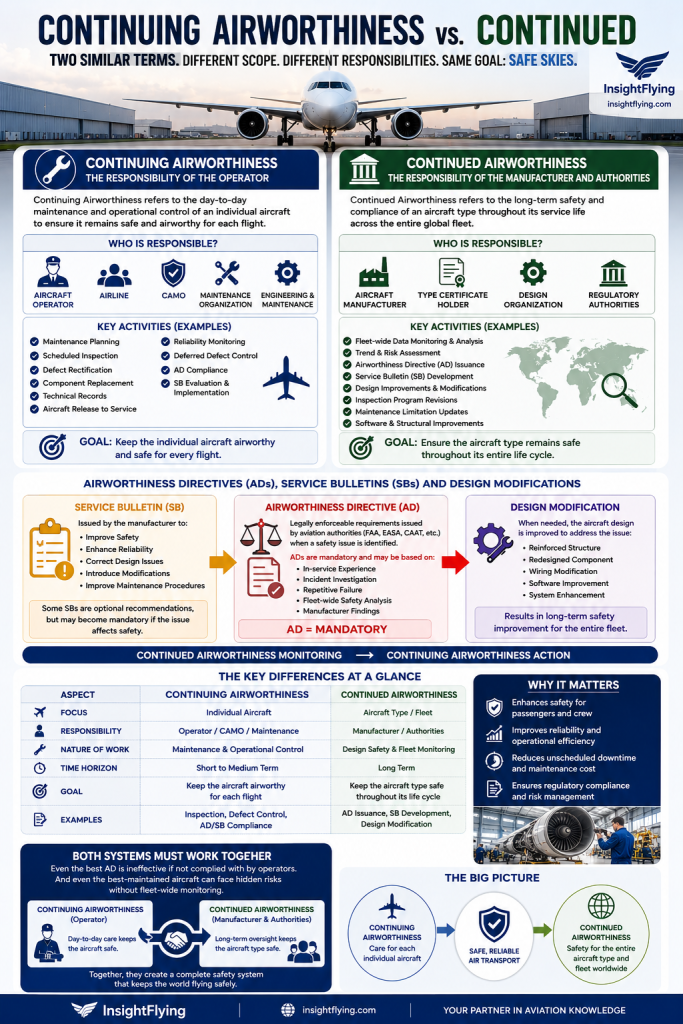
Continuing Airworthiness
The Responsibility of the Operator
Continuing Airworthiness refers to:
The processes and activities required to keep an individual aircraft airworthy and safe for operation.
This is primarily the responsibility of:
- Aircraft Operators
- Airlines
- CAMO
- Maintenance Organizations
- Engineering & Maintenance Departments
It focuses on the day-to-day maintenance and operational control of individual aircraft.
Typical activities include:
- Maintenance Planning
- Scheduled Inspections
- Defect Rectification
- Component Replacement
- Technical Records Management
- Reliability Monitoring
- Airworthiness Directive (AD) Compliance
- Service Bulletin (SB) Evaluation and Implementation
- Deferred Defect Control
- Aircraft Release to Service
Operators are responsible for ensuring that mandatory requirements such as ADs are complied with within the required timeframe, while also assessing and implementing applicable Service Bulletins that may improve safety, reliability, or operational performance.
In simple terms:
Continuing Airworthiness is about ensuring that a specific aircraft remains safe to fly every day.
This is why we commonly hear terms such as:
- Continuing Airworthiness Management Organization (CAMO)
- Continuing Airworthiness Records
- Continuing Airworthiness System
Because the emphasis is on continuous maintenance and operational management.
Continued Airworthiness
The Responsibility of the Manufacturer and Authorities
Continued Airworthiness has a broader perspective.
Instead of focusing on one aircraft, it focuses on the long-term safety of an entire aircraft type or fleet.
Examples include:
- Airbus A320 Family
- Boeing 737 Series
- ATR72
- Embraer E-Jets
Continued Airworthiness refers to:
The ongoing monitoring and preservation of the safety and compliance of an aircraft type throughout its service life.
This responsibility primarily belongs to:
- Aircraft Manufacturers
- Type Certificate Holders
- Design Organizations
- Regulatory Authorities
Because thousands of aircraft may be operating worldwide, manufacturers and authorities must continuously monitor global fleet data for emerging risks and trends.
These may include:
- Structural cracks
- Corrosion patterns
- Recurring incidents
- Software-related issues
- Aging aircraft concerns
- Unexpected design vulnerabilities
- Human-machine interaction problems
When systemic risks or safety concerns are identified, manufacturers and authorities may issue:
- Airworthiness Directives (ADs)
- Service Bulletins (SBs)
- Design Modifications
- Inspection Program Revisions
- Maintenance Limitation Updates
- Software Enhancements
- Structural Reinforcement Programs
This is one of the clearest examples of Continued Airworthiness in action.
A Service Bulletin may introduce an improved inspection method, a redesigned component, or a modification intended to enhance long-term safety or reliability.
If the issue becomes safety-critical, aviation authorities may then mandate compliance through an Airworthiness Directive.
In many cases, design modifications resulting from operational experience become essential to maintaining the long-term safety of the fleet.
In other words:
Continued Airworthiness is about ensuring that the aircraft type itself remains safe over the long term.
Instructions for Continued Airworthiness (ICA)
One of the clearest examples of this concept is:
Instructions for Continued Airworthiness (ICA)
These are documents issued by manufacturers or design approval holders that specify:
- Inspection requirements
- Maintenance procedures
- Operational limitations
- Continued maintenance instructions
especially after modifications, repairs, or new installations.
The purpose is to ensure that the aircraft type remains safe and compliant throughout its operational life.
The Relationship Between ADs, SBs, and Airworthiness
Understanding the relationship between ADs and SBs is essential in distinguishing Continuing and Continued Airworthiness.
Service Bulletin (SB)
An SB is normally issued by the manufacturer to:
- Improve safety
- Enhance reliability
- Correct design issues
- Introduce modifications
- Improve maintenance procedures
Some SBs are optional, while others may later become mandatory if regulators determine that the issue affects safety.
Airworthiness Directive (AD)
An AD is a legally enforceable requirement issued by an aviation authority such as:
- FAA
- EASA
- CAAT
ADs are mandatory and must be complied with within the specified timeframe.
Many ADs originate from:
- In-service experience
- Incident investigations
- Repetitive failures
- Manufacturer findings
- Fleet-wide safety analysis
This demonstrates how Continued Airworthiness monitoring eventually translates into Continuing Airworthiness actions at the operator level.
The Key Difference
| Topic | Continuing Airworthiness | Continued Airworthiness |
|---|---|---|
| Main Focus | Individual Aircraft | Aircraft Type / Fleet |
| Responsibility | Operator / CAMO / Maintenance | Manufacturer / Authorities |
| Scope | Maintenance & Operational Control | Design Safety & Fleet Monitoring |
| Time Horizon | Short to Medium Term | Long Term |
| Goal | Keep the aircraft airworthy for each flight | Keep the aircraft type safe over its lifecycle |
| Examples | Inspection, Defect Control, AD/SB Compliance | AD Issuance, SB Development, Design Modification |
Why Continued Airworthiness Is More Complex
Many people think maintenance is simply about repairing aircraft.
But one of the most challenging aspects of modern aviation safety is actually Continued Airworthiness.
Because it requires:
- Global fleet monitoring
- Long-term trend analysis
- Predictive risk assessment
- Engineering data integration
- Safety data analysis
- Cross-organizational collaboration
- Thinking beyond basic compliance
Sometimes, safety trends only become visible after years of operational data.
And when a systemic issue is discovered, it may affect thousands of aircraft worldwide simultaneously.
This is why Continued Airworthiness plays such a critical role in modern aviation safety.
Both Systems Must Work Together
Even the best Airworthiness Directive is meaningless if operators fail to comply with it.
At the same time, even the best-maintained aircraft may still face hidden risks if no one is monitoring fleet-wide safety trends.
That is why:
- Continuing Airworthiness
- Continued Airworthiness
are two interconnected parts of the same aviation safety ecosystem.
One focuses on maintaining individual aircraft.
The other focuses on protecting the long-term safety of the entire aircraft type.
And when both systems work together effectively, passengers can confidently trust that the aircraft carrying them through the skies remains safe — on every flight.