
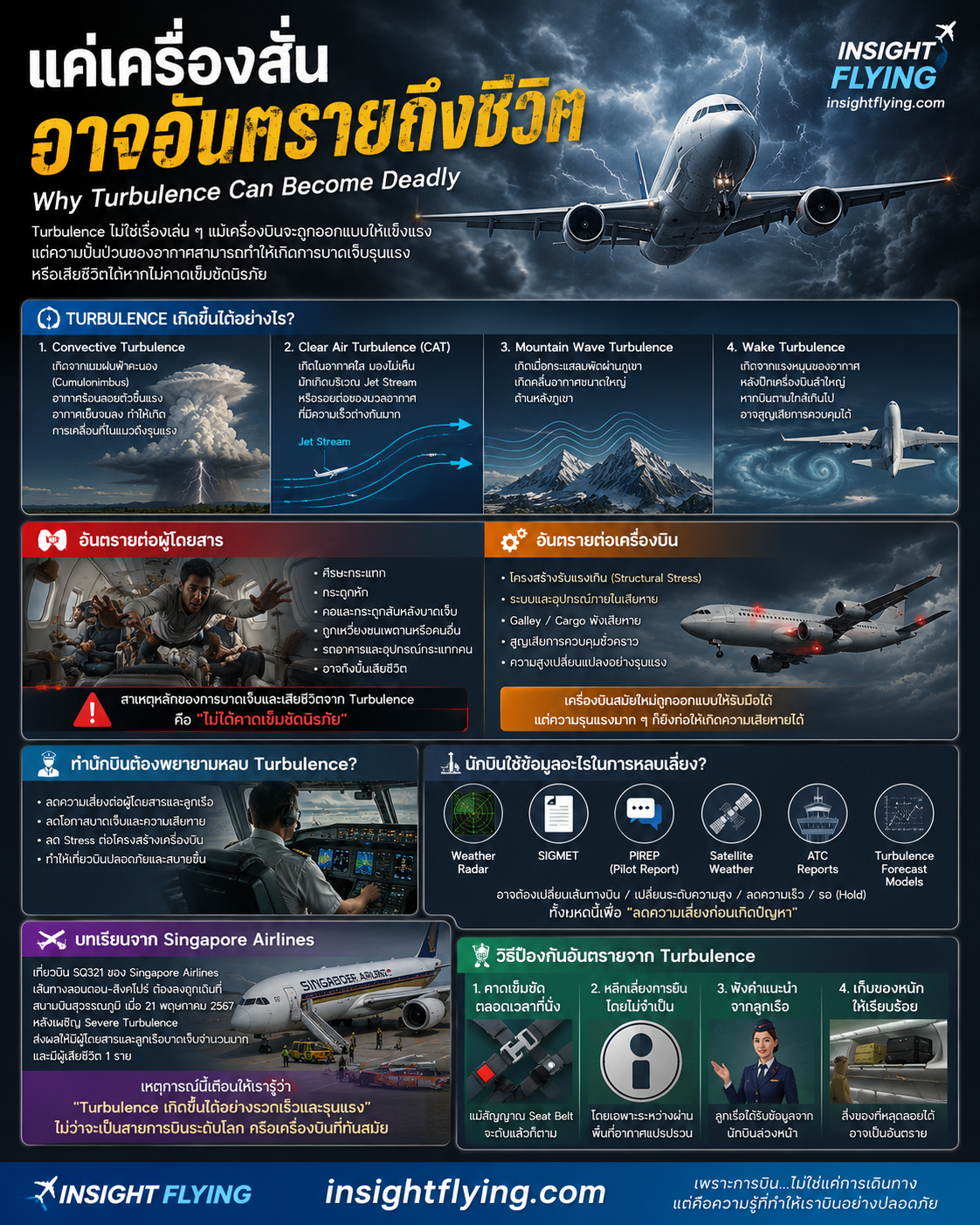
Why Turbulence Can Become Deadly — และทำไมนักบินจึงพยายามหลบหลีกมันเสมอ
หลายคนเข้าใจว่า Turbulence หรือ “อากาศปั่นป่วน” เป็นเพียงอาการเครื่องบินสั่นเล็กน้อยระหว่างเดินทาง
แต่ในความเป็นจริง Turbulence สามารถสร้างอันตรายรุนแรงได้ทั้งต่อผู้โดยสาร ลูกเรือ และตัวเครื่องบินเอง
ในบางกรณี มันอาจรุนแรงถึงขั้นทำให้เครื่องบินต้องลงฉุกเฉิน และมีผู้เสียชีวิตได้
กรณีของเที่ยวบินของ Singapore Airlines ที่ต้องลงฉุกเฉินที่ Suvarnabhumi Airport หลังเผชิญ Severe Turbulence ระหว่างบิน คือหนึ่งในตัวอย่างที่ทำให้ทั้งโลกกลับมาตระหนักว่า
“Turbulence ไม่ใช่เรื่องเล่น ๆ”
Turbulence คืออะไร?
Turbulence คือ การเคลื่อนที่ของมวลอากาศแบบไม่เรียบ
ทำให้เครื่องบินเกิดการสั่น กระแทก โยนตัว หรือเปลี่ยนระดับความสูงอย่างรวดเร็ว
เปรียบง่าย ๆ เหมือนเราขับรถผ่านถนนขรุขระ
แต่ต่างกันตรงที่เครื่องบินกำลังเคลื่อนที่ด้วยความเร็วหลายร้อยกิโลเมตรต่อชั่วโมง และอยู่ในอากาศ
แรงที่เกิดขึ้นจึงมหาศาลกว่ามาก
Turbulence เกิดขึ้นได้อย่างไร?
Turbulence สามารถเกิดได้หลายสาเหตุ เช่น
1. Convective Turbulence
เกิดจากเมฆฝนฟ้าคะนอง หรือ Cumulonimbus (CB)
อากาศร้อนลอยตัวขึ้นอย่างรุนแรง
ขณะที่อากาศเย็นจมตัวลง
ทำให้เกิด Vertical Air Movement อย่างรุนแรง
นี่คือสาเหตุที่นักบินพยายามหลบหลีก Thunderstorm อย่างจริงจัง
2. Clear Air Turbulence (CAT)
อันตรายที่สุดชนิดหนึ่ง
เกิดในอากาศใส ไม่มีเมฆ ไม่มีสัญญาณเตือนชัดเจนบนเรดาร์อากาศ
มักเกิดบริเวณ Jet Stream หรือรอยต่อของมวลอากาศที่มีความเร็วต่างกันมาก
ผู้โดยสารจำนวนมากจึงมักเข้าใจผิดว่า
“ฟ้าใส ไม่น่ามีอันตราย”
แต่จริง ๆ แล้ว CAT คือหนึ่งใน Turbulence ที่คาดเดายากที่สุด
3. Mountain Wave Turbulence
เกิดเมื่อกระแสลมพัดผ่านภูเขา
อากาศด้านหลังภูเขาจะเกิดคลื่นอากาศขนาดใหญ่
บางครั้งรุนแรงมากแม้ห่างภูเขาหลายสิบไมล์
4. Wake Turbulence
เกิดจากแรงหมุนของอากาศหลังปีกเครื่องบินลำใหญ่
โดยเฉพาะเครื่องบิน Heavy Jet เช่น Airbus A380 หรือ Boeing 777
หากเครื่องบินลำเล็กบินตามใกล้เกินไป
อาจสูญเสียการควบคุมได้
Turbulence อันตรายต่อผู้โดยสารอย่างไร?
สิ่งที่อันตรายที่สุด ไม่ใช่ตัวเครื่องบินพังทันที
แต่คือ “คนในห้องโดยสาร”
เมื่อเครื่องบินตกหลุมอากาศอย่างรุนแรง
ร่างกายคนจะยังคงเคลื่อนที่ตาม inertia
ผู้โดยสารที่ไม่ได้คาดเข็มขัด อาจถูกเหวี่ยงกระแทกเพดานห้องโดยสารได้ทันที
อาการบาดเจ็บที่พบได้บ่อย เช่น
- ศีรษะกระแทก
- กระดูกหัก
- คอและกระดูกสันหลังบาดเจ็บ
- ผู้โดยสารหรือลูกเรือถูกเหวี่ยงชนกัน
- รถอาหารและอุปกรณ์หลุดกระแทกคน
ในเหตุการณ์รุนแรง
แรง G-force ที่เกิดขึ้นสามารถทำให้คน “ลอย” จากที่นั่งได้จริง
และนี่คือเหตุผลว่าทำไมลูกเรือจึงเตือนเสมอว่า
“Even when the seat belt sign is off, keep your seat belt fastened while seated.”
Turbulence อันตรายต่อเครื่องบินอย่างไร?
โดยทั่วไป เครื่องบินสมัยใหม่ถูกออกแบบให้แข็งแรงมาก
และสามารถรับแรง Turbulence ได้สูงกว่าที่คนส่วนใหญ่คิด
ปีกเครื่องบินถูกออกแบบให้ยืดหยุ่นและรับแรงกระแทกได้มหาศาล
แต่ Turbulence รุนแรงมาก ๆ ก็ยังสามารถก่อให้เกิดอันตรายได้ เช่น
- Structural Stress
- Overload ต่อ airframe
- ความเสียหายต่อ interior cabin
- ความเสียหายต่อ galley หรือ cargo
- การสูญเสียการควบคุมชั่วคราว
- Altitude deviation อย่างรุนแรง
โดยเฉพาะหากเครื่องบินบินเร็วเกินไปในอากาศปั่นป่วน
แรงที่เกิดขึ้นจะเพิ่มขึ้นอย่างมาก
นี่จึงเป็นเหตุผลที่นักบินจะลดความเร็วเข้าสู่ “Turbulence Penetration Speed”
ทำไมนักบินต้องพยายามหลบ Turbulence?
นักบินไม่ได้หลบเพราะ “กลัวเครื่องบินตก”
แต่หลบเพื่อ
- ลดความเสี่ยงต่อผู้โดยสาร
- ลดโอกาสบาดเจ็บของลูกเรือ
- ลด stress ต่อโครงสร้างเครื่องบิน
- ทำให้เที่ยวบินปลอดภัยและสบายขึ้น
เครื่องบินพาณิชย์จึงมีการใช้ข้อมูลหลายอย่างร่วมกัน เช่น
- Weather Radar
- SIGMET
- PIREP (Pilot Report)
- Satellite Weather
- ATC Reports
- Turbulence Forecast Models
บางครั้งนักบินอาจต้อง
- เปลี่ยนเส้นทางบิน
- เปลี่ยนระดับความสูง
- ลดความเร็ว
- รอ hold เพื่อหลบแนวพายุ
ทั้งหมดนี้เพื่อ “ลดความเสี่ยงก่อนเกิดปัญหา”
บทเรียนจาก Singapore Airlines
เหตุการณ์ของ Singapore Airlines ที่ต้องลงฉุกเฉินที่ Suvarnabhumi Airport แสดงให้เห็นว่า
แม้สายการบินระดับโลก
แม้เครื่องบินทันสมัย
แม้นักบินมีประสบการณ์สูง
Turbulence ก็ยังสามารถเกิดขึ้นได้อย่างรวดเร็วและรุนแรง
รายงานระบุว่ามีผู้โดยสารและลูกเรือจำนวนมากได้รับบาดเจ็บ
โดยเฉพาะผู้ที่ไม่ได้คาดเข็มขัดนิรภัยในขณะเกิดเหตุ
เหตุการณ์นี้ทำให้หลายคนเริ่มเข้าใจว่า
“Seat Belt” อาจเป็นอุปกรณ์ที่สำคัญที่สุดชิ้นหนึ่งบนเครื่องบิน
วิธีป้องกันอันตรายจาก Turbulence
สำหรับผู้โดยสาร สิ่งง่ายที่สุด แต่สำคัญที่สุด คือ
1. คาดเข็มขัดตลอดเวลาที่นั่งอยู่
แม้สัญญาณ Seat Belt จะดับแล้วก็ตาม
2. หลีกเลี่ยงการยืนโดยไม่จำเป็น
โดยเฉพาะระหว่างผ่านพื้นที่อากาศแปรปรวน
3. ฟังคำแนะนำจากลูกเรือ
ลูกเรือมักได้รับข้อมูลจากนักบินล่วงหน้า
ก่อนที่ Turbulence จะมาถึง
4. เก็บของหนักให้เรียบร้อย
สิ่งของที่หลุดลอยได้ สามารถกลายเป็นวัตถุอันตรายได้ทันที
สุดท้ายแล้ว Turbulence น่ากลัวไหม?
คำตอบคือ
“Turbulence เป็นเรื่องที่ต้องตระหนัก แต่ไม่ใช่เรื่องที่ต้องตื่นตระหนก”
นักบินได้รับการฝึกฝนสำหรับเรื่องนี้โดยเฉพาะ
เครื่องบินถูกออกแบบให้รับมือได้
และระบบพยากรณ์อากาศสมัยใหม่ก็พัฒนาขึ้นมาก
แต่สิ่งสำคัญที่สุด คือ
อุบัติเหตุจาก Turbulence ส่วนใหญ่ “ป้องกันได้”
เพียงแค่คาดเข็มขัดนิรภัยไว้เสมอ
บางครั้ง สายเข็มขัดเส้นเล็ก ๆ
อาจช่วยชีวิตคุณได้จริง ๆ।
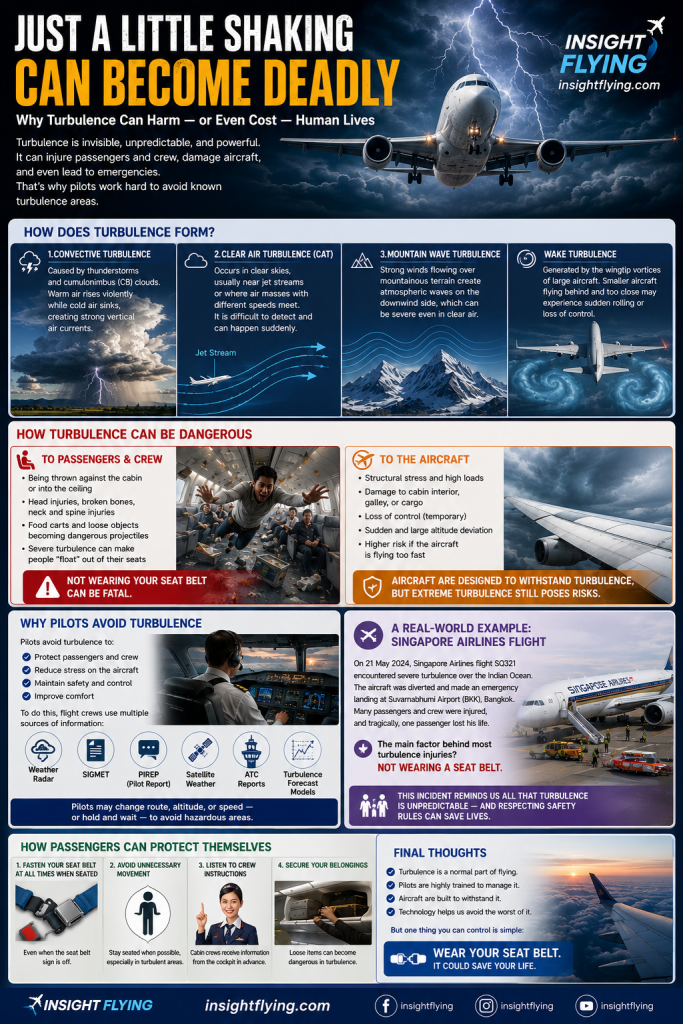
“Just a Little Shaking” Can Become Deadly
Why Turbulence Can Harm — or Even Cost — Human Lives
Many passengers think turbulence is just a minor inconvenience during a flight.
A few bumps, a little shaking, and then everything goes back to normal.
But in reality, turbulence can become one of the most dangerous situations in aviation — not only for passengers and cabin crew, but sometimes even for the aircraft itself.
The emergency diversion of a Singapore Airlines flight to Suvarnabhumi Airport after encountering severe turbulence reminded the world that turbulence is far more serious than many people realize.
What Is Turbulence?
Turbulence is irregular and unstable movement of air.
As an aircraft flies through disturbed airflow, it may suddenly shake, drop, climb, roll, or experience abrupt changes in altitude and attitude.
It is similar to driving a car on a rough road — except an aircraft is moving at hundreds of kilometers per hour in three-dimensional space.
The forces involved can therefore become extremely powerful.
How Does Turbulence Occur?
Turbulence can develop from several atmospheric conditions.
1. Convective Turbulence
This is associated with thunderstorms and towering cumulonimbus (CB) clouds.
Warm air rises rapidly while colder air sinks violently, creating strong vertical air currents.
This is why pilots actively avoid thunderstorms whenever possible.
2. Clear Air Turbulence (CAT)
One of the most dangerous forms of turbulence.
It occurs in clear skies without visible clouds and often without clear radar indications.
CAT is commonly found near jet streams or boundaries between air masses moving at different speeds.
Passengers often assume that clear skies mean smooth flying, but some of the worst turbulence can occur in perfectly clear weather.
3. Mountain Wave Turbulence
This occurs when strong winds flow over mountainous terrain.
The airflow creates atmospheric waves downstream of the mountains, sometimes extending many miles away.
These waves can become extremely severe even when the sky appears calm.
4. Wake Turbulence
Wake turbulence is generated by the powerful wingtip vortices produced by large aircraft.
Heavy aircraft such as the Airbus A380 or Boeing 777 can leave behind intense rotating air currents.
If a smaller aircraft encounters those vortices, it may experience sudden roll movements or even temporary loss of control.
How Dangerous Is Turbulence for Passengers?
The greatest danger during turbulence is usually not the aircraft itself — it is the people inside the cabin.
When an aircraft suddenly drops or accelerates vertically, the human body continues moving due to inertia.
Passengers who are not wearing seat belts can literally be thrown into the ceiling within seconds.
Common injuries include:
- Head injuries
- Broken bones
- Neck and spinal injuries
- Cabin crew being thrown into equipment or passengers
- Food carts and loose objects becoming dangerous projectiles
In severe turbulence, the G-forces can become strong enough to lift passengers completely out of their seats.
This is why cabin crews repeatedly remind passengers:
“Even when the seat belt sign is off, keep your seat belt fastened while seated.”
Can Turbulence Damage an Aircraft?
Modern airliners are designed to withstand far greater forces than most people imagine.
Aircraft wings are intentionally flexible and engineered to absorb enormous aerodynamic loads.
However, extremely severe turbulence can still create serious risks, including:
- Structural stress
- Excessive airframe loading
- Damage to cabin interiors
- Damage to galley equipment or cargo
- Temporary loss of control
- Sudden altitude deviations
The danger increases significantly if the aircraft is flying too fast in turbulent conditions.
That is why pilots reduce speed to a specific “turbulence penetration speed” when necessary.
Why Do Pilots Try to Avoid Turbulence?
Pilots do not avoid turbulence simply because they fear the aircraft will crash.
They avoid it because turbulence can:
- Injure passengers and crew
- Increase stress on the aircraft structure
- Create operational risks
- Reduce passenger comfort and safety
To avoid hazardous areas, flight crews use multiple sources of information, including:
- Weather radar
- SIGMETs
- PIREPs (Pilot Reports)
- Satellite weather data
- Air traffic control reports
- Turbulence forecast models
Pilots may decide to:
- Change route
- Change altitude
- Reduce speed
- Delay or hold temporarily
All of these decisions are made to reduce risk before conditions worsen.
The Singapore Airlines Case: A Wake-Up Call
The recent Singapore Airlines turbulence event that resulted in an emergency landing at Suvarnabhumi Airport demonstrated how rapidly turbulence can escalate.
Even with a world-class airline, experienced pilots, and a modern aircraft, severe turbulence can occur unexpectedly.
Many passengers and crew members were injured, particularly those who were not wearing seat belts at the time.
The incident became a powerful reminder that one of the simplest safety devices onboard may also be one of the most important:
The seat belt.
How Passengers Can Protect Themselves
1. Keep Your Seat Belt Fastened Whenever Seated
Even if the seat belt sign is turned off.
2. Avoid Unnecessary Movement Around the Cabin
Especially when flying through unstable weather regions.
3. Listen Carefully to Cabin Crew Instructions
Cabin crews often receive turbulence information from the cockpit before passengers notice anything unusual.
4. Secure Loose Items
Unsecured objects can quickly become dangerous during severe turbulence.
Final Thoughts
Turbulence is something aviation professionals deeply respect — but not something passengers should panic about.
Pilots are trained extensively to handle it.
Aircraft are engineered to survive it.
Weather forecasting technology continues to improve every year.
But one important fact remains:
Most turbulence-related injuries are preventable.
Sometimes, a simple seat belt can save your life.