
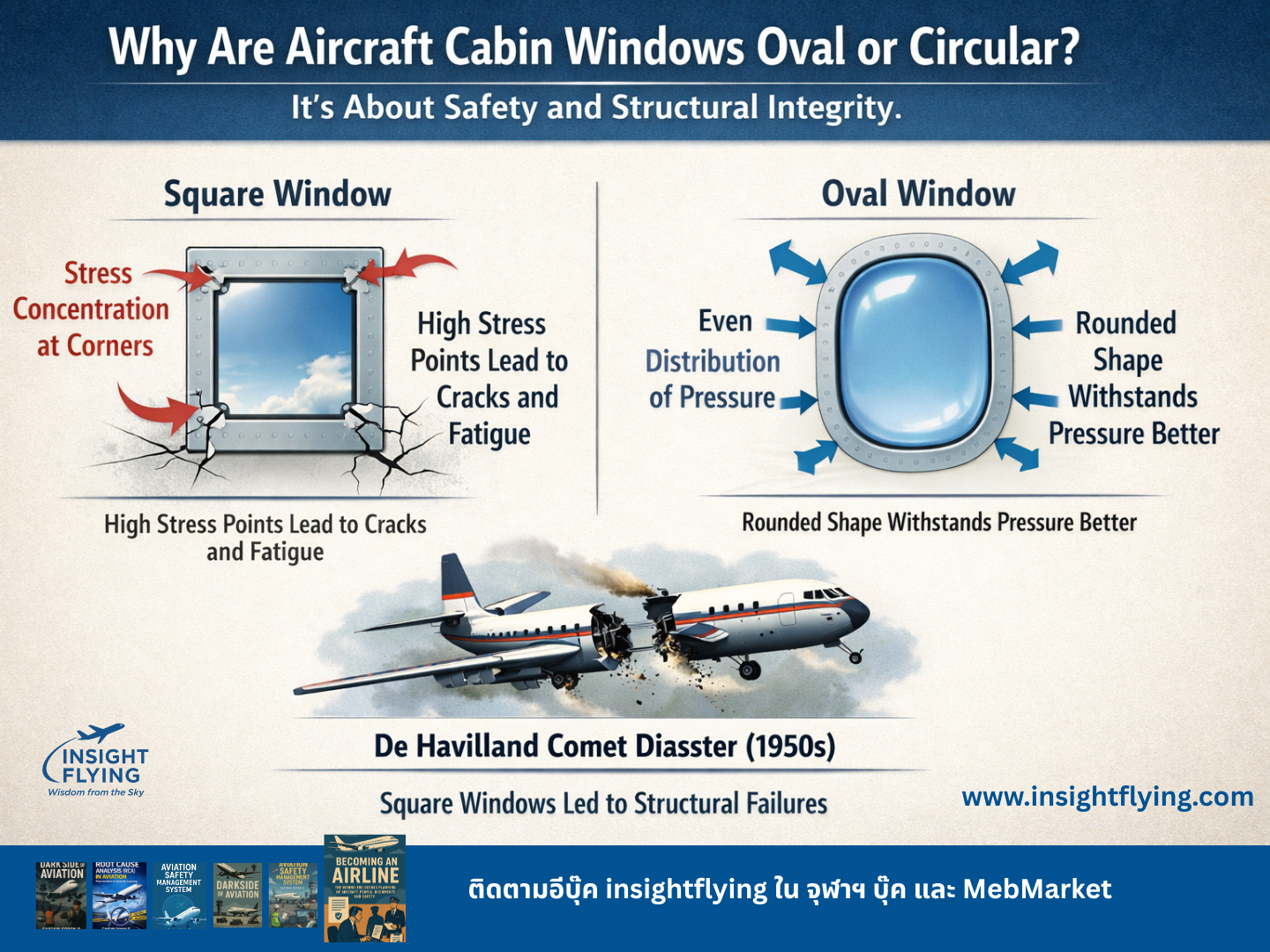
คำถามนี้เป็นคำถามคลาสสิกของงานออกแบบอากาศยาน และคำตอบไม่ได้เป็นเรื่อง “ความสวยงาม” แต่เป็นเรื่อง โครงสร้าง ความดัน และความปลอดภัยโดยตรง
ผมขออธิบายเป็นลำดับเหตุผลครับ
#ENGRead in ENGLISH click here
1. ความดันในห้องโดยสารคือศัตรูหลักของหน้าต่าง
ขณะบินที่ระดับความสูงประมาณ 35,000 ฟุต
ความดันอากาศภายนอกต่ำมาก
แต่ภายในห้องโดยสารถูกอัดความดันไว้ใกล้เคียงระดับ 6,000–8,000 ฟุต
ผลคือ
ผนังลำตัวเครื่องบินถูกดันออกจากด้านในตลอดเวลา
หน้าต่างคือ “ช่องโหว่” ทางโครงสร้างที่อ่อนแอที่สุดจุดหนึ่ง
2. ปัญหาของมุมแหลม: จุดรวมความเค้น (Stress Concentration)
ถ้าหน้าต่างเป็นทรงสี่เหลี่ยม
จะเกิดปัญหาทันทีที่ มุม
ที่มุมของรูปทรงเหลี่ยม:
- แรงดันจะไปรวมตัว
- ความเค้นกระจุกอยู่ที่จุดเล็ก ๆ
- วัสดุจะเริ่มเกิดรอยร้าวจากมุมก่อน
ในงานวิศวกรรม เรียกว่า
Stress Concentration
ยิ่งเป็นความดันแบบขึ้น–ลงซ้ำ ๆ ทุกเที่ยวบิน (Pressurization Cycle)
รอยร้าวจะค่อย ๆ โตขึ้นโดยที่มองไม่เห็นด้วยตาเปล่า
3. บทเรียนราคาแพง: De Havilland Comet
เครื่องบินเจ็ตโดยสารรุ่นแรกของโลกในยุค 1950
ใช้ หน้าต่างสี่เหลี่ยม
ผลลัพธ์คือ:
- เครื่องแตกกลางอากาศหลายลำ
- การสอบสวนพบว่า
รอยร้าวเริ่มจาก มุมหน้าต่าง - นำไปสู่การเปลี่ยนมาตรฐานการออกแบบทั้งอุตสาหกรรม
หลังจากนั้น
ไม่มีเครื่องบินโดยสารแบบกดดันห้องโดยสารลำใดใช้หน้าต่างเหลี่ยมอีกเลย
4. ทำไมต้อง “วงกลม” หรือ “วงรี”
4.1 วงกลม
- ไม่มีมุม
- แรงดันกระจายเท่ากันทุกทิศ
- เป็นรูปทรงที่ดีที่สุดทางโครงสร้าง
4.2 วงรี (หรือสี่เหลี่ยมมน)
- ประนีประนอมระหว่างโครงสร้างกับการใช้งาน
- ให้มุมมองกว้างขึ้น
- ยังคงไม่มีจุดรวมความเค้นแบบมุมแหลม
จริง ๆ แล้วหน้าต่างเครื่องบินส่วนใหญ่คือ
วงรีที่ออกแบบให้ใกล้วงกลมมากที่สุดเท่าที่การใช้งานจะยอมรับได้
5. หน้าต่างไม่ได้มีแผ่นเดียว
เพื่อเสริมความปลอดภัย:
- มีหลายชั้น (Panes)
- แผ่นด้านในสุดไม่ได้รับความดัน
- ความดันหลักรับโดยแผ่นกลาง
- ถ้ามีรอยร้าว ยังไม่ทำให้ความดันหายทันที
ทั้งหมดนี้ทำงานร่วมกับรูปทรงโค้ง

|
|
Why Are Aircraft Cabin Windows Oval or Circular?
This question touches the core of aircraft structural design. The answer has nothing to do with aesthetics and everything to do with pressurization, structural integrity, and safety.
1. Cabin Pressurization Is the Primary Challenge
At typical cruise altitudes of around 35,000 feet, outside air pressure is extremely low.
Inside the cabin, pressure is maintained at the equivalent of approximately 6,000–8,000 feet.
This creates a continuous outward force on the fuselage.
Any opening in the fuselage—especially windows—represents a potential structural weakness.
2. The Problem with Sharp Corners: Stress Concentration
If cabin windows were square or rectangular, a serious structural issue would arise at the corners.
At sharp corners:
- Loads concentrate instead of spreading evenly
- Stress accumulates at very small areas
- Cracks tend to initiate at those points
In engineering terms, this is known as stress concentration.
Because pressurization occurs on every flight (pressurization and depressurization cycles), even microscopic cracks can grow progressively over time, eventually leading to structural failure.
3. A Hard-Learned Lesson: The De Havilland Comet
The world’s first commercial jet airliner, introduced in the 1950s, used square windows.
The result:
- Several catastrophic mid-air breakups
- Accident investigations revealed that cracks initiated at the window corners
- Repeated pressurization cycles caused metal fatigue and eventual failure
This tragedy fundamentally changed aircraft structural design.
Since then, no pressurized commercial airliner has used square windows.
4. Why Circular or Oval Shapes Work
4.1 Circular Windows
- No corners
- Uniform stress distribution
- Structurally the most efficient shape
4.2 Oval (or Rounded-Rectangle) Windows
- A practical compromise between structure and usability
- Provide a wider field of view for passengers
- Still avoid sharp stress-concentrating corners
In practice, most aircraft windows are oval shapes engineered to behave structurally like circles.
5. Windows Are Not Single Panels
Aircraft windows are designed with multiple layers:
- Typically two or three panes
- The outer or middle pane carries the pressure load
- The inner pane is primarily for protection and insulation
This layered design, combined with rounded geometry, ensures redundancy and gradual failure rather than sudden decompression.
6. Pilot’s Summary
Aircraft windows are oval or circular because pressurized cabins cannot tolerate sharp corners.
This design standard exists because aviation learned—at great cost—that structure, pressure, and fatigue must be treated with absolute respect.

|
|
|
หนังสือการบิน ทางลัดสู่ความเข้าใจที่นำไปใช้งานจริง

|
|

|
|


|
|
|
|

|
|
accident Airbus aircraft airline airmanship aviation Aviation SMS become a captain become a pilot Boeing captain Crisis Crisis Management diversion emergency engine fatigue flight safety flood go-around hydroplane Indigo interview judgement management motivation pilot pilot interview qualified pilot safety Safety Management System safety report self-knowledge SMS student pilot technology turbulence weather weather radar การจัดการภาวะวิกฤติ การบิน การสอบสัมภาษณ์ นักบิน ระบบบริหารความปลอดภัย สอบนักบิน
ขายดีที่สุด
|
|
|