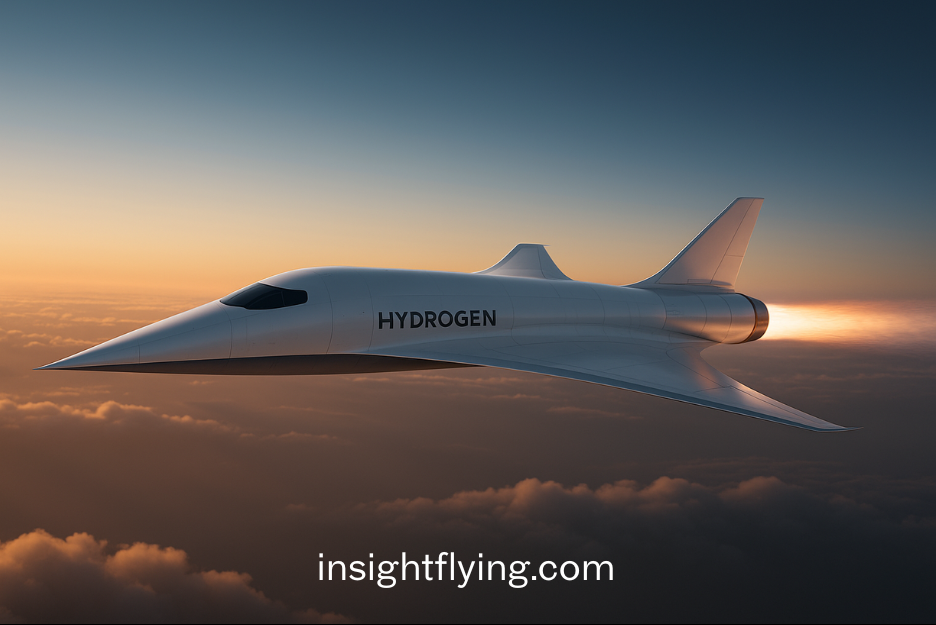
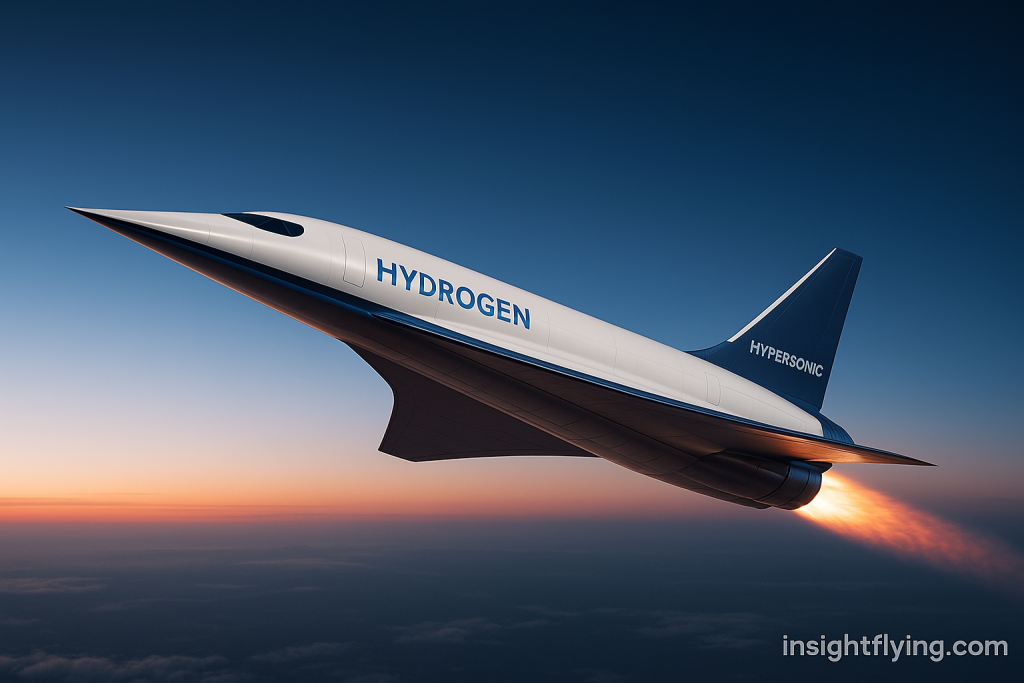
Supersonic and hypersonic flight represent the next great leap in aviation technology. While traditional supersonic jets, such as the Concorde, reached speeds of Mach 2, new research aims far beyond — toward aircraft capable of flying at Mach 12, or twelve times the speed of sound. That’s nearly 14,800 kilometers per hour, fast enough to travel from Bangkok to New York in less than an hour.
Supersonic: Faster than Mach 1 (the speed of sound, ~1,235 km/h at sea level).
Hypersonic: Generally defined as Mach 5 and above.
Mach 12 means approximately 14,800 km/h — extremely fast, in the high hypersonic regime.
🔥 Why Hydrogen?
ทำไมต้องเป็นไฮโดรเจน?
Hydrogen is emerging as the most promising fuel for high-speed flight. It offers the highest energy per unit mass of any chemical fuel, meaning it delivers tremendous thrust while keeping the aircraft light. Moreover, hydrogen can be used to cool the airframe and engine before combustion — a crucial factor when dealing with the extreme heat generated by hypersonic speeds. When it burns, it produces only water vapor, making it an environmentally friendly option for future aviation.
One of the most notable achievements in this field was NASA’s X-43A, an unmanned experimental aircraft that used a hydrogen-fueled scramjet engine to reach Mach 9.6 in 2004. Another example is DARPA’s HTV-2, designed to explore flight at up to Mach 20. Though the mission faced challenges, it demonstrated the potential of hypersonic travel.
Hydrogen-powered hypersonic flight could redefine global transportation — enabling intercontinental travel in under an hour, rapid response missions, and even reusable space vehicles. However, major challenges remain: the extreme heat at Mach 12 requires advanced materials, cryogenic fuel storage adds complexity, and safety and cost must be addressed before such technology becomes commercially viable.
From research labs to aerospace companies, the race toward hydrogen-fueled hypersonic flight is accelerating. Projects like Reaction Engines’ SABRE (UK) aim to create hybrid jet-rocket systems that could take off from runways and reach space. If successful, the next generation of aircraft might make the world truly smaller — connecting continents in minutes, sustainably powered by hydrogen.
To provide the best experiences, we use technologies like cookies to store and/or access device information. Consenting to these technologies will allow us to process data such as browsing behavior or unique IDs on this site. Not consenting or withdrawing consent, may adversely affect certain features and functions.
Functional
Always active
The technical storage or access is strictly necessary for the legitimate purpose of enabling the use of a specific service explicitly requested by the subscriber or user, or for the sole purpose of carrying out the transmission of a communication over an electronic communications network.
Preferences
The technical storage or access is necessary for the legitimate purpose of storing preferences that are not requested by the subscriber or user.
Statistics
The technical storage or access that is used exclusively for statistical purposes.The technical storage or access that is used exclusively for anonymous statistical purposes. Without a subpoena, voluntary compliance on the part of your Internet Service Provider, or additional records from a third party, information stored or retrieved for this purpose alone cannot usually be used to identify you.
Marketing
The technical storage or access is required to create user profiles to send advertising, or to track the user on a website or across several websites for similar marketing purposes.