

|
|
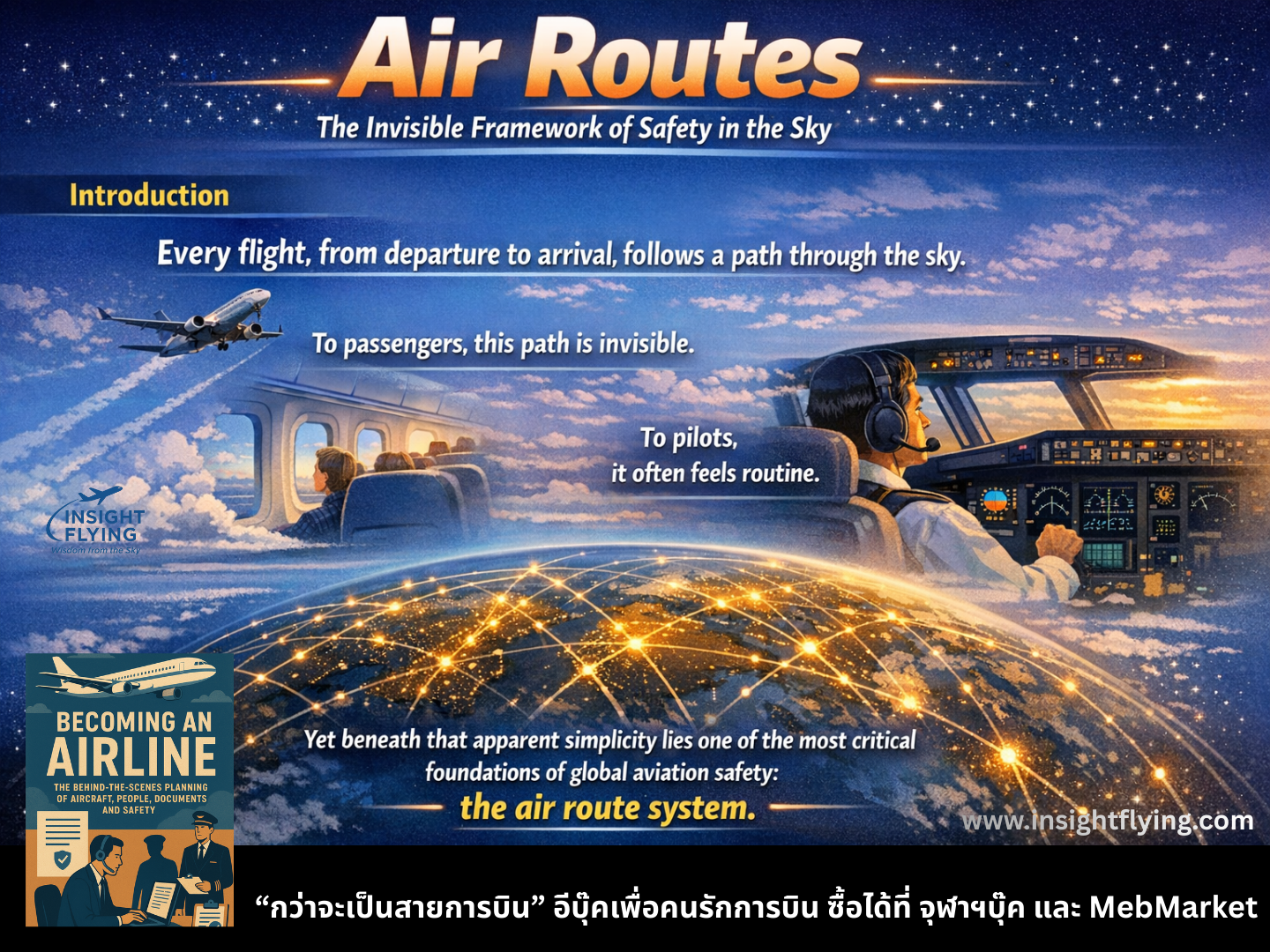
ทุกเที่ยวบินที่ขึ้นจากสนามบินหนึ่งไปยังอีกสนามบินหนึ่ง ล้วนต้อง “เดินทางผ่านเส้นทาง”
แม้ผู้โดยสารจะไม่เห็นมัน และนักบินจะไม่ได้รู้สึกถึงมันโดยตรง
เส้นทางบินไม่ใช่เพียงเส้นสมมุติบนแผนที่
แต่คือ โครงสร้างพื้นฐานของระบบการบินพลเรือนโลก
เป็นกลไกที่ทำให้เครื่องบินหลายหมื่นลำต่อวันสามารถบินร่วมกันในห้วงอากาศเดียวกันได้
โดยไม่ชนกัน ไม่สับสน และไม่ต้องพึ่งการแก้ปัญหาเฉพาะหน้าตลอดเวลา
บทนี้จะอธิบายว่า
- เส้นทางบินคืออะไร
- ถูกออกแบบบนหลักการใด
- มีโครงสร้างอย่างไร
- และเกี่ยวข้องกับกติกา ข้อตกลง และมนุษย์ในระบบการบินอย่างไร
1. เส้นทางบินคืออะไร และทำไมต้องมี
ในเชิงนิยาม
เส้นทางบิน (Air Route) คือแนวทางการบินที่ถูกกำหนดไว้ล่วงหน้าในห้วงอากาศ
เพื่อใช้เป็นกรอบให้เครื่องบินปฏิบัติการบินได้อย่างปลอดภัย เป็นระเบียบ และสามารถควบคุมได้
หากไม่มีเส้นทางบิน
- ATC ต้องควบคุมเครื่องบินแต่ละลำแบบ “เฉพาะราย”
- ความซับซ้อนจะเพิ่มขึ้นแบบทวีคูณ
- ความเสี่ยงจาก Human Error จะสูงขึ้นทันที
เส้นทางบินจึงเป็นเครื่องมือที่ทำให้
“ระบบสามารถทำงานได้ แม้มนุษย์จะไม่สมบูรณ์แบบ”
2. หลักการพื้นฐานของการออกแบบเส้นทางบิน
การออกแบบเส้นทางบินไม่ได้เริ่มจากคำถามว่า
“บินอย่างไรให้เร็วที่สุด”
แต่เริ่มจากคำถามว่า
“ทำอย่างไรให้เครื่องบินจำนวนมากบินร่วมกันได้อย่างปลอดภัยที่สุด”
2.1 Separation – หัวใจของความปลอดภัย
หลักการแรกคือ การแยกอากาศยาน (Separation)
เส้นทางบินช่วยให้การแยกเป็นไปอย่างมีระบบ ได้แก่
- การแยกในแนวราบ (Lateral Separation)
- การแยกในแนวดิ่ง (Vertical Separation)
- การแยกเชิงเวลา (Time-based Separation)
เส้นทางที่กำหนดไว้ล่วงหน้าทำให้ ATC สามารถ
- คาดการณ์ตำแหน่งเครื่องบิน
- วางแผนการแยกได้ล่วงหน้า
- ลดการแก้ปัญหาเฉพาะหน้า
2.2 Predictability – ระบบต้อง “คาดเดาได้”
ระบบจราจรทางอากาศพึ่งพา ความสามารถในการคาดการณ์ (Predictability)
มากกว่าความยืดหยุ่นแบบอิสระ
เมื่อทุกลำใช้เส้นทางเดียวกัน
- ATC รู้ว่าลำต่อไปจะมาจากไหน
- นักบินรู้ว่าจะเจออะไรล่วงหน้า
- ระบบสามารถคำนวณภาระงานได้
Predictability คือสิ่งที่ทำให้ระบบขนาดใหญ่ “ไม่ล้ม”
2.3 Efficiency – ประสิทธิภาพในภาพรวม
เส้นทางบินอาจไม่ใช่เส้นตรงที่สุด
แต่ถูกออกแบบให้เหมาะสมกับภาพรวมของระบบ เช่น
- ความจุของห้วงอากาศ
- ความสามารถของ ATC
- การไหลของการจราจรทางอากาศ
ประสิทธิภาพของเส้นทางบินจึงไม่ใช่เรื่องของเครื่องบินลำเดียว
แต่เป็นเรื่องของ ระบบทั้งหมด
3. โครงสร้างของเส้นทางบิน
เส้นทางบินไม่ได้มีเพียงเส้นเดียว แต่เป็นโครงข่าย
3.1 Airways แบบดั้งเดิม
ในอดีต เส้นทางบินถูกสร้างจาก
- VOR
- NDB
เครื่องบินบินจากสถานีหนึ่งไปยังอีกสถานีหนึ่ง
คล้ายการเดินทางจากหลักกิโลเมตรบนถนน
แม้ระบบนี้จะมีข้อจำกัด
แต่เป็นรากฐานของโครงสร้างที่ใช้มาจนถึงปัจจุบัน
3.2 RNAV และ ATS Routes
ปัจจุบัน เส้นทางบินจำนวนมากเป็น RNAV Routes
- ไม่ยึดติดกับสถานีภาคพื้น
- ใช้ Waypoints ที่กำหนดด้วยพิกัด
- รองรับ Performance-Based Navigation (PBN)
ผลที่ได้คือ
- ความยืดหยุ่นมากขึ้น
- เส้นทางสั้นลง
- การใช้ห้วงอากาศมีประสิทธิภาพสูงขึ้น
3.3 SIDs และ STARs: การเชื่อมต่อระบบ
เส้นทางบินไม่ได้เริ่มและจบกลางอากาศ
- SID (Standard Instrument Departure)
ทำหน้าที่เชื่อม Runway กับ En-route Structure - STAR (Standard Terminal Arrival Route)
เชื่อม En-route Structure เข้ากับ Terminal Area
SIDs และ STARs คือส่วนที่ทำให้ระบบ “ไหลต่อกัน”
ตั้งแต่ล้อเริ่มหมุนจนถึงล้อแตะพื้น
4. เส้นทางบินกับกติกาและข้อตกลงระหว่างประเทศ
4.1 บทบาทของ ICAO
เส้นทางบินอยู่ภายใต้กรอบของ ICAO โดยเฉพาะ
- Annex 2: Rules of the Air
- Annex 11: Air Traffic Services
- Annex 15: Aeronautical Information
ประเทศต่าง ๆ มีสิทธิออกแบบเส้นทางบินของตนเอง
แต่ต้องทำให้ เชื่อมต่อกันได้อย่างปลอดภัยข้าม FIR
4.2 FIR อธิปไตย และการเมืองการบิน
เส้นทางบินพาดผ่าน
- FIR
- เขตควบคุม
- เขตอธิปไตยของรัฐ
การเปิด ปิด หรือเปลี่ยนเส้นทางบิน
จึงไม่ใช่เรื่องเทคนิคอย่างเดียว
แต่เกี่ยวข้องกับ
- ความมั่นคง
- การทหาร
- การทูต
- เศรษฐกิจการบิน
5. มุมมองของนักบินต่อเส้นทางบิน
สำหรับนักบิน เส้นทางบินคือ
- กรอบการปฏิบัติ
- เครื่องมือช่วยลดภาระงาน
- โครงสร้างที่ทำให้การตัดสินใจง่ายขึ้น
นักบินมืออาชีพเข้าใจว่า
การบินตามเส้นทางไม่ได้ลดทอนทักษะ
แต่ช่วยให้ทักษะถูกใช้ในจุดที่สำคัญจริง ๆ
6. เส้นทางบินในอนาคต
แนวคิดสมัยใหม่กำลังเปลี่ยนจาก
- Fixed Routes → Flexible Airspace
- Static Structure → Trajectory-Based Operations
เชื่อมโยงกับ
- SWIM
- Flow Management
- Collaborative Decision Making (CDM)
แต่ไม่ว่าเทคโนโลยีจะพัฒนาไปไกลแค่ไหน
เส้นทางบินจะยังคงเป็นกระดูกสันหลังของระบบการบิน
เพียงแต่อาจ “ยืดหยุ่นและชาญฉลาด” มากขึ้น
บทสรุป
เส้นทางบินคือโครงสร้างที่ผู้โดยสารไม่เห็น
แต่นักบินและ ATC พึ่งพาทุกวินาที
มันคือผลลัพธ์ของ
- วิศวกรรม
- กฎระเบียบ
- ประสบการณ์
- และบทเรียนจากอุบัติเหตุในอดีต
การเข้าใจเส้นทางบิน
ไม่ใช่แค่เข้าใจ “ทางที่เครื่องบินบิน”
แต่คือการเข้าใจ ระบบความปลอดภัยทั้งระบบ
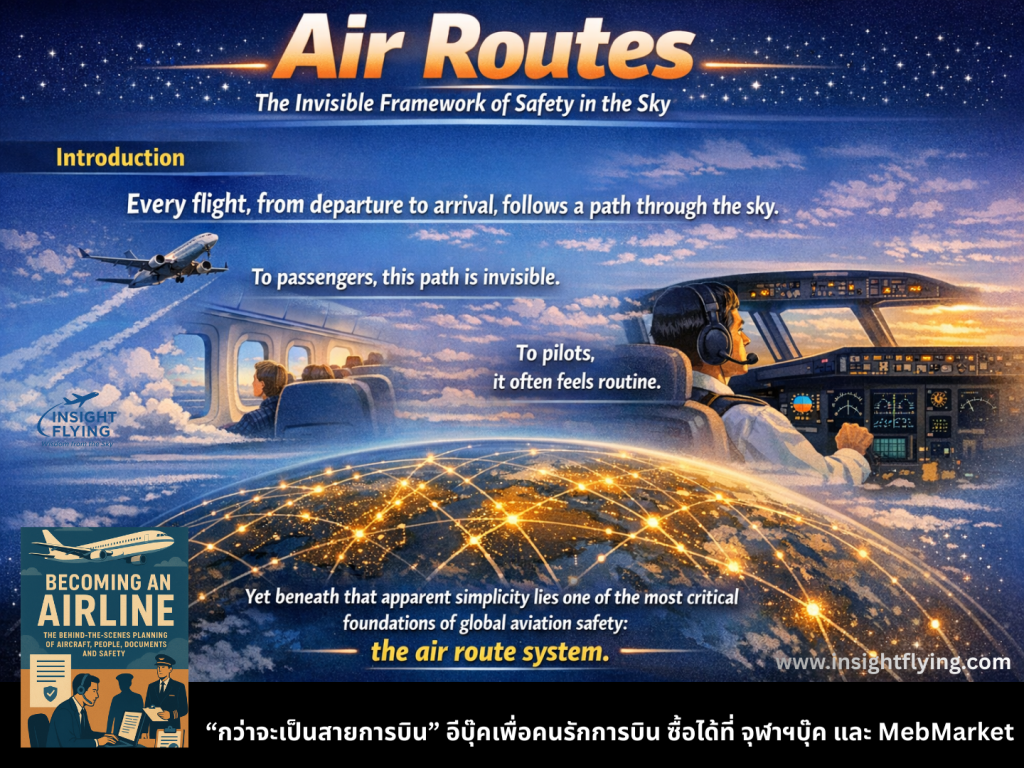
Air Routes: The Invisible Framework of Safety in the Sky
Introduction
Every flight, from departure to arrival, follows a path through the sky.
To passengers, this path is invisible.
To pilots, it often feels routine.
Yet beneath that apparent simplicity lies one of the most critical foundations of global aviation safety: the air route system.
Air routes are not arbitrary lines drawn on a chart. They are the result of decades of operational experience, engineering logic, regulatory discipline, and international coordination. Without them, modern air traffic as we know it would be impossible.
This chapter explains what air routes are, why they exist, how they are structured, and how they are governed—technically, operationally, and politically.
1. What Is an Air Route—and Why Does It Exist?
An air route is a predefined path through controlled airspace, established to allow aircraft to operate safely, orderly, and efficiently.
In practical terms, air routes serve the same function in the sky that highways serve on the ground:
- They organize traffic
- They enable separation
- They make large-scale movement predictable
Without air routes:
- Air traffic controllers would need to manage every aircraft individually
- System complexity would increase exponentially
- The probability of human error would rise sharply
Air routes exist not to restrict pilots, but to protect the system from chaos.
2. Fundamental Principles of Air Route Design
Air routes are not designed around convenience or fuel efficiency alone. Their primary objective is system safety.
2.1 Separation: The Core Safety Function
The most fundamental role of air routes is to support aircraft separation.
Separation may be achieved through:
- Lateral separation (horizontal distance)
- Vertical separation (altitude differences)
- Time-based separation (sequencing)
By channeling traffic along known paths, air routes allow controllers to:
- Anticipate conflicts
- Apply standard separation minima
- Reduce reliance on last-second tactical intervention
2.2 Predictability: A System Must Be Foreseeable
Air traffic management depends heavily on predictability.
When aircraft follow standardized routes:
- Controllers know where traffic will appear
- Pilots can anticipate constraints and clearances
- Traffic flow can be planned rather than improvised
In large, complex systems, predictability is often more valuable than maximum flexibility.
2.3 Efficiency at the System Level
While an individual aircraft might prefer a direct, shortest-distance track, air routes are designed for overall system efficiency, not individual optimization.
Design considerations include:
- Airspace capacity
- Controller workload
- Traffic flow balance
- Interaction with adjacent airspace sectors and FIRs
Efficiency in aviation is measured in system stability, not just minutes saved.
3. Structural Components of the Air Route System
Air routes are part of a layered, interconnected structure rather than isolated lines.
3.1 Conventional Airways
Historically, air routes were built around ground-based navigation aids such as:
- VOR (VHF Omnidirectional Range)
- NDB (Non-Directional Beacon)
Aircraft navigated from station to station, forming fixed corridors in the sky.
Although technologically limited, this structure established the fundamental concept of organized airspace.
3.2 RNAV and ATS Routes
Modern air routes increasingly rely on Area Navigation (RNAV) principles.
RNAV routes:
- Are not tied to ground stations
- Use waypoint-based coordinates
- Support Performance-Based Navigation (PBN)
This allows for:
- More direct routing
- Greater airspace flexibility
- Improved fuel efficiency and capacity management
3.3 SIDs and STARs: Connecting the Network
Air routes do not begin or end abruptly in cruise flight.
- Standard Instrument Departures (SIDs) connect runways to the en-route structure.
- Standard Terminal Arrival Routes (STARs) connect en-route airspace to terminal areas.
Together, they ensure continuity from takeoff roll to final approach, minimizing ambiguity and workload during high-density operations.
4. Governance, Standards, and International Agreements
4.1 ICAO and Global Standardization
Air routes operate within a global regulatory framework established by ICAO, particularly:
- Annex 2 — Rules of the Air
- Annex 11 — Air Traffic Services
- Annex 15 — Aeronautical Information Services
While each State designs and manages its own air routes, international consistency is essential for cross-border operations.
4.2 FIRs, Sovereignty, and Aviation Politics
Air routes pass through:
- Flight Information Regions (FIRs)
- Controlled and restricted airspace
- National sovereign airspace
As a result, changes to air routes often involve:
- National security considerations
- Military coordination
- Diplomatic negotiation
- Economic and strategic interests
Airspace design is therefore as much a policy decision as a technical one.
5. The Pilot’s Perspective
To pilots, air routes may appear as constraints:
- Assigned tracks
- Mandatory altitudes
- Standardized procedures
In reality, they are risk-reducing tools.
Well-designed routes:
- Reduce cockpit workload
- Improve situational awareness
- Allow pilots to focus on decision-making rather than navigation improvisation
Professional pilots understand that flying within a structured system enhances—not diminishes—operational freedom.
6. The Future of Air Routes
The aviation industry is moving toward concepts such as:
- Flexible airspace use
- Trajectory-Based Operations (TBO)
- System-Wide Information Management (SWIM)
- Flow and capacity management integration
The trend is shifting from:
- Fixed routes → adaptive trajectories
- Static structures → data-driven coordination
Yet even in this future, air routes will not disappear.
They will evolve into dynamic frameworks rather than rigid corridors.
Conclusion
Air routes are invisible to passengers but indispensable to safety.
They represent the collective experience of aviation—lessons learned from incidents, accidents, and operational challenges over decades. They embody engineering logic, regulatory discipline, and human factors understanding.
To understand air routes is to understand how aviation manages complexity, uncertainty, and risk—at a global scale.
accident Airbus aircraft airline airmanship aviation Aviation SMS become a captain become a pilot Boeing captain Crisis Crisis Management diversion emergency engine fatigue flight safety flood go-around hydroplane Indigo interview judgement management motivation pilot pilot interview qualified pilot safety Safety Management System safety report self-knowledge SMS student pilot technology turbulence weather weather radar การจัดการภาวะวิกฤติ การบิน การสอบสัมภาษณ์ นักบิน ระบบบริหารความปลอดภัย สอบนักบิน