
สถานการณ์ฉุกเฉินที่ต้องอพยพออกจากเครื่องบิน (Emergency Evacuation)
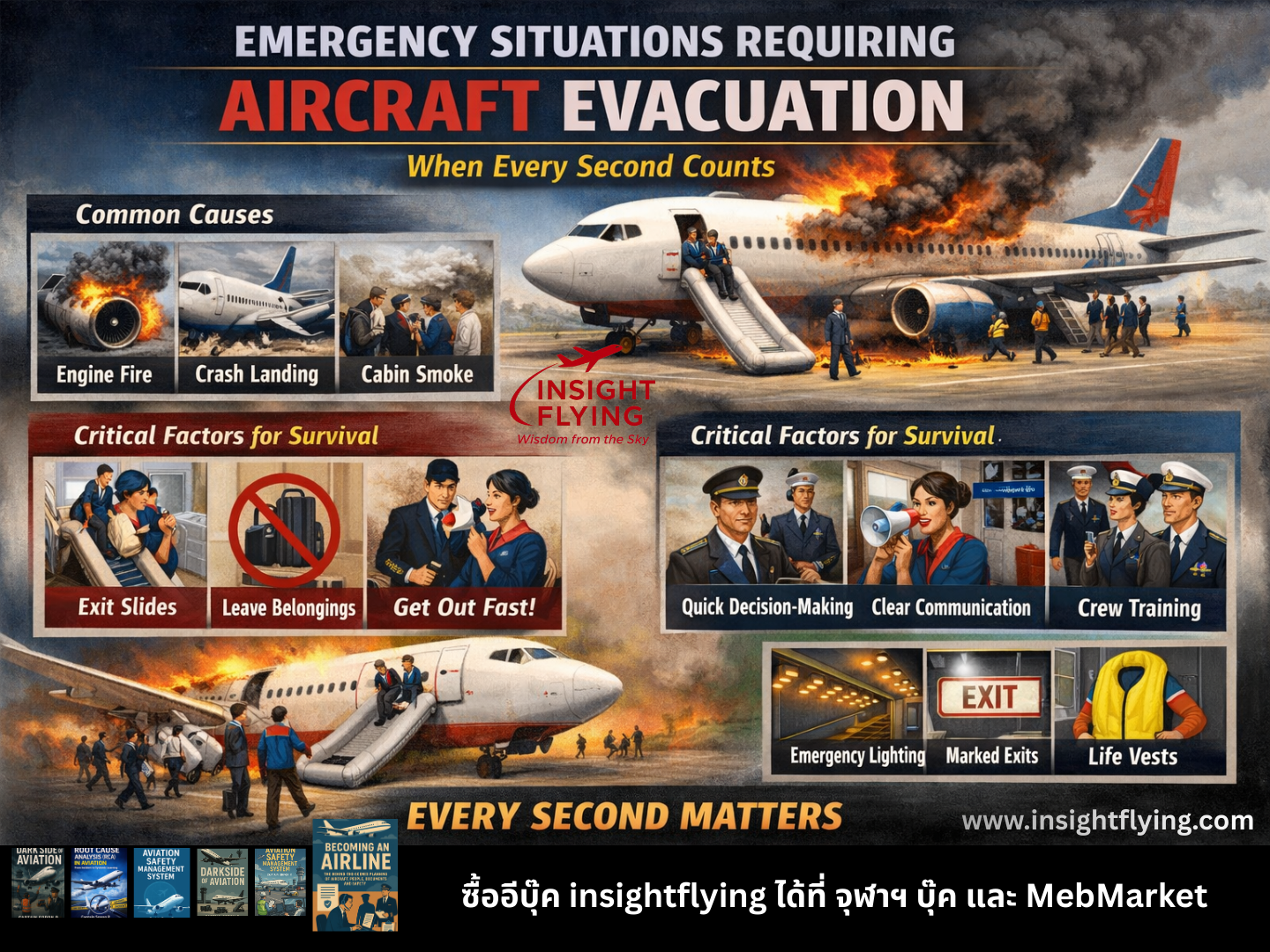
ในอุตสาหกรรมการบิน “การอพยพออกจากอากาศยาน” ถือเป็นหนึ่งในสถานการณ์ที่ร้ายแรงที่สุด แม้จะเกิดขึ้นไม่บ่อย แต่เมื่อเกิดขึ้นแล้ว เวลาทุกวินาทีมีค่าอย่างยิ่ง ความอยู่รอดของผู้โดยสารและลูกเรือไม่ได้ขึ้นอยู่กับเทคโนโลยีเพียงอย่างเดียว แต่ขึ้นอยู่กับ การตัดสินใจที่ถูกต้อง การสื่อสารที่ชัดเจน และระบบความปลอดภัยที่ถูกออกแบบมาเพื่อรองรับสถานการณ์เลวร้ายที่สุด
Read an ENGLISH version click here
สถานการณ์ที่อาจต้องทำการอพยพ
ตัวอย่างสถานการณ์ที่ต้องพิจารณาอพยพทันที ได้แก่
- ไฟไหม้เครื่องบินหรือควันในห้องโดยสาร
- อุบัติเหตุขณะขึ้น–ลงจอด (Rejected Takeoff, Runway Excursion)
- โครงสร้างเครื่องบินเสียหายอย่างรุนแรง
- การลงจอดฉุกเฉินและมีความเสี่ยงต่อไฟไหม้หรือการระเบิด
- สถานการณ์ที่กัปตันเห็นว่า “การอยู่บนเครื่องต่อไปมีความเสี่ยงมากกว่าการออกจากเครื่อง”
สิ่งสำคัญคือ ไม่ใช่ทุกเหตุฉุกเฉินต้องอพยพ แต่เมื่อมีคำสั่งอพยพแล้ว ต้องปฏิบัติทันทีโดยไม่มีความลังเล
การอพยพ (Evacuation)
ICAO และหน่วยงานกำกับดูแลกำหนดให้เครื่องบินพาณิชย์ต้องสามารถอพยพผู้โดยสารทั้งหมดออกจากเครื่องได้ภายใน 90 วินาที แม้จะใช้งานทางออกเพียงครึ่งหนึ่ง และในสภาพแสงสว่างจำกัด
การอพยพที่มีประสิทธิภาพประกอบด้วยองค์ประกอบหลัก 3 ประการ
- การตัดสินใจ (Decision)
กัปตันต้องตัดสินใจอย่างเด็ดขาด ไม่ช้าเกินไป และไม่เร็วเกินไป โดยอาศัยข้อมูลจากลูกเรือ ระบบแจ้งเตือน และสถานการณ์ภายนอก - การสื่อสาร (Communication)
คำสั่งอพยพต้องสั้น ชัดเจน และเป็นมาตรฐาน เช่น
“Evacuate, Evacuate”
ลูกเรือต้องใช้เสียง คำสั่ง และภาษากายเพื่อควบคุมการอพยพของผู้โดยสาร - การลำเลียงเคลื่อนย้ายของผู้โดยสาร (Passenger Flow)
ผู้โดยสารต้องเคลื่อนที่อย่างต่อเนื่อง ไม่หยุด ไม่ย้อนกลับ ไม่หยิบสัมภาระ ซึ่งเป็นสาเหตุสำคัญของการเสียชีวิตในหลายอุบัติเหตุที่ผ่านมา
สัญญาณในการอพยพ (Evacuation Signals)
สัญญาณที่ใช้ในการอพยพถูกออกแบบให้ทำงานได้แม้ในสภาพเลวร้าย เช่น ไฟดับ ควันหนา หรือความโกลาหล
1. สัญญาณจากลูกเรือ
- คำสั่งด้วยเสียง (Verbal Commands)
- ภาษากาย เช่น ชี้ทาง ผลักมือ กระตุ้นให้เคลื่อนที่
- เสียงนกหวีด (ในบางสายการบิน)
2. ระบบเสียงประกาศ (Passenger Announcement, PA System)
ใช้ประกาศคำสั่งอพยพทั้งจากห้องนักบินและห้องโดยสาร
3. สัญญาณแสง (Visual Aids)
รวมถึงไฟฉุกเฉิน ไฟป้าย EXIT และที่สำคัญที่สุดคือ ไฟนำทางระดับพื้น
ไฟนำทาง Floor Proximity Light / Floor Path Lighting System
หน้าที่ของระบบ
ไฟนำทางระดับพื้นมีหน้าที่ นำทางผู้โดยสารไปยังทางออกฉุกเฉินในกรณีที่มองไม่เห็นระดับสายตา เช่น มีควันหนา ซึ่งสถิติอุบัติเหตุแสดงชัดว่า ควันจะลอยขึ้นด้านบนก่อน ทำให้การมองเห็นในระดับต่ำยังพอใช้งานได้
ลักษณะการติดตั้ง
- ติดตั้งตามแนวทางเดินในห้องโดยสาร
- วางใกล้พื้นหรือระดับต่ำกว่าที่นั่ง
- นำไปสู่ประตู EXIT และ Overwing Exit
หลักการทำงานของการเรืองแสง
ระบบไฟนำทางมี 2 แนวคิดหลัก
1. ระบบไฟฟ้า (Electrically Powered)
- ใช้พลังงานจากระบบฉุกเฉินของเครื่องบิน
- เชื่อมกับ Emergency Lighting System
- ให้ความสว่างสม่ำเสมอและควบคุมได้
2. ระบบเรืองแสงด้วยตัวเอง (Photoluminescent)
- ไม่ต้องใช้ไฟฟ้า
- วัสดุจะดูดซับแสงจากไฟห้องโดยสารปกติ
- เมื่อไฟดับ วัสดุจะปล่อยแสงออกมาเอง
- มีความน่าเชื่อถือสูง เพราะไม่ขึ้นกับระบบไฟฟ้า
ระบบนี้จึงถูกออกแบบมาเพื่อรองรับกรณี “ไฟดับพร้อมกันทั้งลำ” ซึ่งเป็น Worst-case scenario
บทเรียนด้าน Human Factors
อุบัติเหตุจำนวนมากแสดงให้เห็นว่า
- ผู้โดยสารมักก้มมองพื้นโดยสัญชาตญาณเมื่ออยู่ในควัน
- ผู้ที่ทำตามไฟนำทางมีโอกาสรอดสูงกว่า
- ความลังเลเพียงไม่กี่วินาที อาจหมายถึงความสูญเสีย
ดังนั้น การบรีฟความปลอดภัยก่อนบิน แม้จะดูซ้ำซาก แต่มีผลจริงต่อพฤติกรรมในสถานการณ์ฉุกเฉิน
สรุป
การอพยพออกจากเครื่องบินไม่ใช่เรื่องของความตื่นตระหนก แต่เป็นผลลัพธ์ของ
- การออกแบบทางวิศวกรรม
- มาตรฐานความปลอดภัย
- การฝึกของลูกเรือ
- และการตัดสินใจของมนุษย์ภายใต้ความกดดัน
ไฟนำทางระดับพื้นอาจดูเป็นเพียงเส้นแสงเล็ก ๆ บนพื้นห้องโดยสาร แต่ในสถานการณ์ฉุกเฉิน มันคือ เส้นแบ่งระหว่างการรอดชีวิตกับความสูญเสีย


|
|
หนังสือการบิน ทางลัดสู่ความเข้าใจที่นำไปใช้งานจริง

|
|

|
|


|
|
|
|

|
|
accident Airbus aircraft airline airmanship aviation Aviation SMS become a captain become a pilot Boeing captain Crisis Crisis Management diversion emergency engine fatigue flight safety flood go-around hydroplane Indigo interview judgement management motivation pilot pilot interview qualified pilot safety Safety Management System safety report self-knowledge SMS student pilot technology turbulence weather weather radar การจัดการภาวะวิกฤติ การบิน การสอบสัมภาษณ์ นักบิน ระบบบริหารความปลอดภัย สอบนักบิน
ขายดีที่สุด
|
|
|

Emergency Situations Requiring Aircraft Evacuation
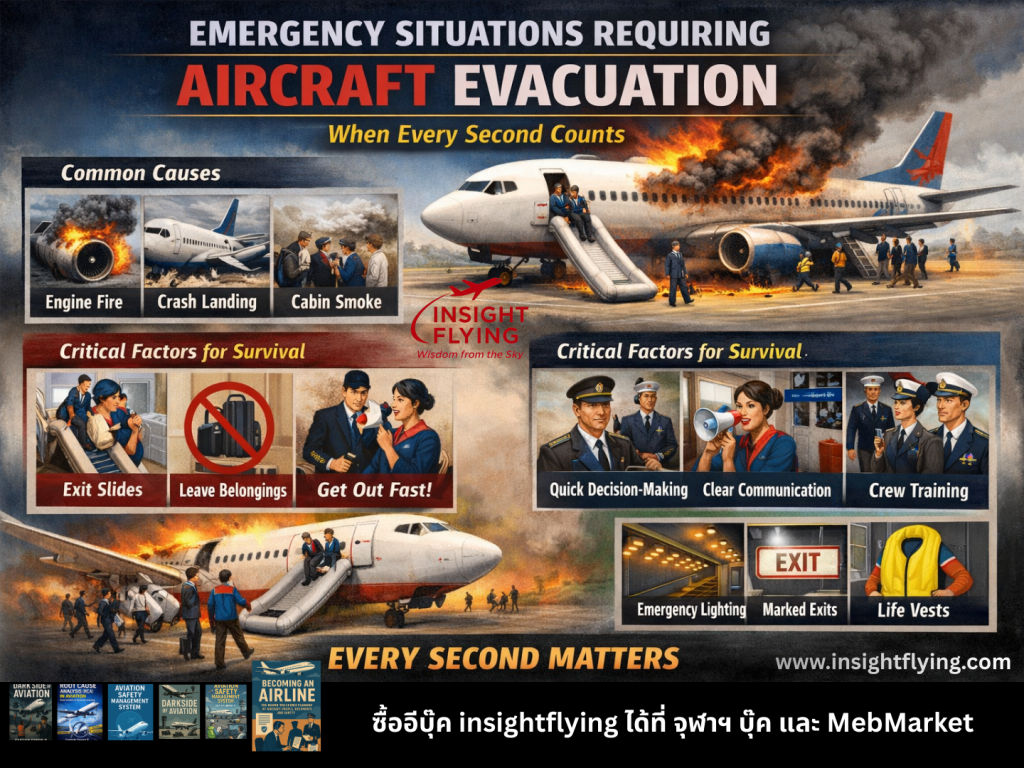
In aviation, aircraft evacuation represents one of the most critical emergency scenarios. Although evacuations are statistically rare, when they do occur, every second matters. Survival is not determined by technology alone, but by the quality of decision-making, clarity of communication, crew training, and the effectiveness of safety systems designed for worst-case scenarios.
An evacuation is never routine. It is an extraordinary event in which time pressure, limited visibility, noise, and human stress converge.
Situations That May Require Evacuation
An evacuation may be required both on the ground and, in some cases, following an emergency landing or ditching. Typical situations include:
- Fire or smoke in the cabin or cargo compartments
- Aborted takeoff or runway excursion
- Severe structural damage to the aircraft
- Emergency landing with a high risk of fire or explosion
- Any situation where the commander determines that remaining on board presents a greater risk than exiting the aircraft
It is essential to recognize that not every emergency requires evacuation. However, once the evacuation decision is made, it must be executed immediately and decisively.
Aircraft Evacuation
Regulatory authorities require that transport-category aircraft be capable of evacuating all occupants within 90 seconds, using only half of the available exits and under reduced lighting conditions.
An effective evacuation rests on three core elements:
1. Decision-Making
The captain must make a firm, timely decision—neither delayed nor premature—based on available system indications, crew reports, and external conditions.
2. Communication
Evacuation commands must be short, clear, and standardized, such as:
“Evacuate, Evacuate.”
Cabin crew then take control using loud verbal commands, assertive body language, and physical guidance to maintain continuous movement.
3. Passenger Flow
Passengers must move continuously toward the exits without stopping, turning back, or retrieving carry-on baggage. Historical accident data clearly shows that hesitation and baggage retrieval significantly increase fatalities.
Evacuation Signals
Evacuation signals are designed to function under the most adverse conditions, including power loss, dense smoke, and high stress.
1. Crew Commands
- Verbal commands
- Hand signals and physical guidance
- Whistles (used by some operators)
2. Public Address (PA) System
Used by both flight deck and cabin crew to issue evacuation instructions.
3. Visual Guidance Systems
These include emergency lighting, illuminated EXIT signs, and critically, floor-level escape path lighting.
Floor Proximity Lighting System (Escape Path Lighting)
Purpose of the System
Floor proximity lighting is designed to guide occupants to emergency exits when visibility at eye level is severely reduced, particularly in smoke-filled cabins.
Accident investigations consistently show that smoke accumulates first at higher levels, while lower-level visibility often remains usable. This makes floor-level guidance a vital survival feature.
Installation and Layout
- Installed along cabin aisles
- Positioned near floor level or seat tracks
- Clearly leads toward EXIT doors and overwing exits
The system provides a continuous visual path, even when overhead lighting is ineffective.
Principles of Illumination
Two primary technologies are used:
1. Electrically Powered Systems
- Supplied by the aircraft’s emergency electrical system
- Integrated with the emergency lighting system
- Provide consistent and controllable illumination
2. Photoluminescent Systems
- Do not require electrical power
- Absorb energy from normal cabin lighting
- Emit visible light when cabin lights fail
- Highly reliable due to independence from electrical systems
Photoluminescent materials are particularly valuable in total power-loss scenarios, representing a true worst-case design philosophy.
Human Factors Considerations
Human behavior during evacuations follows predictable patterns:
- Passengers instinctively move low when surrounded by smoke
- Individuals who follow floor lighting reach exits faster
- Even a few seconds of hesitation can be fatal
This is why the pre-flight safety briefing—often dismissed as repetitive—has a measurable and proven effect on passenger behavior during real emergencies.
Conclusion
Aircraft evacuation is not a matter of panic; it is the result of:
- Engineering design
- Regulatory standards
- Crew training
- Human decision-making under extreme pressure
Floor proximity lighting may appear insignificant under normal conditions, yet in an emergency, it becomes a critical visual lifeline—a thin line of light separating survival from catastrophe.
accident Airbus aircraft airline airmanship aviation Aviation SMS become a captain become a pilot Boeing captain Crisis Crisis Management diversion emergency engine fatigue flight safety flood go-around hydroplane Indigo interview judgement management motivation pilot pilot interview qualified pilot safety Safety Management System safety report self-knowledge SMS student pilot technology turbulence weather weather radar การจัดการภาวะวิกฤติ การบิน การสอบสัมภาษณ์ นักบิน ระบบบริหารความปลอดภัย สอบนักบิน