
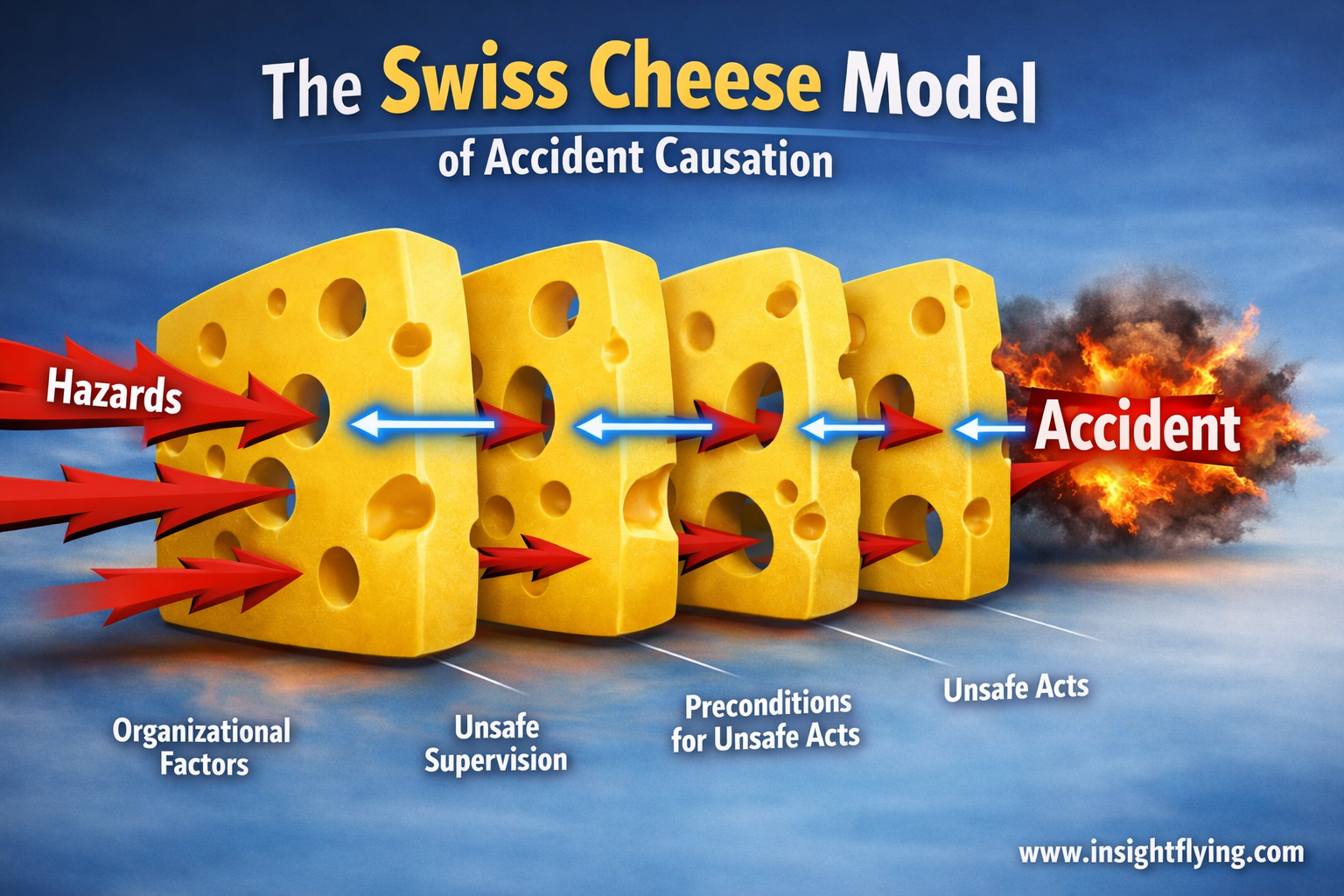
1. ที่มาและแนวคิดหลัก
Swiss Cheese Model ถูกพัฒนาโดยศาสตราจารย์ James Reason นักจิตวิทยาด้าน Human Factors เพื่ออธิบายกลไกการเกิดอุบัติเหตุในระบบที่ซับซ้อน เช่น การบิน พลังงานนิวเคลียร์ และการแพทย์
แนวคิดสำคัญคือ:
อุบัติเหตุไม่ได้เกิดจากความผิดพลาดเพียงครั้งเดียว แต่เกิดจากช่องโหว่หลายชั้นที่เรียงตัวตรงกัน
แต่ละ “แผ่นชีส” เปรียบเสมือน ชั้นป้องกัน (Defensive Layer) ของระบบ
ส่วน “รูในชีส” คือ จุดอ่อนหรือช่องโหว่ (Weaknesses / Holes)
เมื่อรูของแต่ละชั้นเรียงตัวตรงกัน อันตราย (Hazard) จะทะลุผ่านทุกแนวป้องกันและนำไปสู่อุบัติเหตุ
2. องค์ประกอบสำคัญของโมเดล
(1) Hazard
แหล่งอันตรายที่อาจก่อให้เกิดความเสียหาย เช่น สภาพอากาศเลวร้าย ระบบขัดข้อง ความซับซ้อนของภารกิจ
(2) Defensive Layers
มาตรการป้องกันหลายระดับ เช่น:
- กฎระเบียบและข้อบังคับ
- SOP และ Checklist
- ระบบฝึกอบรม
- การตรวจสอบและกำกับดูแล
- ระบบเทคนิคและ Automation
(3) Holes (ช่องโหว่)
ช่องโหว่มีสองประเภทหลัก:
- Active Failures
ความผิดพลาดที่เกิดขึ้นที่ระดับผู้ปฏิบัติงาน เช่น ละเลย checklist, misjudgment - Latent Conditions
จุดอ่อนที่ฝังอยู่ในระบบ เช่น นโยบายไม่ชัดเจน การฝึกอบรมไม่เพียงพอ วัฒนธรรมองค์กรอ่อนแอ
3. ความสำคัญในบริบทการบิน
Swiss Cheese Model เปลี่ยนมุมมองจาก:
“ใครทำผิด?”
ไปสู่
“ระบบมีจุดอ่อนตรงไหน?”
ในอุตสาหกรรมการบิน โมเดลนี้สนับสนุนแนวคิดว่า:
- อุบัติเหตุไม่ใช่ผลจาก Human Error เพียงอย่างเดียว
- Human Error มักเป็นอาการ (Symptom) ของปัญหาระดับระบบ
- การลงโทษบุคคลโดยไม่แก้ไขระบบ จะไม่ป้องกันอุบัติเหตุในอนาคต
แนวคิดนี้เป็นรากฐานสำคัญของ:
- Safety Management System (SMS)
- Just Culture
- Threat and Error Management (TEM)
4. ตัวอย่างเชิงปฏิบัติในการบิน
สมมติกรณี Runway Excursion:
ชั้นป้องกันที่ควรมี:
- การพยากรณ์อากาศและ NOTAM
- SOP ด้าน Unstable Approach
- CRM และ Cross-check
- ระบบแจ้งเตือนใน cockpit
แต่หากเกิดช่องโหว่ เช่น:
- การฝึกอบรมไม่เน้น Go-Around Decision
- วัฒนธรรมองค์กรไม่สนับสนุนการ Go-Around
- ความกดดันเรื่อง On-time Performance
- Crew fatigue
เมื่อช่องโหว่เหล่านี้เรียงตัวตรงกัน เหตุการณ์ก็อาจทะลุทุกชั้นป้องกันได้
5. จุดแข็งของโมเดล
- เข้าใจง่าย
- อธิบายอุบัติเหตุเชิงระบบได้ชัดเจน
- สนับสนุนแนวคิด Proactive Safety
- ใช้ได้ทั้งใน Accident Investigation และ Risk Assessment
6. ข้อจำกัดของโมเดล
แม้โมเดลนี้ทรงพลัง แต่ก็มีข้อจำกัด:
- มองระบบในลักษณะค่อนข้างเชิงเส้น (Linear)
- ไม่ได้อธิบายความซับซ้อนแบบ Dynamic Interaction มากนัก
- ปัจจุบันมีโมเดลที่พัฒนาต่อยอด เช่น FRAM (Functional Resonance Analysis Method)
อย่างไรก็ตาม Swiss Cheese Model ยังคงเป็นกรอบความคิดพื้นฐานที่ใช้แพร่หลายในอุตสาหกรรมการบินทั่วโลก
7. มุมมองเชิงผู้นำด้านความปลอดภัย
สำหรับผู้บริหารด้านการบิน ประเด็นสำคัญไม่ใช่การทำให้ “ไม่มีรูเลย”
เพราะระบบใด ๆ ย่อมมีความไม่สมบูรณ์
สิ่งสำคัญคือ:
- ลดขนาดของรู (ลดความเสี่ยง)
- ลดจำนวนรู (ปิดช่องโหว่)
- ป้องกันไม่ให้รูเรียงตัวตรงกัน (สร้าง redundancy และ monitoring)
นี่คือหัวใจของ Safety Leadership และระบบ SMS ที่มีวุฒิภาวะ
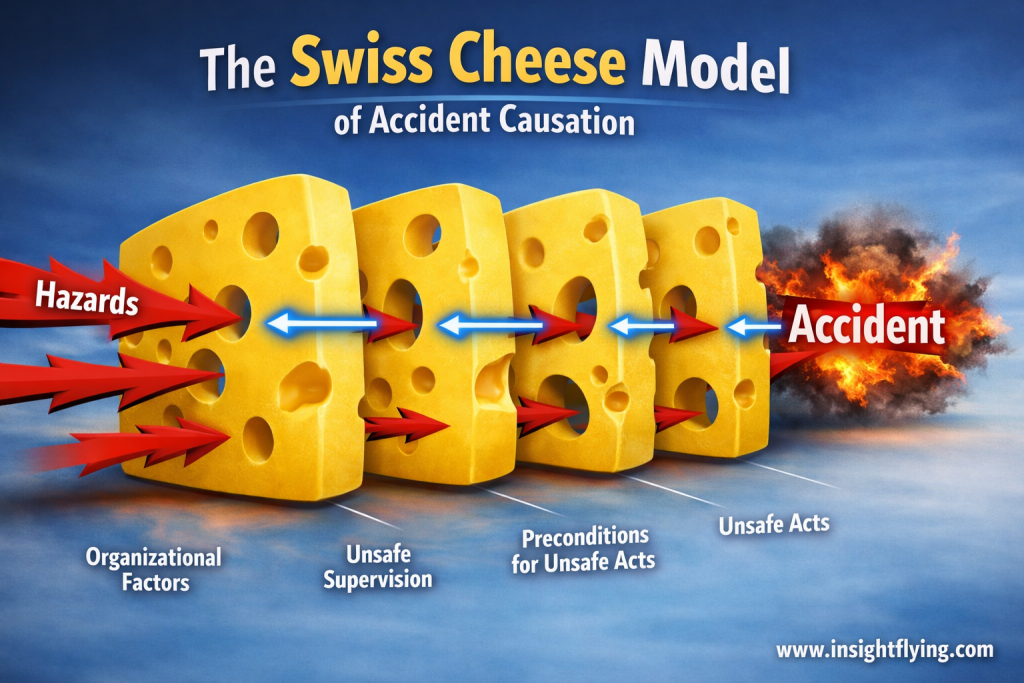
Swiss Cheese Model – James Reason
1. Origin and Core Concept
The Swiss Cheese Model was developed by Professor James Reason, a psychologist specializing in human factors, to explain how accidents occur in complex, high-risk systems such as aviation, healthcare, and nuclear power.
The central premise is:
Accidents are rarely caused by a single failure. They occur when multiple layers of defense are breached due to aligned weaknesses.
Each slice of “cheese” represents a defensive layer within the system.
The “holes” represent weaknesses or vulnerabilities.
When the holes in multiple layers momentarily align, a hazard can pass through all defenses, resulting in an accident.
2. Key Components of the Model
(1) Hazard
A potential source of harm, such as adverse weather, technical malfunction, operational complexity, or environmental stress.
(2) Defensive Layers
Multiple safeguards designed to prevent hazards from causing harm, including:
- Regulations and oversight
- Standard Operating Procedures (SOPs)
- Training systems
- Supervision and audits
- Technical systems and automation
- Organizational controls
(3) Holes (System Weaknesses)
These vulnerabilities fall into two primary categories:
Active Failures
Errors or unsafe acts committed by frontline operators.
Examples: incorrect switch selection, procedural deviation, misjudgment.
Latent Conditions
Hidden systemic weaknesses embedded within organizational structures or decisions.
Examples: inadequate training design, poor manpower planning, weak safety culture, ambiguous procedures.
Active failures are often the final trigger.
Latent conditions create the environment in which those failures become consequential.
3. Relevance to Aviation Safety
The Swiss Cheese Model shifted accident investigation from asking:
“Who made the mistake?”
to asking:
“What weaknesses in the system allowed this to happen?”
In aviation, this perspective reinforces several fundamental principles:
- Human error is often a symptom, not the root cause.
- Accidents emerge from systemic interactions, not isolated mistakes.
- Punishing individuals without correcting system deficiencies does not improve safety.
The model underpins modern safety frameworks such as:
- Safety Management Systems (SMS)
- Just Culture
- Threat and Error Management (TEM)
4. Practical Aviation Example
Consider a runway excursion scenario.
Potential defensive layers may include:
- Weather forecasting and NOTAM dissemination
- SOP criteria for unstable approach
- CRM and cross-check procedures
- Onboard alerting systems
However, holes may exist in these layers:
- Training does not strongly reinforce go-around decision-making
- Organizational culture subtly discourages go-arounds
- Commercial pressure for on-time performance
- Crew fatigue due to scheduling practices
If these weaknesses align, the aircraft may penetrate all defenses despite the existence of multiple safeguards.
5. Strengths of the Model
- Conceptually simple and intuitive
- Effective for explaining systemic accident causation
- Supports proactive safety management
- Widely applicable in investigation and risk assessment
6. Limitations of the Model
- Presents system behavior in a relatively linear manner
- Does not fully capture complex dynamic interactions
- More advanced systemic models (e.g., FRAM) offer deeper analysis of complexity
Nevertheless, the Swiss Cheese Model remains foundational in aviation safety thinking worldwide.
7. Strategic Insight for Safety Leadership
The objective is not to eliminate all holes — no system is perfect.
Instead, effective safety leadership aims to:
- Reduce the size of the holes (mitigate risk severity)
- Reduce the number of holes (strengthen system design)
- Prevent alignment of holes (introduce redundancy and monitoring)
This is the essence of mature safety governance and robust SMS implementation.
หนังสือ A Pilot Books ในรูปแบบ eBook ที่ MebMarket
สร้างแรงบันดาลใจ…..เริ่มเมื่อไหร่


|
|
|
|

|
|
|
|


|
|
A350 accident Airbus aircraft airline airmanship attitude aviation Aviation SMS become a captain become a pilot Boeing captain Crisis Crisis Management emergency engine ERP fatigue flight safety flood FRMS go-around Indigo interview judgement life jacket management pilot pilot interview qualified pilot safety Safety Management System self-knowledge SMS student pilot technology turbulence weather การจัดการความปลอดภัย การบิน การสอบสัมภาษณ์ นักบิน ระบบบริหารความปลอดภัย สอบนักบิน