
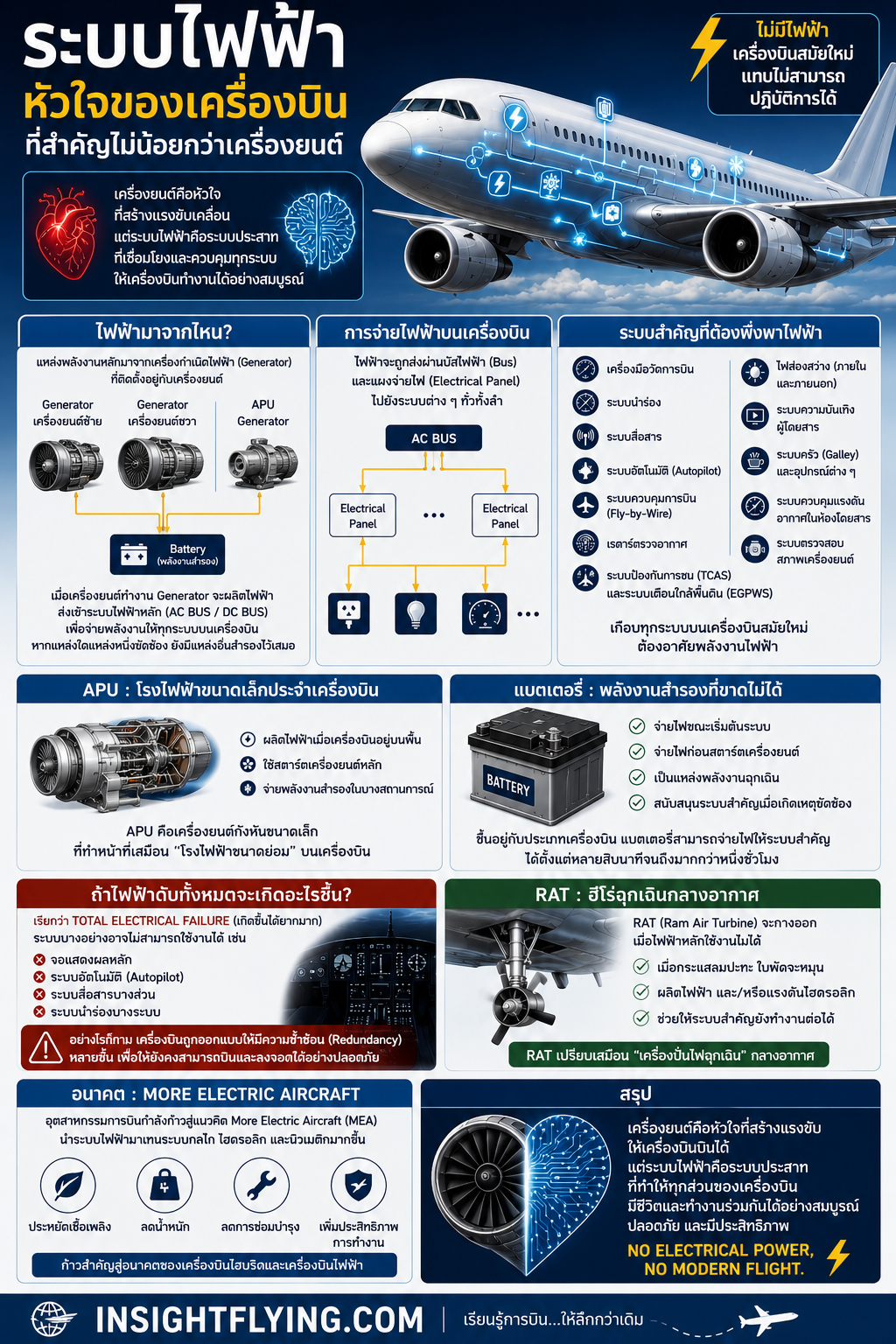
เมื่อพูดถึงเครื่องบิน คนส่วนใหญ่มักนึกถึงเครื่องยนต์ขนาดใหญ่ที่สร้างแรงขับมหาศาลพาเครื่องบินทะยานขึ้นสู่ท้องฟ้า แต่ในความเป็นจริงแล้ว ยังมีอีกระบบหนึ่งที่มีความสำคัญอย่างยิ่งต่อการบิน นั่นคือ ระบบไฟฟ้า (Aircraft Electrical System)
หากเปรียบเครื่องยนต์เป็น “หัวใจ” ที่สูบฉีดพลังงานให้เครื่องบินเคลื่อนที่ ระบบไฟฟ้าก็เปรียบเสมือน “ระบบประสาท” ที่เชื่อมโยงและควบคุมการทำงานของทุกส่วนบนเครื่องบิน
ในเครื่องบินยุคใหม่ หากระบบไฟฟ้าขัดข้องอย่างรุนแรง ผลกระทบอาจรุนแรงจนทำให้เครื่องบินสูญเสียระบบสำคัญหลายอย่างพร้อมกัน แม้ว่าเครื่องยนต์จะยังทำงานอยู่ก็ตาม
ทำไมเครื่องบินจึงต้องมีระบบไฟฟ้า?
ไฟฟ้าถูกใช้ในเกือบทุกระบบของเครื่องบิน ไม่ว่าจะเป็น
- เครื่องมือวัดการบิน (Flight Instruments)
- ระบบนำร่อง (Navigation Systems)
- ระบบสื่อสาร (Communication Systems)
- ระบบอัตโนมัติ (Autopilot)
- ระบบควบคุมการบินแบบ Fly-by-Wire
- เรดาร์ตรวจอากาศ (Weather Radar)
- ระบบป้องกันการชน (TCAS)
- ระบบเตือนใกล้พื้นดิน (EGPWS)
- ระบบไฟส่องสว่างทั้งภายในและภายนอก
- ระบบความบันเทิงผู้โดยสาร
- ระบบครัว (Galley)
- ระบบควบคุมแรงดันอากาศในห้องโดยสาร
- ระบบตรวจสอบสภาพเครื่องยนต์
กล่าวได้ว่า เครื่องบินสมัยใหม่แทบทุกระบบต้องพึ่งพาพลังงานไฟฟ้า
ไฟฟ้ามาจากไหน?
หลายคนเข้าใจผิดว่าเครื่องบินใช้แบตเตอรี่เป็นแหล่งพลังงานหลัก
ความจริงแล้ว แบตเตอรี่เป็นเพียงแหล่งพลังงานสำรองเท่านั้น
แหล่งผลิตไฟฟ้าหลักมาจากเครื่องกำเนิดไฟฟ้า (Generator) ที่ติดตั้งอยู่กับเครื่องยนต์
เมื่อเครื่องยนต์หมุน
- Generator จะผลิตกระแสไฟฟ้า
- ส่งไปยังระบบไฟฟ้าหลัก
- จ่ายพลังงานให้ทุกระบบบนเครื่องบิน
เครื่องบินโดยสารขนาดใหญ่ส่วนมากจะมี Generator หลายตัวเพื่อเพิ่มความปลอดภัย
ตัวอย่างเช่น
เครื่องบินสองเครื่องยนต์
- Generator จากเครื่องยนต์ซ้าย
- Generator จากเครื่องยนต์ขวา
- APU Generator
- Battery Backup
จึงมีระบบสำรองหลายชั้นหากเกิดความขัดข้อง
APU ผู้ช่วยสำคัญด้านพลังงาน
หลายคนเคยได้ยินคำว่า APU หรือ Auxiliary Power Unit
APU คือเครื่องยนต์กังหันขนาดเล็กที่ติดตั้งอยู่บริเวณท้ายเครื่องบิน
หน้าที่สำคัญคือ
- ผลิตไฟฟ้าเมื่อเครื่องบินจอดอยู่บนพื้น
- ใช้สตาร์ตเครื่องยนต์หลัก
- เป็นแหล่งพลังงานสำรองในบางสถานการณ์
จึงถือเป็น “โรงไฟฟ้าขนาดเล็ก” ประจำเครื่องบิน
แบตเตอรี่มีไว้ทำอะไร?
แม้ Generator จะเป็นแหล่งพลังงานหลัก แต่เครื่องบินทุกลำยังคงต้องมีแบตเตอรี่
หน้าที่สำคัญได้แก่
- จ่ายไฟขณะเริ่มต้นระบบ
- จ่ายไฟก่อนสตาร์ตเครื่องยนต์
- เป็นแหล่งพลังงานฉุกเฉิน
- สนับสนุนระบบสำคัญเมื่อเกิดเหตุขัดข้อง
ในเครื่องบินสมัยใหม่ แบตเตอรี่อาจสามารถจ่ายไฟให้ระบบสำคัญได้ตั้งแต่หลายสิบนาทีจนถึงมากกว่าหนึ่งชั่วโมง ขึ้นอยู่กับประเภทเครื่องบิน
แล้วถ้าไฟฟ้าดับทั้งหมดจะเกิดอะไรขึ้น?
นักบินเรียกเหตุการณ์นี้ว่า
Total Electrical Failure
เป็นสถานการณ์ที่เกิดขึ้นได้ยากมาก เพราะระบบถูกออกแบบให้มีความซ้ำซ้อน (Redundancy) หลายชั้น
หากเกิดขึ้นจริง ระบบบางอย่างอาจไม่สามารถใช้งานได้ เช่น
- จอแสดงผลหลัก
- ระบบอัตโนมัติ
- ระบบสื่อสารบางส่วน
- ระบบนำร่องบางระบบ
อย่างไรก็ตาม เครื่องบินพาณิชย์สมัยใหม่ยังมีระบบฉุกเฉินเพิ่มเติม เช่น
RAT (Ram Air Turbine)
อุปกรณ์ขนาดเล็กคล้ายใบพัดที่สามารถกางออกจากลำตัวเครื่องบิน
เมื่อกระแสลมปะทะขณะบิน
RAT จะหมุนและผลิตพลังงาน
- ไฟฟ้า
- หรือแรงดันไฮดรอลิก
เพื่อให้ระบบสำคัญยังทำงานต่อได้
RAT เปรียบเสมือน “เครื่องปั่นไฟฉุกเฉินกลางอากาศ”
ยุคใหม่: More Electric Aircraft
อุตสาหกรรมการบินกำลังก้าวเข้าสู่แนวคิด
More Electric Aircraft (MEA)
ซึ่งนำระบบไฟฟ้ามาแทนระบบกลไกและระบบนิวเมติกแบบเดิมมากขึ้น
ตัวอย่างที่ชัดเจนคือ
Boeing 787 Dreamliner
ซึ่งใช้ระบบไฟฟ้าในหลายส่วนมากกว่าเครื่องบินรุ่นก่อนอย่างมาก
ข้อดีคือ
- ประหยัดเชื้อเพลิง
- ลดน้ำหนัก
- ลดการบำรุงรักษา
- เพิ่มประสิทธิภาพการทำงาน
และยังเป็นก้าวสำคัญสู่อนาคตของเครื่องบินไฟฟ้าและเครื่องบินไฮบริดในอนาคต
สรุป
แม้เครื่องยนต์จะเป็นผู้สร้างแรงขับให้เครื่องบินบินได้ แต่ระบบไฟฟ้าคือผู้ทำให้ระบบต่าง ๆ ของเครื่องบินสามารถทำงานได้อย่างสมบูรณ์
ตั้งแต่การสื่อสาร การนำร่อง การควบคุมการบิน ไปจนถึงระบบความปลอดภัยที่ช่วยปกป้องผู้โดยสารและลูกเรือ
ดังนั้นจึงไม่เกินจริงที่จะกล่าวว่า
“เครื่องยนต์คือหัวใจของเครื่องบิน แต่ระบบไฟฟ้าคือระบบประสาทที่ทำให้ทุกส่วนของเครื่องบินมีชีวิต”
และในโลกการบินยุคใหม่ ความสำคัญของระบบไฟฟ้าก็กำลังเพิ่มขึ้นอย่างต่อเนื่อง จนอาจกลายเป็นเทคโนโลยีหลักที่จะกำหนดอนาคตของการบินในศตวรรษต่อไป
InsightFlying.com
“Understanding Aviation Beyond the Sky” ✈️
Aircraft Electrical Systems: The Unsung Heart of Modern Aviation
When people think about airplanes, they usually picture powerful jet engines producing enormous thrust and carrying passengers across continents. While engines are undoubtedly essential, there is another system that is just as critical to modern flight: the aircraft electrical system.
If engines are the heart that provides power for movement, the electrical system is the nervous system that connects, monitors, and controls almost every function of the aircraft.
In today’s highly sophisticated aircraft, a major electrical failure can affect multiple critical systems simultaneously, even if the engines continue to operate normally.
Why Do Aircraft Need Electrical Power?
Electricity is used in nearly every aspect of modern aviation. Essential systems powered by electricity include:
- Flight instruments
- Navigation systems
- Communication systems
- Autopilot
- Fly-by-wire flight controls
- Weather radar
- Traffic Collision Avoidance System (TCAS)
- Enhanced Ground Proximity Warning System (EGPWS)
- Interior and exterior lighting
- Passenger entertainment systems
- Galley equipment
- Cabin pressurization controls
- Engine monitoring systems
In fact, modern airliners rely so heavily on electrical power that many functions would simply not be possible without it.
Where Does the Electricity Come From?
Many people assume that aircraft operate primarily on battery power. In reality, batteries serve mainly as backup power sources.
The primary source of electrical power comes from generators driven by the aircraft engines.
As the engines rotate, generators produce electricity that is distributed throughout the aircraft to power all onboard systems.
Most commercial aircraft are equipped with multiple generators for redundancy and safety.
For example, a twin-engine airliner typically has:
- A generator on the left engine
- A generator on the right engine
- An Auxiliary Power Unit (APU) generator
- Battery backup systems
This layered design ensures that electrical power remains available even if one component fails.
The APU: A Small Power Plant on Board
The Auxiliary Power Unit (APU) is a small gas turbine engine usually located in the tail section of the aircraft.
Although much smaller than the main engines, it plays several important roles:
- Producing electrical power while the aircraft is on the ground
- Providing pneumatic power for engine starts
- Serving as an additional power source during certain flight situations
For this reason, the APU is often described as a miniature power station built into the aircraft.
What Is the Role of the Battery?
Despite the presence of generators, every aircraft still requires batteries.
Aircraft batteries are used to:
- Power essential systems during startup
- Energize aircraft systems before engine start
- Provide emergency electrical power
- Support critical systems during abnormal situations
Depending on the aircraft type, batteries can provide power to essential equipment for several minutes or even longer until alternative power sources become available.
What Happens If All Electrical Power Is Lost?
A complete loss of electrical power, known as a Total Electrical Failure, is extremely rare because modern aircraft are designed with multiple layers of redundancy.
However, if such a situation were to occur, pilots could lose access to systems such as:
- Primary display screens
- Autopilot
- Certain communication systems
- Some navigation equipment
To mitigate this risk, many modern airliners are equipped with emergency backup systems.
RAT: The Emergency Lifesaver
One of the most remarkable backup systems is the Ram Air Turbine (RAT).
The RAT is a small propeller-like device that automatically deploys from the aircraft when normal electrical power is unavailable.
As air flows over the turbine, it spins and generates:
- Electrical power
- Hydraulic power
- Or both, depending on the aircraft design
This allows critical flight systems to continue operating even during severe electrical emergencies.
In simple terms, the RAT functions as an emergency airborne generator.
The Future: More Electric Aircraft
The aviation industry is increasingly moving toward the concept of the More Electric Aircraft (MEA).
This approach replaces traditional mechanical, hydraulic, and pneumatic systems with electrically powered alternatives wherever possible.
A notable example is the Boeing 787 Dreamliner, which relies far more heavily on electrical systems than previous generations of commercial aircraft.
The advantages include:
- Improved fuel efficiency
- Reduced aircraft weight
- Lower maintenance costs
- Greater operational efficiency
This trend also represents an important step toward future hybrid-electric and fully electric aircraft technologies.
Conclusion
While engines provide the thrust that keeps an aircraft moving through the sky, electrical systems enable the aircraft to function as a complete and safe transportation system.
From communication and navigation to flight controls and safety systems, electricity powers the technologies that modern aviation depends upon every day.
It is therefore not an exaggeration to say:
“The engines may be the heart of an aircraft, but the electrical system is its nervous system—the network that keeps every part alive and connected.”
As aviation technology continues to evolve, electrical systems will become even more important, shaping the future of flight for decades to come.
InsightFlying.com
Understanding Aviation Beyond the Sky
A350 accident Airbus aircraft airline airmanship Air Traffic Control airworthiness ATC aviation Aviation SMS B787 become a captain become a pilot Boeing captain CAT Crisis Crisis Management emergency engine fatigue flight safety go-around interview management pilot qualified pilot safety Safety Management System SMS student pilot swiss cheese TCAS technology training travel tips turbulence weather การจัดการความปลอดภัย การบิน การสอบสัมภาษณ์ ความปลอดภัย นักบิน สอบนักบิน