
ในอดีต นักบินต้องอาศัยแผนที่ เข็มทิศ และสถานีวิทยุภาคพื้นดินในการนำทาง แต่ปัจจุบันเครื่องบินส่วนใหญ่ทั่วโลกใช้ระบบดาวเทียมนำร่อง หรือ GPS (Global Positioning System) เป็นเครื่องมือหลักในการกำหนดตำแหน่ง ความเร็ว และเส้นทางบิน
GPS ช่วยให้เครื่องบินสามารถบินได้อย่างแม่นยำ ประหยัดเชื้อเพลิง และเพิ่มความปลอดภัยในการเดินทางทางอากาศ
แต่เทคโนโลยีที่มีประโยชน์อย่างมากนี้ กำลังเผชิญกับความท้าทายครั้งสำคัญจากสิ่งที่เรียกว่า “GPS Spoofing”
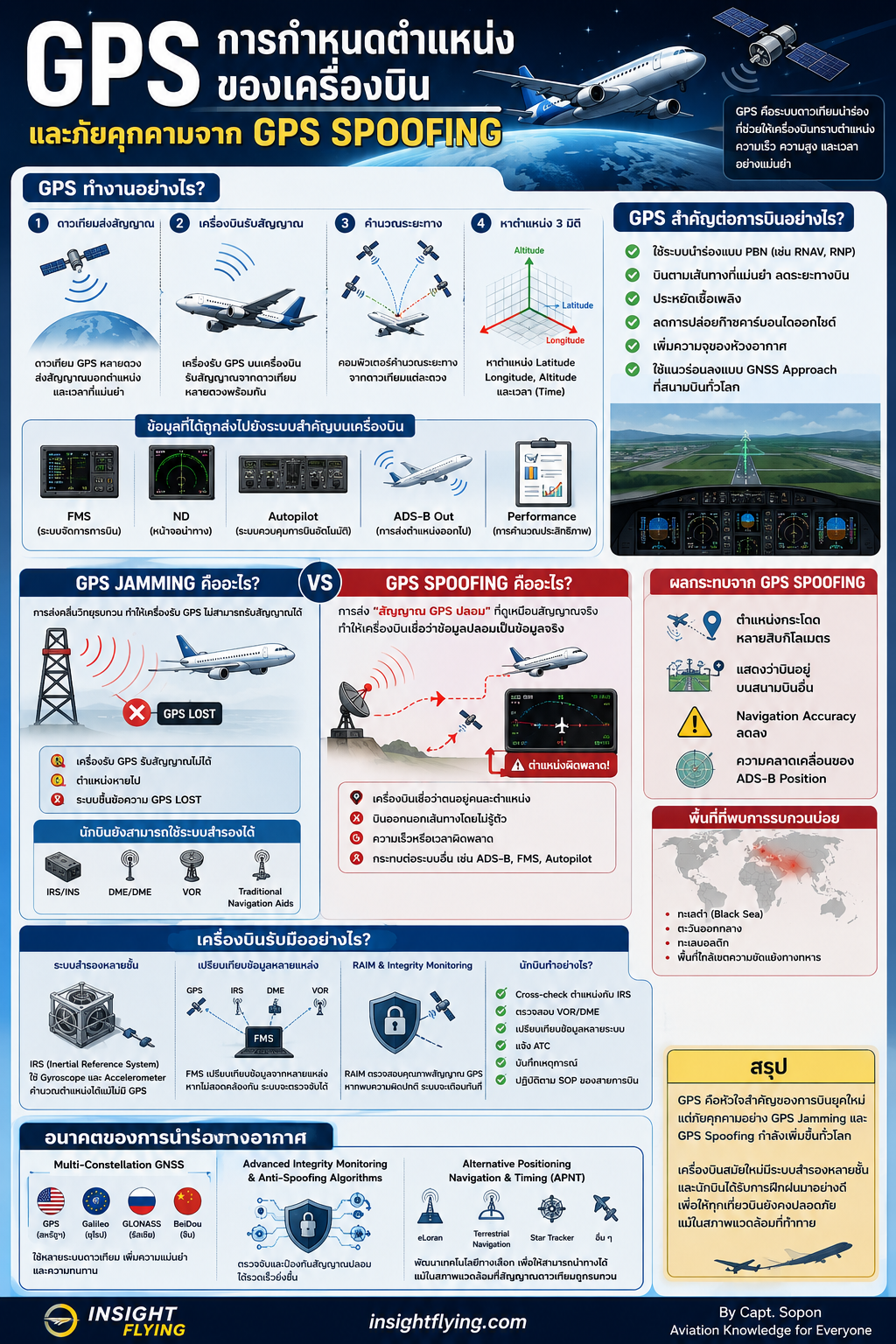
GPS ทำงานอย่างไร?
GPS เป็นระบบที่ใช้ดาวเทียมหลายดวงโคจรรอบโลก
หลักการทำงานมีดังนี้
- ดาวเทียมแต่ละดวงส่งสัญญาณบอกตำแหน่งและเวลาที่แม่นยำ
- เครื่องรับ GPS บนเครื่องบินรับสัญญาณจากดาวเทียมหลายดวงพร้อมกัน
- คอมพิวเตอร์คำนวณระยะทางจากดาวเทียมแต่ละดวง
- หาตำแหน่งสามมิติของเครื่องบิน
โดยทั่วไป เครื่องบินต้องรับสัญญาณจากดาวเทียมอย่างน้อย 4 ดวงเพื่อคำนวณ
- Latitude (ละติจูด)
- Longitude (ลองจิจูด)
- Altitude (ความสูง)
- Time (เวลา)
ข้อมูลเหล่านี้จะถูกส่งต่อไปยังระบบต่าง ๆ เช่น
- Flight Management System (FMS)
- Navigation Display (ND)
- Autopilot
- ADS-B Out
- Performance Calculation Systems
GPS สำคัญต่อการบินอย่างไร?
ปัจจุบันสายการบินทั่วโลกใช้ระบบนำร่องแบบ Performance-Based Navigation (PBN)
ซึ่งรวมถึง
- RNAV (Area Navigation)
- RNP (Required Navigation Performance)
ระบบเหล่านี้ช่วยให้เครื่องบิน
✅ บินตามเส้นทางที่แม่นยำกว่าเดิม
✅ ลดระยะทางบิน
✅ ลดการใช้น้ำมัน
✅ ลดการปล่อยก๊าซคาร์บอนไดออกไซด์
✅ เพิ่มความจุของห้วงอากาศ
สนามบินหลายแห่งทั่วโลกยังใช้แนวร่อนลงแบบ GNSS Approach ซึ่งอาศัย GPS เป็นหลักอีกด้วย
GPS Jamming คืออะไร?
ก่อนพูดถึง Spoofing ต้องเข้าใจคำว่า Jamming ก่อน
GPS Jamming คือการส่งคลื่นวิทยุรบกวน
ผลที่เกิดขึ้นคือ
- เครื่องรับ GPS รับสัญญาณไม่ได้
- ตำแหน่งหายไป
- ระบบขึ้นข้อความ GPS LOST
เปรียบเสมือนมีคนเปิดลำโพงเสียงดังจนเราไม่ได้ยินเสียงคนที่กำลังคุยด้วย
นักบินยังสามารถใช้ระบบสำรองอื่นได้ เช่น
- IRS / INS
- DME/DME
- VOR
- Traditional Navigation Aids
จึงมักไม่ก่อให้เกิดอันตรายโดยตรงหากได้รับการจัดการอย่างถูกต้อง
GPS Spoofing คืออะไร?
GPS Spoofing อันตรายกว่ามาก
แทนที่จะรบกวนสัญญาณ
ผู้โจมตีจะส่ง “สัญญาณ GPS ปลอม” ที่ดูเหมือนเป็นสัญญาณจริงจากดาวเทียม
เครื่องบินจึงเชื่อว่าข้อมูลปลอมเหล่านั้นเป็นข้อมูลจริง
เปรียบเหมือนมีคนสร้างป้ายบอกทางปลอมและหลอกให้ผู้ขับรถเข้าใจว่าตนอยู่คนละตำแหน่ง
ผลกระทบจาก GPS Spoofing
เมื่อเครื่องบินถูกหลอก
ระบบอาจแสดงว่า
- อยู่คนละตำแหน่ง
- บินออกนอกเส้นทาง
- เคลื่อนที่เร็วกว่าหรือช้ากว่าความจริง
- เวลาที่อ้างอิงจาก GPS ผิดพลาด
ในบางกรณีที่พบจริง
นักบินรายงานว่า
- เครื่องบินกระโดดตำแหน่งบนแผนที่หลายสิบกิโลเมตร
- แสดงว่าบินอยู่บนสนามบินอื่น
- ระบบเตือน Navigation Accuracy ลดลง
- เกิดความคลาดเคลื่อนของ ADS-B Position
พื้นที่ที่พบ GPS Spoofing บ่อย
ในช่วงหลายปีที่ผ่านมา มีรายงานการรบกวน GPS จำนวนมากบริเวณ
- ทะเลดำ (Black Sea)
- ตะวันออกกลาง
- ทะเลบอลติก
- พื้นที่ใกล้เขตความขัดแย้งทางทหาร
องค์กรการบินและหน่วยงานความปลอดภัยหลายแห่งได้ออกคำเตือนให้นักบินเฝ้าระวังปรากฏการณ์ดังกล่าว
เครื่องบินรับมืออย่างไร?
ข่าวดีคือ
เครื่องบินพาณิชย์สมัยใหม่ไม่ได้พึ่ง GPS เพียงอย่างเดียว
ยังมีระบบสำรองหลายชั้น เช่น
Inertial Reference System (IRS)
ระบบใช้
- Gyroscope
- Accelerometer
ในการคำนวณตำแหน่ง
แม้ไม่มี GPS ก็ยังสามารถนำทางได้เป็นเวลานาน
Multi-Sensor Navigation
FMS จะเปรียบเทียบข้อมูลจากหลายแหล่ง
- GPS
- IRS
- DME
- VOR
หากข้อมูลไม่สอดคล้องกัน
ระบบจะตรวจจับความผิดปกติได้
RAIM และ Integrity Monitoring
Receiver Autonomous Integrity Monitoring (RAIM)
เป็นระบบตรวจสอบคุณภาพสัญญาณ GPS
หากพบข้อมูลผิดปกติ
ระบบจะเตือนนักบินทันที
นักบินทำอย่างไรเมื่อสงสัยว่าเกิด GPS Spoofing?
โดยทั่วไปนักบินจะ
- Cross-check ตำแหน่งกับ IRS
- ตรวจสอบ VOR/DME
- เปรียบเทียบข้อมูลหลายระบบ
- แจ้ง Air Traffic Control
- บันทึกเหตุการณ์ใน Technical Log
- ปฏิบัติตาม SOP ของสายการบิน
การฝึกอบรมสมัยใหม่เริ่มเพิ่มสถานการณ์ GPS Interference เข้าไปในหลักสูตร Simulator มากขึ้นเรื่อย ๆ
อนาคตของการนำร่องทางอากาศ
อุตสาหกรรมการบินกำลังพัฒนาเทคโนโลยีใหม่เพื่อเพิ่มความทนทานต่อการโจมตี
เช่น
- Multi-Constellation GNSS
- GPS (สหรัฐฯ)
- Galileo (ยุโรป)
- GLONASS (รัสเซีย)
- BeiDou (จีน)
- Advanced Integrity Monitoring
- Anti-Spoofing Algorithms
- Alternative Positioning Navigation and Timing (APNT)
เป้าหมายคือทำให้เครื่องบินสามารถนำทางได้อย่างปลอดภัย แม้ในสภาพแวดล้อมที่สัญญาณดาวเทียมถูกรบกวน
บทสรุป
GPS ได้เปลี่ยนโลกการบินอย่างสิ้นเชิง ทำให้เครื่องบินสามารถบินได้อย่างแม่นยำ ปลอดภัย และมีประสิทธิภาพมากกว่าที่เคย
อย่างไรก็ตาม เทคโนโลยีนี้ไม่ได้ปราศจากความเสี่ยง
GPS Jamming และ GPS Spoofing กลายเป็นภัยคุกคามรูปแบบใหม่ที่อุตสาหกรรมการบินทั่วโลกกำลังเฝ้าระวังอย่างใกล้ชิด
โชคดีที่เครื่องบินพาณิชย์สมัยใหม่ได้รับการออกแบบให้มีระบบนำร่องสำรองหลายชั้น และนักบินได้รับการฝึกฝนให้สามารถรับมือกับสถานการณ์เหล่านี้ได้อย่างเหมาะสม
ดังนั้น แม้ GPS จะเป็น “ดวงตา” สำคัญของการบินยุคใหม่ แต่ความปลอดภัยยังคงขึ้นอยู่กับการตรวจสอบข้อมูลจากหลายแหล่ง และการตัดสินใจของมนุษย์ที่อยู่หลังแผงควบคุมเสมอ
Capt. Sopon Insights
InsightFlying.com – Aviation Knowledge for Everyone ✈️
A350 accident Airbus aircraft airline airmanship Air Traffic Control airworthiness ATC aviation Aviation SMS B787 become a captain become a pilot Boeing captain CAT Crisis Crisis Management emergency engine fatigue flight safety go-around interview management pilot qualified pilot safety Safety Management System SMS student pilot swiss cheese TCAS technology training travel tips turbulence weather การจัดการความปลอดภัย การบิน การสอบสัมภาษณ์ ความปลอดภัย นักบิน สอบนักบิน

GPS: The Eyes of Modern Aviation and the Growing Threat of GPS Spoofing
For decades, aircraft navigation relied on maps, compasses, and ground-based radio navigation aids. Today, most aircraft around the world depend heavily on the Global Positioning System (GPS) to determine their position, speed, and flight path with remarkable accuracy.
GPS has revolutionized aviation by enabling more efficient routes, reducing fuel consumption, and enhancing flight safety. However, this critical technology is facing an emerging threat known as GPS Spoofing—a form of electronic interference that can mislead aircraft navigation systems.
How Does GPS Work?
GPS consists of a constellation of satellites orbiting the Earth. Each satellite continuously broadcasts signals containing precise timing and position information.
An aircraft’s GPS receiver performs the following steps:
- Receives signals from multiple satellites.
- Measures the time it takes for each signal to arrive.
- Calculates the distance to each satellite.
- Determines the aircraft’s three-dimensional position.
To accurately calculate its location, the receiver typically needs signals from at least four satellites. This allows it to determine:
- Latitude
- Longitude
- Altitude
- Precise Time
This information is then used by various aircraft systems, including:
- Flight Management System (FMS)
- Navigation Displays (ND)
- Autopilot
- ADS-B Out
- Performance Management Systems
Why Is GPS Important for Aviation?
Modern aviation relies heavily on Performance-Based Navigation (PBN), including:
- RNAV (Area Navigation)
- RNP (Required Navigation Performance)
These technologies allow aircraft to:
- Fly more precise routes
- Reduce flight distances
- Save fuel
- Lower carbon emissions
- Increase airspace capacity
Many airports also utilize GNSS-based approach procedures, which depend on satellite navigation to guide aircraft during arrival and landing.
What Is GPS Jamming?
Before discussing spoofing, it is important to understand GPS Jamming.
GPS Jamming occurs when radio-frequency interference blocks GPS signals from reaching the aircraft receiver.
As a result:
- GPS position information becomes unavailable.
- Navigation accuracy decreases.
- Aircraft systems may display GPS LOST warnings.
A useful analogy is trying to hear a conversation in a room filled with loud noise—the message is still there, but it cannot be received clearly.
Fortunately, modern aircraft can continue navigating using backup systems such as:
- Inertial Reference Systems (IRS)
- DME/DME Navigation
- VOR Navigation
- Traditional Radio Navigation Aids
What Is GPS Spoofing?
GPS Spoofing is significantly more dangerous.
Instead of blocking GPS signals, a spoofer transmits counterfeit GPS signals that appear legitimate to the aircraft’s receiver.
The navigation system may then accept false position information as real.
Imagine following a road sign that has been deliberately placed in the wrong location. You may confidently believe you are on the correct route while actually heading somewhere else.
Potential Effects of GPS Spoofing
When GPS spoofing occurs, aircraft systems may display incorrect information such as:
- False aircraft position
- Incorrect track or heading
- Navigation errors
- Time synchronization issues
Pilots have reported cases where:
- Aircraft symbols suddenly jump on navigation displays.
- Aircraft appear to be located many miles away from their actual position.
- Navigation accuracy warnings are triggered.
- ADS-B position reports become inaccurate.
Regions with Frequent GPS Interference
In recent years, GPS interference events have been reported in several areas, including:
- The Black Sea Region
- The Eastern Mediterranean
- Parts of the Middle East
- The Baltic Region
- Areas near military conflicts
As geopolitical tensions increase, aviation authorities continue to monitor these incidents closely.
How Do Aircraft Defend Against GPS Spoofing?
Fortunately, modern commercial aircraft are designed with multiple layers of redundancy.
Inertial Reference Systems (IRS)
IRS uses:
- Gyroscopes
- Accelerometers
to calculate aircraft position independently of GPS signals.
Even if GPS becomes unavailable, the aircraft can continue navigating using inertial data.
Multi-Sensor Navigation
Modern Flight Management Systems compare information from multiple sources, including:
- GPS
- IRS
- DME
- VOR
When discrepancies occur, the system can detect abnormal behavior and alert the flight crew.
RAIM and Integrity Monitoring
Receiver Autonomous Integrity Monitoring (RAIM) continuously checks the quality and consistency of GPS signals.
If unreliable data is detected, the system warns pilots and may reject the affected navigation solution.
What Do Pilots Do When GPS Spoofing Is Suspected?
When pilots suspect GPS interference or spoofing, they typically:
- Cross-check positions using IRS data.
- Verify navigation using VOR and DME.
- Compare multiple navigation sources.
- Inform Air Traffic Control (ATC).
- Record the event in maintenance or operational reports.
- Follow airline Standard Operating Procedures (SOPs).
Today, many airlines incorporate GPS interference scenarios into simulator training programs to ensure crews are prepared for such events.
The Future of Aviation Navigation
The aviation industry is actively developing technologies to improve resilience against GPS interference.
These include:
Multi-Constellation GNSS
Using multiple satellite systems simultaneously:
- GPS (United States)
- Galileo (European Union)
- GLONASS (Russia)
- BeiDou (China)
Advanced Integrity Monitoring
More sophisticated methods for validating navigation signals and detecting anomalies.
Anti-Spoofing Technologies
Algorithms designed to identify and reject counterfeit satellite signals.
Alternative Positioning, Navigation, and Timing (APNT)
New navigation concepts that can provide reliable positioning even when satellite signals are unavailable.
Conclusion
GPS has transformed aviation by enabling precise, efficient, and safe navigation around the globe.
However, the growing challenges posed by GPS Jamming and GPS Spoofing remind us that no technology is completely immune to disruption.
The good news is that modern aircraft are equipped with multiple layers of backup systems, and pilots receive extensive training to manage these situations safely.
While GPS may be the eyes of modern aviation, flight safety ultimately depends on robust system design, operational procedures, and the judgment of the professionals in the cockpit.
Capt. Sopon Insights
Aviation Knowledge for Everyone