
ENG version click here
คนทั่วไปมักมองว่า “นักบินก็คือนักบิน” แต่ในความจริงแล้ว แนวคิด วิธีฝึก วัตถุประสงค์ และระดับความเสี่ยงของ “นักบินรบ” กับ “นักบินพาณิชย์” แตกต่างกันแทบจะคนละโลก
นักบินรบ vs นักบินพาณิชย์
เมื่อ “Mission” ที่ต่างกัน สร้างโลกการบินคนละแบบ
เครื่องบินอาจมีปีกเหมือนกัน
นักบินอาจเรียนหลักอากาศพลศาสตร์เหมือนกัน
แต่ “ภารกิจ” ของนักบินรบ และนักบินพาณิชย์นั้น แตกต่างกันอย่างสิ้นเชิง
และเมื่อ Mission ต่างกัน
วิธีคิดเรื่อง “ความเสี่ยง” ก็แตกต่างกันด้วย
นักบินรบ : Mission First
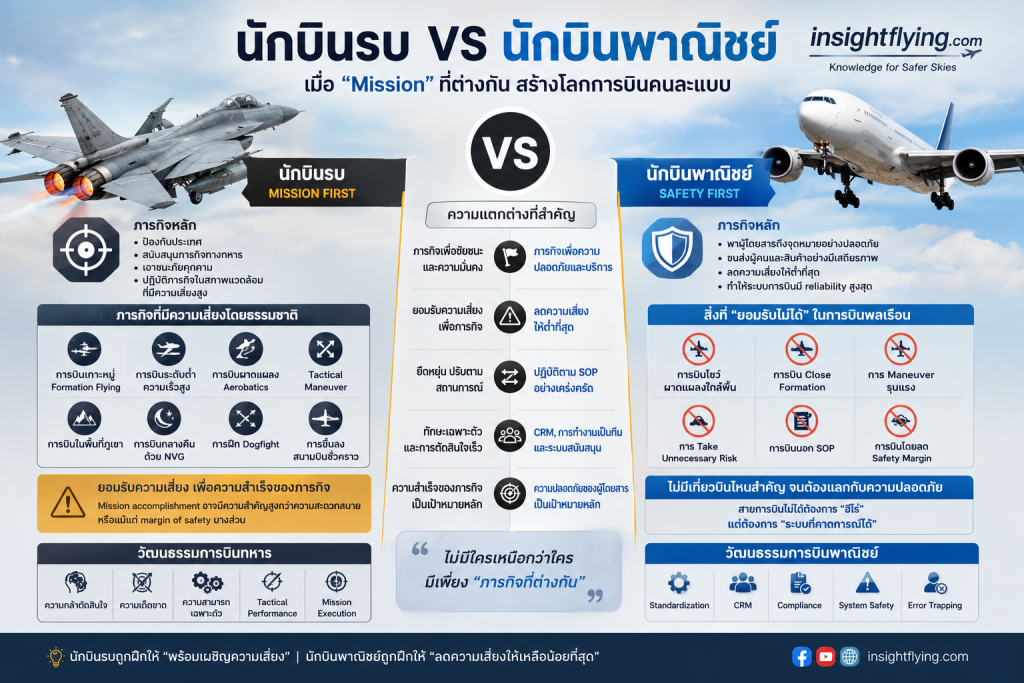
ภารกิจหลักของนักบินทหาร คือ
- ป้องกันประเทศ
- สนับสนุนภารกิจทางทหาร
- เอาชนะภัยคุกคาม
- ปฏิบัติภารกิจในสภาพแวดล้อมที่มีความเสี่ยงสูง
บางภารกิจถูกออกแบบมาให้ “ยอมรับความเสี่ยง” ตั้งแต่ต้น
เช่น
- การบินเกาะหมู่ (Formation Flying)
- การบินระดับต่ำความเร็วสูง
- การบินผาดแผลง (Aerobatics)
- การบิน Tactical Maneuver
- การบินในพื้นที่ภูเขา
- การบินกลางคืนด้วย NVG
- การฝึก Dogfight
- การขึ้นลงสนามบินชั่วคราว
ภารกิจเหล่านี้มีความเสี่ยงโดยธรรมชาติ
และบางครั้ง ความเสี่ยงนั้น “หลีกเลี่ยงไม่ได้” เพราะเป็นส่วนหนึ่งของการเตรียมพร้อมรบ
ในโลกการบินทหาร
Mission accomplishment อาจมีความสำคัญสูงกว่าความสะดวกสบาย หรือแม้แต่ margin of safety บางส่วน
นักบินพาณิชย์ : Safety First
ในทางกลับกัน
ภารกิจของนักบินพาณิชย์ คือ
- พาผู้โดยสารถึงจุดหมายอย่างปลอดภัย
- ขนส่งผู้คนและสินค้าอย่างมีเสถียรภาพ
- ลดความเสี่ยงให้ต่ำที่สุด
- ทำให้ระบบการบินมี reliability สูงสุด
โลกของการบินพาณิชย์ จึงถูกสร้างบนแนวคิดว่า
“ไม่มีเที่ยวบินไหนสำคัญ จนต้องแลกกับความปลอดภัย”
สิ่งที่การบินทหาร “ยอมรับได้”
หลายอย่างกลับ “ยอมรับไม่ได้เลย” ในการบินพลเรือน
เช่น
- การบินโชว์ผาดแผลงใกล้พื้น
- การบิน close formation กับผู้โดยสาร
- การ maneuver รุนแรง
- การ take unnecessary risk
- การบินนอก SOP
- การบินโดยลด safety margin
สายการบินไม่ได้ต้องการ “ฮีโร่”
แต่ต้องการ “ระบบที่คาดการณ์ได้”
อุบัติเหตุที่คนทั่วไปอาจไม่เข้าใจ
เมื่อเกิดอุบัติเหตุจากการบินโชว์
หรือเครื่องบินทหารตกขณะบินเกาะหมู่
คนทั่วไปอาจถามว่า
“ทำไมต้องบินเสี่ยงแบบนั้น?”
คำตอบคือ
เพราะภารกิจทางทหารบางประเภท จำเป็นต้องฝึกใน profile ที่มีความเสี่ยงสูง
นักบินรบไม่ได้ถูกฝึกให้ “หลีกเลี่ยงความเสี่ยงทั้งหมด”
แต่ถูกฝึกให้ “บริหารความเสี่ยงเพื่อทำภารกิจ”
ขณะที่นักบินพาณิชย์ ถูกฝึกให้
- หลีกเลี่ยงความเสี่ยง
- ลด exposure
- เพิ่ม redundancy
- ปฏิบัติตาม SOP อย่างเคร่งครัด
- ใช้ CRM และ Threat & Error Management ตลอดเวลา
นี่คือคนละ philosophy กันโดยพื้นฐาน
วัฒนธรรมที่ต่างกัน
วัฒนธรรมของการบินทหาร มักเน้น
- ความกล้าตัดสินใจ
- ความเด็ดขาด
- ความสามารถเฉพาะตัว
- Tactical performance
- Mission execution
ส่วนวัฒนธรรมการบินพาณิชย์ เน้น
- Standardization
- CRM
- Compliance
- Predictability
- System safety
- Error trapping
นักบินพาณิชย์ที่เก่ง
อาจไม่ใช่คนที่ “บินหวือหวา” ที่สุด
แต่คือคนที่ทำให้เที่ยวบิน “ธรรมดาที่สุด”
จนผู้โดยสารแทบไม่รู้เลยว่าเบื้องหลังมีการบริหารความเสี่ยงมหาศาลเกิดขึ้นตลอดเวลา
ไม่มีใครเหนือกว่าใคร
มีเพียง “ภารกิจที่ต่างกัน”
นักบินรบ และนักบินพาณิชย์
ต่างต้องใช้ทักษะ ความรู้ และวินัยในระดับสูงมาก
แต่โลกทั้งสองใบ ถูกสร้างขึ้นบน “เป้าหมาย” ที่ต่างกัน
ฝ่ายหนึ่งถูกฝึกให้พร้อมเผชิญความเสี่ยง
อีกฝ่ายถูกฝึกให้ลดความเสี่ยงให้เหลือน้อยที่สุด
และนี่คือเหตุผลว่า
ทำไมวิธีบิน วิธีคิด และวัฒนธรรมความปลอดภัยของทั้งสองโลก จึงแตกต่างกันอย่างสิ้นเชิง
Military Fighter Pilot vs Commercial Pilot
Different Missions. Different Risks. Different Mindsets.
An airplane may have the same wings.
Pilots may study the same principles of aerodynamics.
But the missions of military fighter pilots and commercial airline pilots are fundamentally different.
And when the mission is different,
the philosophy of risk is different as well.
Military Fighter Pilots: Mission First
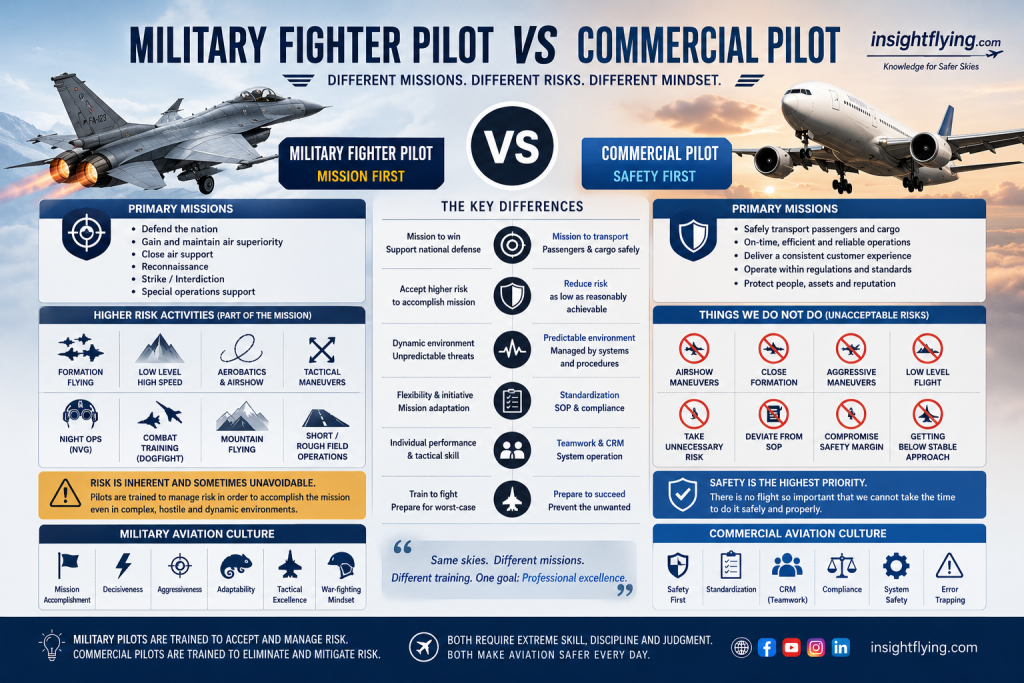
The primary mission of military aviation is to:
- Defend the nation
- Achieve and maintain air superiority
- Support military operations
- Deter or neutralize threats
- Operate in hostile and dynamic environments
Many military flight profiles are inherently high-risk by design.
Examples include:
- Formation flying
- Low-level high-speed flight
- Aerobatics and airshow maneuvers
- Tactical maneuvering
- Mountain operations
- Night operations with NVG
- Dogfight training
- Short or rough-field operations
These activities carry operational risks that are often unavoidable because they are directly linked to combat readiness and mission capability.
In military aviation, mission accomplishment may at times take priority over comfort, efficiency, or even certain safety margins.
Military pilots are not trained to eliminate all risks.
They are trained to manage risk in order to accomplish the mission.
Commercial Pilots: Safety First
Commercial aviation operates on an entirely different philosophy.
The mission of airline pilots is to:
- Transport passengers and cargo safely
- Maintain stable and reliable operations
- Reduce operational risk to the lowest practical level
- Deliver predictable and standardized performance
Commercial aviation is built around a fundamental principle:
“No flight is so important that safety must be compromised.”
Many activities considered acceptable in military aviation would be completely unacceptable in commercial operations.
For example:
- Low-level aerobatic maneuvers
- Close formation flying with passengers onboard
- Aggressive maneuvering
- Unnecessary operational risk
- Deviating from SOPs
- Reducing safety margins
Airlines do not need heroes.
They need systems that are reliable, repeatable, and predictable.
Why Some Military Accidents Look “Risky” to the Public
When military aircraft crash during formation flights, tactical training, or airshows, the public often asks:
“Why were they flying that way in the first place?”
The answer is simple:
Because military missions sometimes require pilots to train in high-risk operational environments.
Combat aviation cannot always be practiced safely from a classroom or simulator alone.
Certain skills must be trained in real-world flight conditions.
Military pilots are prepared to operate in environments where:
- Threats are unpredictable
- Time pressure is extreme
- Decisions must be made instantly
- Tactical effectiveness may determine survival
Commercial aviation, however, is designed to avoid exactly those situations whenever possible.
Two Different Safety Philosophies
Military aviation and commercial aviation are both highly professional, but they are built on different operational philosophies.
Military Aviation Culture
Typically emphasizes:
- Mission accomplishment
- Tactical effectiveness
- Decisiveness
- Individual performance
- Adaptability under pressure
- Combat readiness
Commercial Aviation Culture
Typically emphasizes:
- Standardization
- CRM (Crew Resource Management)
- SOP compliance
- Threat and Error Management
- Predictability
- System safety
An excellent airline pilot is often not the most aggressive or flashy pilot.
Instead, they are the pilot who makes a flight feel completely routine — even though thousands of safety decisions and risk assessments are happening in the background throughout the entire operation.
Neither Is “Better” — They Are Simply Different
Military fighter pilots and commercial pilots both require extraordinary skill, discipline, knowledge, and judgment.
But they operate under different missions, different rules, and different expectations.
One is trained to face and manage operational risk.
The other is trained to reduce and eliminate risk wherever possible.
Both professions are essential to aviation.
Both demand professionalism at the highest level.
They simply exist in different worlds — shaped by different missions.
insightflying.com
Knowledge for Safer Skies