
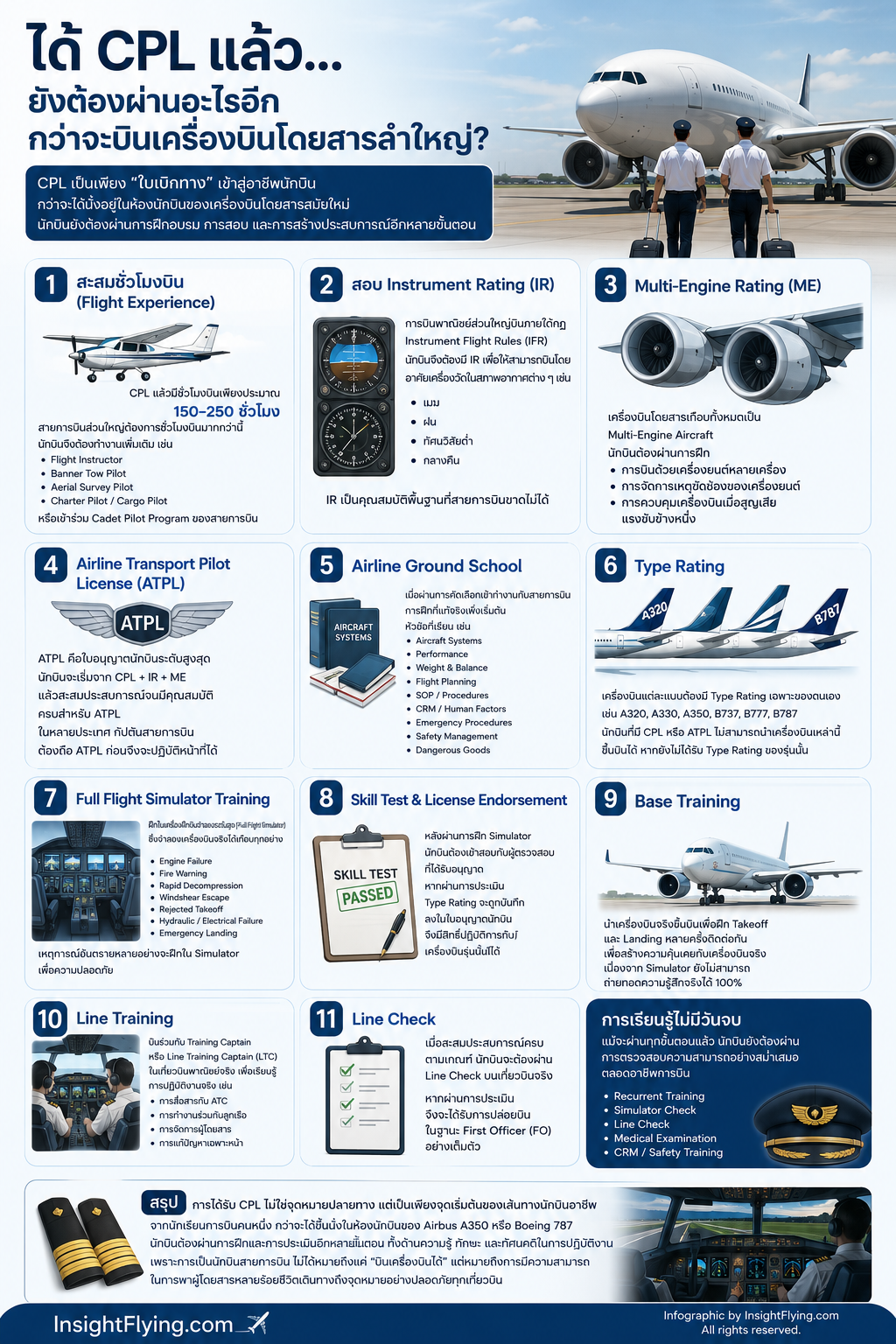
หลายคนเข้าใจว่าเมื่อเรียนจบจากโรงเรียนการบินและได้รับใบอนุญาตนักบินพาณิชย์ (Commercial Pilot License: CPL) แล้ว ก็สามารถสมัครสายการบินและขึ้นบินกับเครื่องบินโดยสารขนาดใหญ่ได้ทันที
ความจริงแล้ว CPL เป็นเพียง “ใบเบิกทาง” เข้าสู่อาชีพนักบินเท่านั้น
กว่าจะได้นั่งอยู่ในห้องนักบินของเครื่องบินโดยสารสมัยใหม่ นักบินยังต้องผ่านการฝึกอบรม การสอบ และการสร้างประสบการณ์อีกหลายขั้นตอน
1. สะสมชั่วโมงบิน (Flight Experience)
แม้จะได้รับ CPL แล้ว แต่นักบินส่วนใหญ่ยังมีชั่วโมงบินเพียงประมาณ
- 150–250 ชั่วโมง
ในขณะที่สายการบินจำนวนมากต้องการนักบินที่มีประสบการณ์มากกว่านั้น
ในหลายประเทศ นักบินอาจต้องทำงานเพิ่มเติม เช่น
- Flight Instructor
- Banner Tow Pilot
- Aerial Survey Pilot
- Charter Pilot
- Cargo Pilot
เพื่อสะสมชั่วโมงบินก่อนเข้าสายการบิน
ปัจจุบันสายการบินบางแห่งมี Cadet Pilot Program ที่รับนักบินใหม่เข้าฝึกต่อโดยไม่จำเป็นต้องมีชั่วโมงบินสูงมาก แต่ก็ต้องผ่านการคัดเลือกที่เข้มงวด
2. สอบ Instrument Rating (IR)
การบินพาณิชย์ส่วนใหญ่ไม่ได้บินโดยอาศัยการมองเห็นภายนอก (Visual Flight Rules: VFR)
แต่บินภายใต้กฎ
Instrument Flight Rules (IFR)
นักบินจึงต้องได้รับ
Instrument Rating (IR)
เพื่อให้สามารถบินโดยอาศัยเครื่องวัดต่าง ๆ ในห้องนักบิน
รวมถึงการปฏิบัติการในสภาพ
- เมฆ
- ฝน
- ทัศนวิสัยต่ำ
- กลางคืน
ได้อย่างปลอดภัย
สำหรับสายการบิน IR ถือเป็นคุณสมบัติพื้นฐานที่ขาดไม่ได้
3. Multi-Engine Rating (ME)
เครื่องบินฝึกส่วนใหญ่ใช้เครื่องยนต์เพียงเครื่องเดียว
แต่เครื่องบินโดยสารแทบทั้งหมดเป็น
Multi-Engine Aircraft
ดังนั้นนักบินต้องผ่านการฝึก
- การบินด้วยเครื่องยนต์หลายเครื่อง
- การจัดการเหตุขัดข้องของเครื่องยนต์
- การควบคุมเครื่องบินเมื่อสูญเสียแรงขับข้างหนึ่ง
ซึ่งเป็นทักษะสำคัญมากของการบินพาณิชย์
4. Airline Transport Pilot License (ATPL)
ATPL คือใบอนุญาตนักบินระดับสูงสุด
เปรียบเสมือน “ปริญญาเอกของนักบิน”
นักบินสายการบินส่วนใหญ่จะเริ่มจาก
- CPL + IR + ME
แล้วค่อยสะสมประสบการณ์จนมีคุณสมบัติครบสำหรับ ATPL
ในหลายประเทศ กัปตันสายการบินจะต้องถือ ATPL ก่อนจึงจะสามารถปฏิบัติหน้าที่ได้
5. Airline Ground School
เมื่อผ่านการคัดเลือกเข้าทำงานกับสายการบินแล้ว การฝึกที่แท้จริงเพิ่งเริ่มต้น
นักบินจะต้องเรียน Ground School อย่างเข้มข้น
หัวข้อที่เรียน เช่น
- Aircraft Systems
- Performance
- Weight & Balance
- Flight Planning
- SOP (Standard Operating Procedures)
- CRM (Crew Resource Management)
- Emergency Procedures
- Dangerous Goods
- Safety Management
สำหรับเครื่องบินสมัยใหม่ ความรู้ระบบต่าง ๆ อาจมีปริมาณหลายพันหน้า
6. Type Rating
นี่คือขั้นตอนที่สำคัญที่สุดก่อนขึ้นบินกับเครื่องบินโดยสาร
เครื่องบินแต่ละแบบต้องมี
Type Rating
เฉพาะของตนเอง
ตัวอย่างเช่น
- Airbus A320
- Airbus A330
- Airbus A350
- Boeing 737
- Boeing 777
- Boeing 787
นักบินที่มี CPL หรือ ATPL ไม่สามารถนำเครื่องบินเหล่านี้ขึ้นบินได้ หากยังไม่ได้รับ Type Rating ของเครื่องบินรุ่นนั้น
7. Full Flight Simulator Training
หลังเรียนระบบเครื่องบินแล้ว นักบินต้องเข้าสู่เครื่องฝึกบินจำลองระดับสูง
Full Flight Simulator (FFS)
ซึ่งจำลองเครื่องบินจริงได้แทบทุกอย่าง
การฝึกประกอบด้วย
- Engine Failure
- Fire Warning
- Hydraulic Failure
- Electrical Failure
- Rapid Decompression
- Windshear Escape
- Rejected Takeoff
- Emergency Landing
เหตุการณ์หลายอย่างอันตรายเกินกว่าจะฝึกบนเครื่องบินจริง
Simulator จึงเป็นสถานที่ที่ปลอดภัยที่สุดในการฝึก
8. Skill Test และ License Endorsement
หลังผ่านการฝึก Simulator
นักบินต้องเข้าสอบกับผู้ตรวจสอบที่ได้รับอนุญาต
หากผ่านการประเมิน
Type Rating จะถูกบันทึกลงในใบอนุญาตนักบิน
จึงมีสิทธิ์ปฏิบัติการกับเครื่องบินรุ่นนั้นได้
9. Base Training
แม้จะผ่าน Simulator แล้ว นักบินยังต้องนำเครื่องบินจริงขึ้นบินอีก
เรียกว่า
Base Training
โดยทำการ
- Takeoff
- Landing
หลายครั้งติดต่อกัน
เพื่อสร้างความคุ้นเคยกับเครื่องบินจริง
เนื่องจาก Simulator ยังไม่สามารถถ่ายทอดความรู้สึกจริงได้ 100%
10. Line Training
หลังจากนั้นนักบินจะยังไม่ถูกปล่อยให้บินเองทันที
แต่จะบินร่วมกับ
Training Captain
หรือ
Line Training Captain (LTC)
ในเที่ยวบินพาณิชย์จริง
เพื่อเรียนรู้
- การปฏิบัติงานจริง
- การสื่อสารกับ ATC
- การทำงานร่วมกับลูกเรือ
- การจัดการผู้โดยสาร
- การแก้ปัญหาเฉพาะหน้า
ช่วงนี้อาจใช้เวลาหลายสิบถึงหลายร้อยชั่วโมงบิน
11. Line Check
เมื่อสะสมประสบการณ์ครบตามเกณฑ์
นักบินจะต้องผ่าน
Line Check
บนเที่ยวบินจริง
หากผ่านการประเมิน
จึงจะได้รับการปล่อยบินในฐานะ
First Officer (FO)
อย่างเต็มตัว
การเรียนรู้ไม่มีวันจบ
แม้จะผ่านทุกขั้นตอนแล้ว นักบินยังต้องผ่านการตรวจสอบความสามารถอย่างสม่ำเสมอ
เช่น
- Recurrent Training
- Simulator Check
- Line Check
- Medical Examination
- CRM Training
ตลอดอาชีพการบิน
สรุป
การได้รับ CPL ไม่ใช่จุดหมายปลายทาง แต่เป็นเพียงจุดเริ่มต้นของเส้นทางนักบินอาชีพ
จากนักเรียนการบินคนหนึ่ง กว่าจะได้ขึ้นนั่งในห้องนักบินของ Airbus A350 หรือ Boeing 787 นักบินต้องผ่านการฝึกและการประเมินอีกหลายขั้นตอน ทั้งด้านความรู้ ทักษะ และทัศนคติในการปฏิบัติงาน
เพราะการเป็นนักบินสายการบิน ไม่ได้หมายถึงแค่ “บินเครื่องบินได้” แต่หมายถึงการมีความสามารถในการพาผู้โดยสารหลายร้อยชีวิตเดินทางถึงจุดหมายอย่างปลอดภัยทุกเที่ยวบิน
InsightFlying.com ✈️
“Every airline captain was once a student pilot who never stopped learning.”
A350 accident Airbus aircraft airline airmanship Air Traffic Control airworthiness ATC aviation Aviation SMS B787 become a captain become a pilot Boeing captain CAT Crisis Crisis Management emergency engine fatigue flight safety go-around interview management pilot qualified pilot safety Safety Management System SMS student pilot swiss cheese TCAS technology training travel tips turbulence weather การจัดการความปลอดภัย การบิน การสอบสัมภาษณ์ ความปลอดภัย นักบิน สอบนักบิน
After Earning a CPL: What Does It Take to Fly Large Airliners?
Many people believe that once a student graduates from flight school and earns a Commercial Pilot License (CPL), they can immediately step into the cockpit of a large airliner.
In reality, a CPL is only the beginning of a professional pilot’s journey.
Before a pilot can fly modern airliners such as the Airbus A320, Airbus A350, Boeing 737, or Boeing 787, there are several additional stages of training, qualification, and experience-building that must be completed.
1. Building Flight Experience
After obtaining a CPL, most pilots have accumulated only around 150 to 250 flight hours.
While some airlines offer cadet programs for low-time pilots, many aviation careers require additional experience before entering airline operations.
Pilots often build flight hours through positions such as:
- Flight Instructor
- Charter Pilot
- Aerial Survey Pilot
- Cargo Pilot
- Banner Tow Pilot
These roles help pilots develop decision-making skills, aircraft handling proficiency, and operational experience.
2. Instrument Rating (IR)
Commercial aviation operates primarily under Instrument Flight Rules (IFR).
To fly in clouds, poor visibility, adverse weather, or at night, pilots must obtain an Instrument Rating (IR).
Instrument training teaches pilots to safely navigate and control an aircraft using cockpit instruments rather than relying solely on visual references outside the aircraft.
An Instrument Rating is considered an essential qualification for airline pilots.
3. Multi-Engine Rating (ME)
Most training aircraft have a single engine, while nearly all transport-category aircraft are multi-engine airplanes.
A Multi-Engine Rating prepares pilots to:
- Operate aircraft with multiple engines
- Manage asymmetric thrust
- Handle engine failures
- Maintain aircraft control during abnormal situations
These skills are fundamental for airline operations.
4. Airline Transport Pilot License (ATPL)
The Airline Transport Pilot License (ATPL) is the highest level of pilot certification.
Many airline pilots begin their careers with CPL, Instrument Rating, and Multi-Engine qualifications before accumulating the experience required for an ATPL.
In most countries, airline captains must hold an ATPL before serving as Pilot-in-Command of commercial air transport flights.
5. Airline Ground School
After being hired by an airline, pilots undergo extensive classroom training known as Ground School.
Subjects typically include:
- Aircraft Systems
- Aircraft Performance
- Weight and Balance
- Flight Planning
- Standard Operating Procedures (SOPs)
- Crew Resource Management (CRM)
- Human Factors
- Safety Management
- Dangerous Goods Regulations
- Emergency Procedures
For modern airliners, the study material can consist of thousands of pages.
6. Type Rating
A pilot cannot simply fly any aircraft after obtaining a license.
Each transport-category aircraft requires a specific Type Rating.
Examples include:
- Airbus A320
- Airbus A330
- Airbus A350
- Boeing 737
- Boeing 777
- Boeing 787
Pilots must complete specialized training and demonstrate proficiency before they are legally authorized to operate a particular aircraft type.
7. Full Flight Simulator Training
Type Rating programs include extensive training in a Full Flight Simulator (FFS).
These advanced simulators accurately replicate the aircraft, cockpit environment, and flight characteristics.
Pilots practice scenarios such as:
- Engine Failures
- Fire Warnings
- Hydraulic Failures
- Electrical Failures
- Windshear Encounters
- Rapid Decompression
- Rejected Takeoffs
- Emergency Landings
Many of these situations would be too dangerous to practice in an actual aircraft.
8. Skill Test and License Endorsement
After simulator training, pilots must successfully complete a formal proficiency check conducted by an authorized examiner.
Once passed, the aircraft Type Rating is added to the pilot’s license, allowing them to operate that specific aircraft type.
9. Base Training
Even after simulator qualification, pilots typically undergo Base Training in the actual aircraft.
This phase focuses primarily on:
- Takeoffs
- Landings
The objective is to provide real-world aircraft handling experience and familiarize pilots with the physical sensations that cannot be perfectly replicated in a simulator.
10. Line Training
Following Base Training, pilots begin Line Training under the supervision of a Training Captain or Line Training Captain (LTC).
During regular commercial flights, pilots gain experience in:
- Real-world airline operations
- Air Traffic Control communications
- Crew coordination
- Passenger operations
- Operational decision-making
Line Training may involve dozens or even hundreds of flight hours.
11. Line Check
Once the required experience has been accumulated, pilots undergo a Line Check on an actual commercial flight.
Successful completion of the Line Check signifies that the pilot is ready to operate independently as a fully qualified First Officer.
Learning Never Stops
Even after becoming an airline pilot, training continues throughout an aviation career.
Pilots regularly undergo:
- Recurrent Training
- Simulator Checks
- Line Checks
- Medical Examinations
- CRM Training
- Emergency Procedure Reviews
Continuous training is one of the key reasons commercial aviation remains one of the safest forms of transportation in the world.
Conclusion
A Commercial Pilot License is not the final destination—it is only the first step toward becoming an airline pilot.
From earning a CPL to flying sophisticated airliners such as the Airbus A350 or Boeing 787, pilots must complete numerous stages of training, qualification, assessment, and experience-building.
Being an airline pilot is not simply about flying an airplane. It is about possessing the knowledge, skills, judgment, and professionalism required to safely transport hundreds of passengers on every flight.
InsightFlying.com
“Every airline captain was once a student pilot who never stopped learning.”
A350 accident Airbus aircraft airline airmanship Air Traffic Control airworthiness ATC aviation Aviation SMS B787 become a captain become a pilot Boeing captain CAT Crisis Crisis Management emergency engine fatigue flight safety go-around interview management pilot qualified pilot safety Safety Management System SMS student pilot swiss cheese TCAS technology training travel tips turbulence weather การจัดการความปลอดภัย การบิน การสอบสัมภาษณ์ ความปลอดภัย นักบิน สอบนักบิน