
คำศัพท์ที่หลายคนใช้แทนกัน แต่จริง ๆ แล้วแตกต่างกันอย่างไร?
เมื่อพูดถึง “สนามบิน” คนส่วนใหญ่มักนึกถึงอาคารผู้โดยสาร เครื่องบินโดยสาร และหอบังคับการบิน แต่ในวงการการบินมีคำศัพท์หลายคำที่ใช้เรียกพื้นที่สำหรับการขึ้นลงของอากาศยาน เช่น Airport, Aerodrome และ Airfield ซึ่งแม้จะมีความเกี่ยวข้องกัน แต่มีความหมายและขอบเขตการใช้งานที่แตกต่างกัน
มาทำความเข้าใจกันว่าแต่ละคำหมายถึงอะไร และมีสนามบินประเภทใดบ้างในโลกการบิน
Aerodrome คืออะไร?
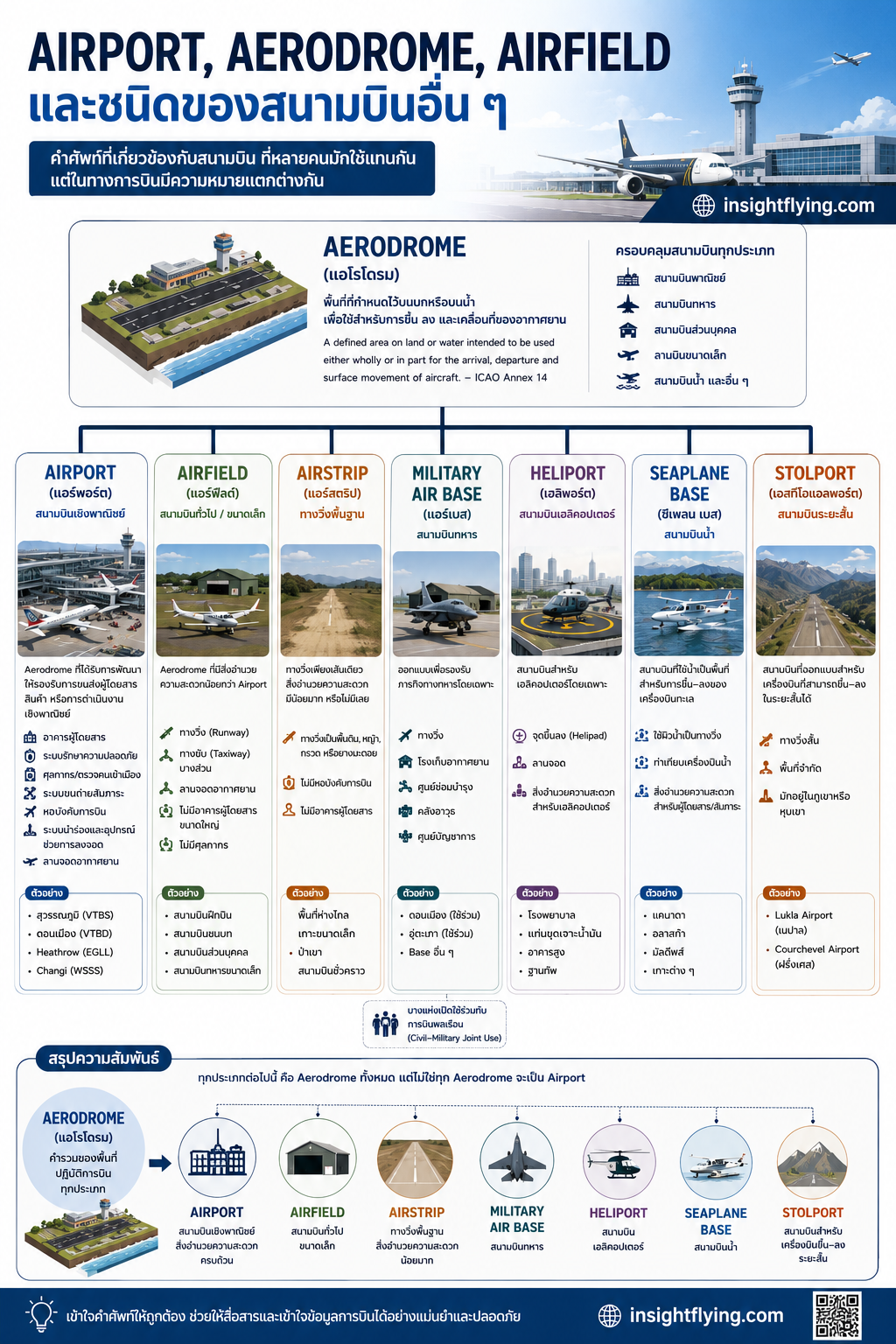
Aerodrome เป็นคำที่มีความหมายกว้างที่สุด
ตามนิยามของ ICAO (International Civil Aviation Organization)
“A defined area on land or water intended to be used either wholly or in part for the arrival, departure and surface movement of aircraft.”
หรือแปลอย่างง่ายว่า
“พื้นที่ที่กำหนดไว้บนบกหรือบนน้ำ เพื่อใช้สำหรับการขึ้น ลง และเคลื่อนที่ของอากาศยาน”
ดังนั้น Aerodrome จึงเป็นคำรวมที่ครอบคลุมทุกสถานที่ที่เครื่องบินสามารถใช้งานได้ ไม่ว่าจะเป็น
- สนามบินพาณิชย์
- สนามบินทหาร
- สนามบินส่วนบุคคล
- ลานบินเล็ก ๆ
- สนามบินน้ำ (Seaplane Base)
กล่าวได้ว่า Airport และ Airfield ล้วนเป็น Aerodrome ทั้งสิ้น
Airport คืออะไร?
Airport คือ Aerodrome ที่ได้รับการพัฒนาให้รองรับการขนส่งผู้โดยสาร สินค้า หรือการดำเนินงานเชิงพาณิชย์
โดยทั่วไป Airport จะมีองค์ประกอบเพิ่มเติม เช่น
- อาคารผู้โดยสาร (Terminal)
- ระบบรักษาความปลอดภัย
- ศุลกากรและตรวจคนเข้าเมือง
- ระบบขนถ่ายสัมภาระ
- หอบังคับการบิน
- ระบบนำร่องและอุปกรณ์ช่วยการลงจอด
- พื้นที่จอดอากาศยาน
ตัวอย่างเช่น
- ท่าอากาศยานสุวรรณภูมิ (VTBS)
- ท่าอากาศยานดอนเมือง (VTBD)
- London Heathrow (EGLL)
- Singapore Changi (WSSS)
ดังนั้น Airport ถือเป็น Aerodrome ประเภทหนึ่งที่มีสิ่งอำนวยความสะดวกครบถ้วนสำหรับการให้บริการเชิงพาณิชย์
Airfield คืออะไร?
Airfield เป็นคำที่มักใช้เรียกสนามบินหรือพื้นที่สำหรับการบินที่มีสิ่งอำนวยความสะดวกน้อยกว่า Airport
โดยทั่วไป Airfield จะมี
- ทางวิ่ง (Runway)
- ทางขับ (Taxiway) บางส่วน
- ลานจอดเครื่องบิน
แต่ไม่จำเป็นต้องมี
- อาคารผู้โดยสารขนาดใหญ่
- ระบบศุลกากร
- สิ่งอำนวยความสะดวกเชิงพาณิชย์
Airfield มักพบใน
- สนามบินทหาร
- สนามบินฝึกบิน
- สนามบินส่วนบุคคล
- สนามบินชนบท
ในหลายประเทศคำว่า Airfield มักเชื่อมโยงกับการบินทั่วไป (General Aviation) มากกว่าการบินพาณิชย์
Airstrip คืออะไร?
Airstrip เป็นรูปแบบที่เรียบง่ายที่สุด
โดยทั่วไปคือ
- ทางวิ่งเพียงเส้นเดียว
- อาจเป็นพื้นดิน หญ้า กรวด หรือยางมะตอย
- ไม่มีหอบังคับการบิน
- ไม่มีอาคารผู้โดยสาร
Airstrip พบได้ใน
- พื้นที่ห่างไกล
- เกาะขนาดเล็ก
- ป่าเขา
- สนามบินชั่วคราว
นักบินจำนวนมากในแอฟริกา ออสเตรเลีย และอลาสก้า ใช้ Airstrip เป็นประจำในการขนส่งผู้โดยสารและเวชภัณฑ์
Military Air Base
สนามบินทหาร หรือ Air Base
ออกแบบเพื่อรองรับภารกิจทางทหารโดยเฉพาะ
อาจประกอบด้วย
- ทางวิ่ง
- โรงเก็บอากาศยาน
- ศูนย์ซ่อมบำรุง
- คลังอาวุธ
- ศูนย์บัญชาการ
บางแห่งเปิดใช้ร่วมกับการบินพลเรือน (Civil-Military Joint Use Airport)
เช่น
- ดอนเมือง
- อู่ตะเภา
Heliport
Heliport คือสนามบินสำหรับเฮลิคอปเตอร์โดยเฉพาะ
องค์ประกอบหลักคือ
- Helipad หรือจุดขึ้นลง
- ลานจอด
- สิ่งอำนวยความสะดวกสำหรับเฮลิคอปเตอร์
พบได้บน
- โรงพยาบาล
- แท่นขุดเจาะน้ำมัน
- อาคารสูง
- ฐานทัพ
Seaplane Base
สนามบินน้ำสำหรับเครื่องบินทะเล
ใช้ผิวน้ำเป็นพื้นที่ขึ้นลงแทนทางวิ่ง
มักพบใน
- แคนาดา
- อลาสก้า
- มัลดีฟส์
นักท่องเที่ยวที่เดินทางไปรีสอร์ตในมัลดีฟส์จำนวนมากต้องใช้ Seaplane เป็นพาหนะหลักในการเดินทาง
STOLport
STOL ย่อมาจาก
Short Takeoff and Landing
STOLport คือสนามบินที่ออกแบบสำหรับเครื่องบินที่สามารถขึ้นลงในระยะสั้นได้
มีลักษณะเด่นคือ
- ทางวิ่งสั้น
- พื้นที่จำกัด
- มักอยู่ในหุบเขาหรือภูเขา
ตัวอย่างที่มีชื่อเสียง ได้แก่
- Lukla Airport ประเทศเนปาล
ซึ่งเป็นหนึ่งในสนามบินที่ท้าทายที่สุดในโลก
แล้วสนามบินทุกแห่งเป็น Airport หรือไม่?
คำตอบคือ “ไม่”
ในทางเทคนิค
- Airport เป็น Aerodrome
- Airfield เป็น Aerodrome
- Heliport เป็น Aerodrome
- Seaplane Base เป็น Aerodrome
แต่ไม่ใช่ Aerodrome ทุกแห่งจะเป็น Airport
Airport จึงถือเป็นเพียงหนึ่งในหลายประเภทของ Aerodrome
สรุป
หากเปรียบเทียบง่าย ๆ
- Aerodrome = คำรวมของพื้นที่ปฏิบัติการบินทุกประเภท
- Airport = สนามบินเชิงพาณิชย์ที่มีสิ่งอำนวยความสะดวกครบถ้วน
- Airfield = สนามบินขนาดเล็กหรือสนามบินทั่วไป
- Airstrip = ทางวิ่งพื้นฐานสำหรับขึ้นลงอากาศยาน
- Air Base = สนามบินทหาร
- Heliport = สนามบินเฮลิคอปเตอร์
- Seaplane Base = สนามบินน้ำ
- STOLport = สนามบินสำหรับเครื่องบินขึ้นลงระยะสั้น
ดังนั้นครั้งต่อไปเมื่อได้ยินคำว่า Airport, Aerodrome หรือ Airfield คุณจะเข้าใจได้ทันทีว่าพวกมันเกี่ยวข้องกัน แต่ไม่ได้หมายถึงสิ่งเดียวกันเสมอไป และแต่ละประเภทถูกออกแบบมาเพื่อตอบสนองภารกิจทางการบินที่แตกต่างกันทั่วโลก
A350 accident Airbus aircraft airline airmanship Air Traffic Control airworthiness ATC aviation Aviation SMS B787 become a captain become a pilot Boeing captain CAT Crisis Crisis Management emergency engine fatigue flight safety go-around interview management pilot qualified pilot safety Safety Management System SMS student pilot swiss cheese TCAS technology training travel tips turbulence weather การจัดการความปลอดภัย การบิน การสอบสัมภาษณ์ ความปลอดภัย นักบิน สอบนักบิน

Airport, Aerodrome, Airfield, and Other Types of Aviation Facilities
“From major international airports to remote mountain airstrips, aviation relies on a diverse network of aerodromes designed for different missions, aircraft, and environments.”
Similar Terms, Different Meanings
When people talk about “airports,” they often imagine passenger terminals, airliners, and control towers. However, in aviation, several terms are used to describe places where aircraft operate, including Airport, Aerodrome, and Airfield. While these terms are related, they do not mean exactly the same thing.
Understanding the differences can help aviation enthusiasts, students, and travelers better appreciate the infrastructure that supports air transportation around the world.
What Is an Aerodrome?
An Aerodrome is the broadest and most inclusive term.
According to ICAO (International Civil Aviation Organization), an aerodrome is:
“A defined area on land or water intended to be used either wholly or in part for the arrival, departure, and surface movement of aircraft.”
In simple terms, an aerodrome is any location where aircraft can take off, land, or move on the ground (or water).
Aerodromes include:
- Commercial airports
- Military air bases
- Private airfields
- Small landing strips
- Seaplane bases
- Heliports
In other words, every airport is an aerodrome, but not every aerodrome is an airport.
What Is an Airport?
An Airport is an aerodrome that has been developed to support commercial aviation operations.
Airports typically include:
- Passenger terminals
- Security screening facilities
- Customs and immigration services
- Baggage handling systems
- Air traffic control services
- Aircraft parking aprons
- Navigation and landing aids
Examples include:
- Suvarnabhumi Airport (VTBS)
- Don Mueang Airport (VTBD)
- London Heathrow Airport (EGLL)
- Singapore Changi Airport (WSSS)
Airports are designed to accommodate passengers, cargo, and scheduled airline operations.
What Is an Airfield?
An Airfield is generally a simpler aviation facility than a commercial airport.
It usually consists of:
- A runway
- Taxiways (if available)
- Aircraft parking areas
Unlike airports, airfields may not have:
- Passenger terminals
- Customs facilities
- Extensive commercial infrastructure
Airfields are commonly used for:
- General aviation
- Flight training
- Agricultural aviation
- Private aircraft operations
- Military activities
In many countries, the term “airfield” often refers to smaller facilities serving local or specialized aviation needs.
What Is an Airstrip?
An Airstrip is the most basic type of aircraft operating area.
Characteristics include:
- A single runway or landing strip
- Minimal infrastructure
- Often made of grass, gravel, dirt, or simple pavement
- No control tower
- Limited or no support facilities
Airstrips are commonly found in:
- Remote regions
- Islands
- Mountainous areas
- Wilderness operations
Many airstrips play a vital role in connecting isolated communities.
Military Air Base
A Military Air Base is an aerodrome designed primarily for military aviation operations.
Facilities may include:
- Runways and taxiways
- Aircraft shelters and hangars
- Maintenance facilities
- Command centers
- Fuel storage
- Weapons storage areas
Some military air bases are shared with civilian aviation in what are known as Joint-Use Airports.
Examples include:
- Don Mueang International Airport
- U-Tapao International Airport
Heliport
A Heliport is an aviation facility specifically designed for helicopter operations.
A heliport may include:
- One or more helipads
- Parking areas
- Refueling facilities
- Passenger handling areas
Heliports can be found on:
- Hospital rooftops
- Offshore oil platforms
- High-rise buildings
- Military installations
Because helicopters can take off and land vertically, heliports require far less space than conventional airports.
Seaplane Base
A Seaplane Base is an aerodrome where aircraft operate from water rather than a traditional runway.
Features may include:
- Water landing areas
- Floating docks
- Passenger boarding facilities
- Maintenance areas
Seaplane bases are common in:
- Canada
- Alaska
- The Maldives
- Island regions worldwide
Many travelers visiting remote islands in the Maldives arrive by seaplane rather than by road transportation.
STOLport
A STOLport is an aerodrome designed for aircraft capable of Short Takeoff and Landing (STOL) operations.
Characteristics include:
- Short runways
- Limited operating space
- Challenging terrain
- Specialized aircraft requirements
One of the world’s most famous examples is:
- Lukla Airport, Nepal
Known as the gateway to Mount Everest, Lukla is often considered one of the most challenging airports in the world.
Are All Aerodromes Airports?
No.
From a technical perspective:
- Every Airport is an Aerodrome.
- Every Airfield is an Aerodrome.
- Every Heliport is an Aerodrome.
- Every Seaplane Base is an Aerodrome.
However, not every Aerodrome qualifies as an Airport.
An airport is simply one category within the larger family of aerodromes.
Summary
A simple way to remember the differences:
| Term | Description |
|---|---|
| Aerodrome | The broadest term for any aircraft operating area |
| Airport | Commercial aviation facility with passenger and cargo services |
| Airfield | Smaller aviation facility with limited infrastructure |
| Airstrip | Basic runway with minimal facilities |
| Military Air Base | Aerodrome for military operations |
| Heliport | Facility designed for helicopters |
| Seaplane Base | Facility where aircraft operate from water |
| STOLport | Facility designed for short takeoff and landing aircraft |
Understanding these terms helps us appreciate the wide variety of aviation facilities that support everything from international airline operations to remote wilderness flights. Whether you are boarding a commercial jet, flying a training aircraft, or landing on a remote mountain strip, you are operating within the diverse world of aerodromes.
A350 accident Airbus aircraft airline airmanship Air Traffic Control airworthiness ATC aviation Aviation SMS B787 become a captain become a pilot Boeing captain CAT Crisis Crisis Management emergency engine fatigue flight safety go-around interview management pilot qualified pilot safety Safety Management System SMS student pilot swiss cheese TCAS technology training travel tips turbulence weather การจัดการความปลอดภัย การบิน การสอบสัมภาษณ์ ความปลอดภัย นักบิน สอบนักบิน