
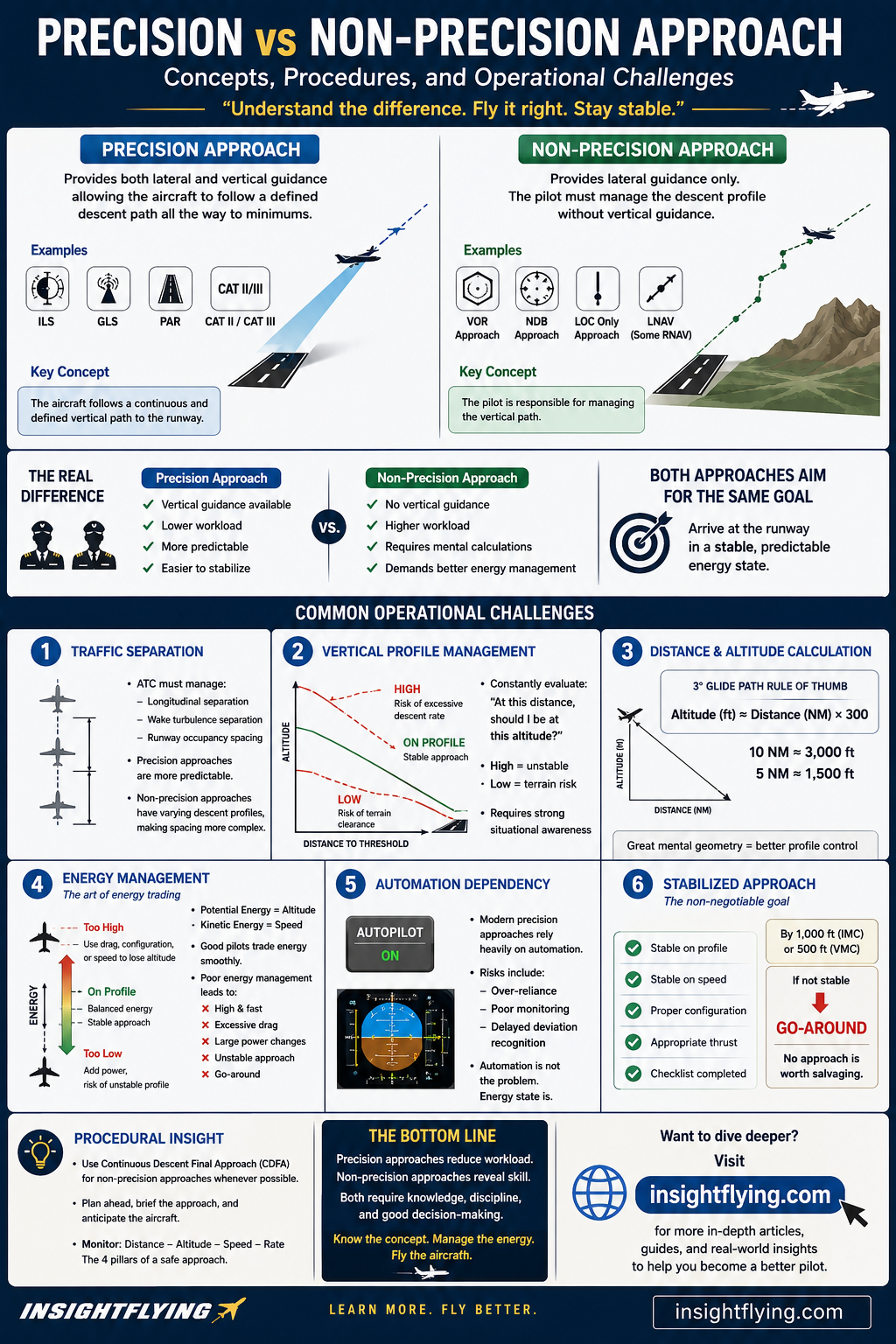
เมื่อพูดถึงการบินเข้าใกล้สนามบินในสภาพอากาศไม่ดี หนึ่งในหัวข้อที่สำคัญที่สุดคือเรื่องของ Precision Approach และ Non-Precision Approach
นักบินจำนวนมากอาจเรียนรู้ขั้นตอนเหล่านี้ตั้งแต่ช่วง Training แต่เมื่อเข้าสู่การปฏิบัติการจริง โดยเฉพาะใน Airline Environment จะพบว่าความแตกต่างของทั้งสองแบบไม่ได้อยู่แค่ “มี Glide Slope หรือไม่มี” เท่านั้น
แต่ยังเกี่ยวข้องกับเรื่องสำคัญอีกหลายด้าน เช่น
- การรักษา Stabilized Approach
- Traffic Separation
- Energy Management
- Terrain Clearance
- Workload ของนักบิน
- และการตัดสินใจในช่วง Critical Phase of Flight
Precision Approach คืออะไร
Precision Approach คือ Instrument Approach Procedure ที่มีทั้ง
- Lateral Guidance
- Vertical Guidance
ให้นักบินสามารถบินตามแนวร่อนที่กำหนดได้อย่างแม่นยำตลอดการลดระดับ
ตัวอย่างที่พบได้บ่อย เช่น
- ILS (Instrument Landing System)
- GLS
- PAR
- CAT II / CAT III Operations
แนวคิดสำคัญของ Precision Approach คือ
“Aircraft follows a defined vertical path continuously down to minimums.”
นักบินจึงสามารถรักษา Vertical Profile ได้อย่างมีเสถียรภาพมากกว่า
Non-Precision Approach คืออะไร
Non-Precision Approach ให้เพียง
- Lateral Guidance
แต่ไม่มี Vertical Guidance แบบ Precision
เช่น
- VOR Approach
- NDB Approach
- LOC only
- บาง RNAV Approaches แบบ LNAV
นักบินจึงต้องคำนวณและควบคุม Vertical Path เอง
ในอดีต การบินแบบ Non-Precision มักใช้วิธี
- Step-down descent
- Dive and drive
ซึ่งเพิ่มความเสี่ยงต่อ
- Unstable Approach
- CFIT (Controlled Flight Into Terrain)
- Excessive Descent Rate
ปัจจุบัน ICAO และสายการบินส่วนใหญ่จึงสนับสนุนแนวคิด
Continuous Descent Final Approach (CDFA)
เพื่อสร้างแนวร่อนที่ต่อเนื่องคล้าย Precision Approach มากที่สุด
ความแตกต่างที่แท้จริง
หลายคนคิดว่า Precision Approach ง่ายกว่าเสมอ
แต่ในความเป็นจริง สิ่งที่แตกต่างมากคือ “ระดับของ Workload”
Precision Approach:
- ระบบช่วยควบคุม Vertical Path
- ลด Mental Calculation
- ลด Workload
- Stabilized ได้ง่ายกว่า
แต่ก็มีความเสี่ยงเรื่อง
- Over-reliance on automation
- Channelized attention
- Raw data monitoring ลดลง
ในขณะที่ Non-Precision Approach ต้องอาศัย
- Situational Awareness สูง
- Mental Geometry
- Time-distance-height relationship
- Energy anticipation
มากกว่าอย่างชัดเจน
ปัญหาที่พบบ่อยในการทำ Precision / Non-Precision Approach
1. Traffic Separation
หนึ่งในปัญหาคลาสสิกคือการจัดระยะห่างระหว่างเครื่องบิน
โดยเฉพาะสนามบินที่มี Traffic Density สูง
ATC ต้องรักษา
- Longitudinal separation
- Wake turbulence separation
- Runway occupancy spacing
ใน Precision Approach เช่น ILS
เครื่องบินทุกลำจะไหลลงตาม Glide Path เดียวกัน ทำให้ Predictable มากกว่า
แต่ใน Non-Precision Approach
- Descent profile ของแต่ละลำอาจแตกต่างกัน
- บางลำ descend เร็ว
- บางลำ level off หลายครั้ง
ส่งผลให้ Speed Control และ Separation ซับซ้อนขึ้น
นักบินจึงมักได้ยินคำสั่งเช่น
- “Maintain high speed to 4 DME”
- “Keep the traffic in sight”
- “Reduce to minimum approach speed”
ซึ่งกลายเป็นการ balance ระหว่าง
- ATC requirements
- Aircraft energy state
- Stabilized approach criteria
2. การควบคุมระยะสูง (Vertical Profile Control)
นี่คือหัวใจสำคัญของ Non-Precision Approach
นักบินต้อง continuously monitor ว่า
“At this distance, should I be at this altitude?”
หากสูงเกินไป (High on profile)
จะเกิดปัญหา:
- Excessive descent rate
- Unstable approach
- Increased landing distance
- Hard landing risk
หากต่ำเกินไป (Low on profile)
จะกลายเป็น Terrain Clearance Issue ทันที
นักบินจึงต้องมี mental picture ของ
- Distance
- Height
- Required descent angle
- Ground speed
- Vertical speed
เชื่อมโยงกันตลอดเวลา
3. การคำนวณระยะทางและความสูง
Approach management จริง ๆ คือ Geometry in motion
ตัวอย่างง่ายที่สุดคือกฎ “3:1”
ถ้าต้อง descend 3,000 feet
ต้องใช้ประมาณ 9 NM
หรือถ้าอยู่บน 3-degree glide path:
\text{Altitude (ft)} \approx \text{Distance (NM)} \times 300
เช่น
- 10 NM ≈ 3,000 ft
- 5 NM ≈ 1,500 ft
นักบินที่เข้าใจ concept นี้ดี จะสามารถ “เห็น profile ในหัว” ได้ทันที
4. Energy Management และ Energy Trading
นี่คือสิ่งที่หลายคนเริ่มเข้าใจจริงหลังบิน Line Operation ไปสักระยะ
Aircraft energy มีสองส่วนหลัก:
- Potential Energy (Altitude)
- Kinetic Energy (Speed)
Approach ที่ดีคือการ “trade energy” อย่างเหมาะสม
เช่น
- สูงเกิน → ต้องแลก altitude เป็น drag
- เร็วเกิน → ต้องใช้ configuration หรือ speed brake
- ช้าเกิน → ต้องเติม thrust และอาจเสีย profile
นักบินที่จัดการ energy ไม่ดี มักจะเกิด pattern เดิม:
- High and fast
- Dragging the aircraft down
- Excessive power changes
- Unstable at 1,000 ft
สุดท้ายอาจนำไปสู่ Go-around
5. Automation Dependency
Precision Approach สมัยใหม่ โดยเฉพาะ CAT II / CAT III ทำให้ automation มีบทบาทสูงมาก
แต่ปัญหาที่พบคือ
- นักบินบางคน monitor automation น้อยเกินไป
- Loss of raw data interpretation
- ไม่ทัน recognize deviation
บางครั้ง automation ไม่ได้ “ผิด”
แต่ aircraft energy state ต่างหากที่ผิด
และ automation เพียงพยายาม compensate จน approach เริ่ม unstable
Stabilized Approach คือสิ่งสำคัญที่สุด
ไม่ว่าจะเป็น Precision หรือ Non-Precision
เป้าหมายสุดท้ายเหมือนกันคือ
“Aircraft must arrive at the runway in a stable, predictable energy state.”
โดยทั่วไปสายการบินจะกำหนดว่า
ก่อนถึง:
- 1,000 ft IMC
- หรือ 500 ft VMC
เครื่องบินต้อง:
- Stable on profile
- Stable on speed
- Correct configuration
- Appropriate thrust setting
- Checklist completed
ถ้าไม่เข้า criteria → Go-around
ไม่มี approach ไหน “ต้องลงให้ได้”
บทสรุป
Precision Approach และ Non-Precision Approach ไม่ได้เป็นเพียง procedural difference
แต่มันสะท้อนถึง
- วิธีคิดของนักบิน
- ความเข้าใจด้าน energy
- situational awareness
- workload management
- และ decision-making
Precision Approach ช่วยลด workload
แต่ Non-Precision Approach มักเป็นสิ่งที่แสดง “พื้นฐานการบินที่แท้จริง” ของนักบินได้ชัดเจนที่สุด
เพราะท้ายที่สุดแล้ว ต่อให้มี automation มากแค่ไหน
นักบินยังคงต้องเข้าใจว่า
เครื่องบินอยู่ที่ไหน
กำลังไปที่ไหน
และพลังงานของเครื่องบินอยู่ในสภาพใดตลอดเวลา
หนังสือ “ด้านมืดของสายการบิน” เรื่องลับ ๆ ในมุมอับที่คนภายนอกไม่ค่อยรู้
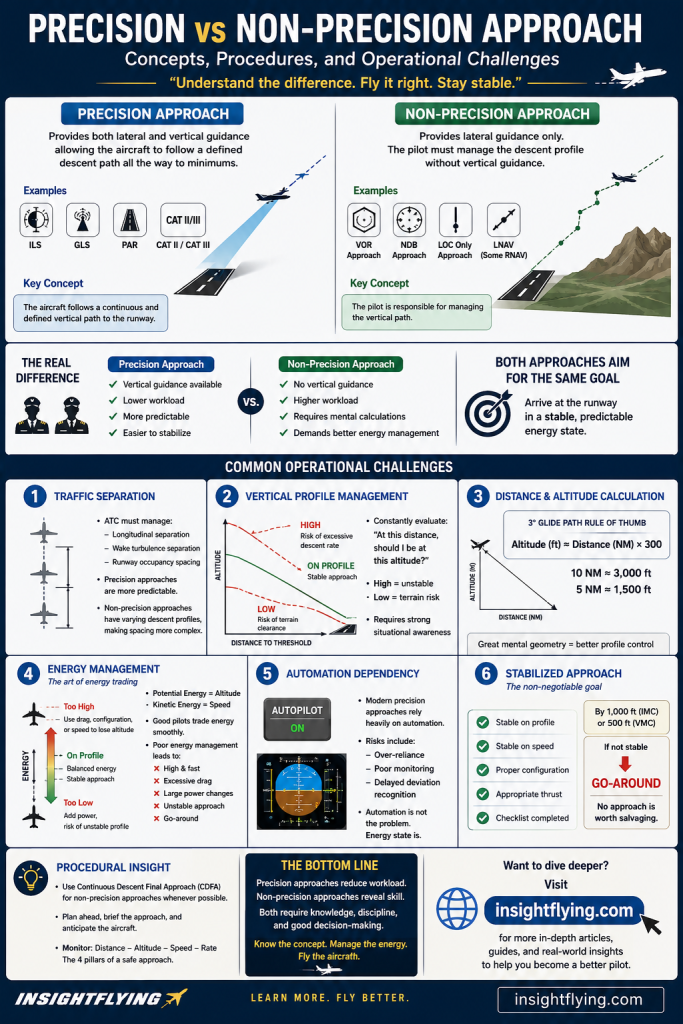
Precision vs Non-Precision Approach — Concepts, Procedures, and Operational Challenges
When discussing instrument approaches in commercial aviation, one of the most fundamental topics is the difference between Precision Approaches and Non-Precision Approaches.
Most pilots learn these procedures early during instrument training. However, real-world airline operations quickly reveal that the difference is far more significant than simply having — or not having — a glide slope.
These approaches affect:
- Stabilized approach management
- Traffic separation
- Energy management
- Terrain clearance
- Pilot workload
- Decision-making during critical phases of flight
What is a Precision Approach?
A Precision Approach is an instrument approach procedure that provides both:
- Lateral guidance
- Vertical guidance
allowing the aircraft to follow a defined descent path accurately all the way down to minimums.
Common examples include:
- ILS (Instrument Landing System)
- GLS
- PAR
- CAT II / CAT III operations
The core philosophy behind a precision approach is:
“The aircraft follows a continuous and defined vertical path to the runway.”
Because vertical guidance is available, pilots can maintain a far more stable descent profile with reduced mental workload.
What is a Non-Precision Approach?
A Non-Precision Approach provides only:
- Lateral guidance
without a precision vertical path.
Examples include:
- VOR Approach
- NDB Approach
- Localizer-only approach
- Some RNAV LNAV procedures
In these approaches, pilots must manage the descent profile themselves.
Historically, non-precision approaches often involved:
- Step-down descents
- “Dive and drive” techniques
which significantly increased the risk of:
- Unstable approaches
- CFIT (Controlled Flight Into Terrain)
- Excessive descent rates
Today, ICAO and most modern airlines promote the concept of:
Continuous Descent Final Approach (CDFA)
which attempts to replicate a stabilized precision-style descent even during non-precision procedures.
The Real Difference Between the Two
Many people assume precision approaches are always easier.
Operationally, however, the biggest difference is actually pilot workload and situational management.
Precision Approaches:
- Reduce workload
- Provide predictable vertical guidance
- Improve stabilization
- Minimize mental calculations
But they also introduce risks such as:
- Over-reliance on automation
- Reduced raw-data monitoring
- Channelized attention
Non-Precision Approaches require substantially more:
- Situational awareness
- Mental geometry
- Time-distance-height calculations
- Energy anticipation
- Manual profile management
In many ways, they expose the pilot’s true instrument flying fundamentals.
Common Operational Challenges
1. Traffic Separation
One of the classic operational challenges is maintaining safe spacing between aircraft, especially at high-density airports.
ATC must continuously manage:
- Longitudinal separation
- Wake turbulence spacing
- Runway occupancy intervals
With Precision Approaches such as ILS, aircraft tend to descend along the same glide path, making traffic flow more predictable.
In Non-Precision Approaches, however:
- Descent profiles vary significantly
- Some aircraft descend aggressively
- Others level off multiple times
This complicates both speed management and traffic sequencing.
Pilots frequently hear instructions such as:
- “Maintain high speed to 4 DME”
- “Keep the traffic in sight”
- “Reduce to minimum approach speed”
which creates a constant balance between:
- ATC requirements
- Aircraft energy state
- Stabilized approach criteria
2. Vertical Profile Management
This is arguably the heart of non-precision approach flying.
Pilots must continuously evaluate:
“At this distance, should I be at this altitude?”
If the aircraft is high on profile:
- Excessive descent rates may be required
- Approach stability deteriorates
- Landing distance increases
- Hard landing risk rises
If the aircraft is low on profile:
- Terrain clearance immediately becomes a concern
Pilots therefore need a constant mental picture integrating:
- Distance
- Altitude
- Descent angle
- Ground speed
- Vertical speed
all at the same time.
3. Distance and Altitude Calculations
Approach management is essentially geometry in motion.
One of the simplest mental models is the “3:1 rule.”
To lose 3,000 feet of altitude, approximately 9 NM are required.
For a standard 3-degree glide path:
\text{Altitude (ft)} \approx \text{Distance (NM)} \times 300
Examples:
- 10 NM ≈ 3,000 ft
- 5 NM ≈ 1,500 ft
Pilots who internalize this relationship develop a strong mental visualization of the approach profile.
4. Energy Management and Energy Trading
This is where real operational experience becomes critical.
Aircraft energy exists primarily in two forms:
- Potential Energy (Altitude)
- Kinetic Energy (Speed)
A good approach is essentially the art of “trading energy” efficiently.
Examples:
- Too high → convert altitude into drag
- Too fast → use configuration changes or speed brakes
- Too slow → add thrust, often compromising profile stability
Pilots with weak energy management skills often fall into familiar patterns:
- High and fast approaches
- Excessive drag usage
- Large thrust fluctuations
- Unstable profiles below 1,000 feet
Eventually resulting in a go-around.
5. Automation Dependency
Modern precision approaches — especially CAT II and CAT III operations — rely heavily on automation.
However, this introduces another operational risk:
- Reduced raw-data interpretation
- Poor automation monitoring
- Delayed recognition of deviations
In many cases, the automation itself is functioning correctly.
The real problem is often the aircraft’s energy state, while the automation merely attempts to compensate for an already unstable situation.
Stabilized Approach Remains the Primary Objective
Regardless of whether the approach is precision or non-precision, the ultimate objective remains identical:
“The aircraft must arrive at the runway in a stable and predictable energy state.”
Most airlines require that by:
- 1,000 ft in IMC
- or 500 ft in VMC
the aircraft must be:
- Stable on profile
- Stable on speed
- Properly configured
- At appropriate thrust setting
- Checklist completed
If those criteria are not met:
Go-around is mandatory.
No approach is worth salvaging.
Conclusion
Precision and Non-Precision Approaches are not merely different procedures.
They represent fundamentally different demands on:
- Pilot thinking
- Energy awareness
- Situational awareness
- Workload management
- Decision-making
Precision approaches reduce workload and improve predictability.
But non-precision approaches often reveal the true depth of a pilot’s instrument flying skills.
Because ultimately, regardless of automation level, every pilot must always understand:
Where the aircraft is,
Where it is going,
And what state its energy is in at every moment of the approach.


|
|
หนังสือการบิน ทางลัดสู่ความเข้าใจที่นำไปใช้งานจริง

|
|

|
|


|
|

|
|

|
|
accident Airbus aircraft air crash airline airmanship automation aviation Aviation SMS become a captain become a pilot Boeing captain Crisis Crisis Management Dark Aviation emergency engine fatigue flight safety FRMS go-around ground operation Indigo interview investigation management pilot qualified pilot safety Safety Management System safety report SARP SMS student pilot technology training turbulence weather การจัดการความปลอดภัย การบิน การสอบสัมภาษณ์ ความปลอดภัย นักบิน สอบนักบิน
ขายดีที่สุด
|
|
|